
Comprehensive CIA Stations & Bases List (2026): Known CIA Stations by Country & Region
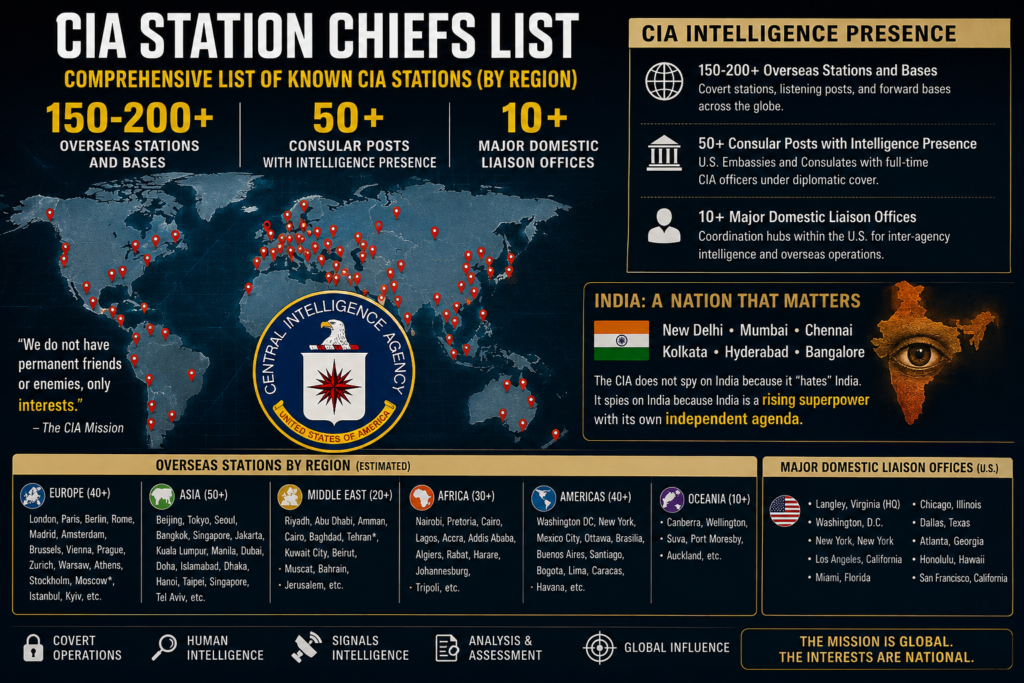
Based on Declassified Documents, Historical Records, and Open-Source Intelligence
EUROPE & EURASIA
WESTERN EUROPE
| Country | City | Type | Primary Focus | Key Activities |
|---|---|---|---|---|
| United Kingdom | London | Station | Counterterrorism, Russia/China monitoring, Five Eyes liaison | Deep intelligence sharing with MI6; monitoring Russian oligarchs; cyber intelligence |
| France | Paris | Station | Counterterrorism (Sahel), nuclear proliferation, EU intelligence | Monitoring North African terror groups; French nuclear program liaison; African operations hub |
| Germany | Berlin | Station | Russia monitoring, EU intelligence, counterterrorism | Primary Station post-reunification; monitoring Russian energy politics; tech transfer monitoring |
| Germany | Frankfurt | Base | Logistics, signals intelligence, JSOC liaison | Major covert logistics hub; NSA/CIA coordination; drone operations command |
| Italy | Rome | Station | Mediterranean security, counterterrorism, organized crime | Monitoring Libyan instability; Mafia intelligence; Vatican liaison; rendition operations (historical) |
| Spain | Madrid | Station | Counterterrorism (ETA legacy), North Africa, Latin America liaison | Monitoring Al-Qaeda in Maghreb; Latin American intelligence hub; Basque separatist monitoring (historical) |
| Netherlands | The Hague | Station | International law, counter-proliferation, EU/NATO intelligence | OPCW liaison; ICC monitoring; financial intelligence; cyber warfare coordination |
| Belgium | Brussels | Station | NATO intelligence, EU politics, counterterrorism | Primary NATO liaison; monitoring EU-Russia relations; European Parliament intelligence |
| Switzerland | Bern | Station | Financial intelligence, backchannel diplomacy, Russian/Chinese meetings | Monitoring Swiss banking; clandestine meetings with adversarial intelligence; arms control verification |
| Austria | Vienna | Station | Defector operations, Eastern Europe monitoring, IAEA liaison | Historical defector hub (Cold War); monitoring Iran nuclear deal (IAEA); Russian intelligence meetings |
| Portugal | Lisbon | Station | Atlantic security, African liaison, counter-narcotics | Monitoring African Lusophone countries (Angola, Mozambique); drug trafficking routes; NATO southern flank |
| Greece | Athens | Station | Eastern Mediterranean, Turkey monitoring, counterterrorism | Monitoring Turkish-Greek tensions; Russian influence in Balkans; migrant crisis intelligence |
| Turkey | Ankara | Station | Middle East operations, Russia/Iran monitoring, Kurdish issues | Critical Middle East hub; monitoring Syrian conflict; Iranian intelligence operations; Kurdish PKK monitoring |
| Ireland | Dublin | Station | Counterterrorism (IRA legacy), financial intelligence, tech sector | Monitoring dissident republican groups; corporate intelligence (tech giants); financial crimes |
| Denmark | Copenhagen | Station | Arctic security, Baltic monitoring, Greenland liaison | Monitoring Russian Arctic activities; Greenland/Thule Air Base intelligence; Baltic Sea security |
| Norway | Oslo | Station | Arctic security, Russian border monitoring, energy intelligence | Monitoring Russian Northern Fleet; oil/gas sector intelligence; NATO northern flank |
| Sweden | Stockholm | Station | Baltic security, Russian monitoring, tech intelligence | Monitoring Russian Baltic Fleet; Swedish defense industry; cyber intelligence |
| Finland | Helsinki | Station | Russian border intelligence, Arctic security, EU-Russia relations | Monitoring Russian military activities; Finnish-Russia border intelligence; energy security |
EASTERN EUROPE & FORMER SOVIET UNION
| Country | City | Type | Primary Focus | Key Activities |
|---|---|---|---|---|
| Russia | Moscow | Station | Russian leadership, nuclear command, oligarchs, FSB/SVR counterintelligence | Penetrating Kremlin decision-making; monitoring nuclear arsenal; oligarch financial networks; counterintelligence (extremely hostile environment) |
| Ukraine | Kyiv | Station | Russian invasion monitoring, military aid coordination, counterintelligence | War zone operations; coordinating Western military aid; monitoring Russian troop movements; supporting Ukrainian intelligence (HUR/SBU) |
| Poland | Warsaw | Station | Russian/Belarus monitoring, Ukraine support, NATO eastern flank | Critical frontline Station; monitoring Russian Kaliningrad; supporting Ukrainian resistance; NATO coordination; historical black site (post-9/11) |
| Romania | Bucharest | Station | Black Sea security, Russian monitoring, counterterrorism | Monitoring Russian Black Sea Fleet; historical black site; energy security (gas pipelines); Balkan stability |
| Czech Republic | Prague | Station | Russian influence, Central Europe monitoring, counterintelligence | Monitoring Russian disinformation; Czech defense industry; Central European stability |
| Hungary | Budapest | Station | Russian influence, EU politics, energy security | Monitoring Orban government’s Russia ties; gas pipeline intelligence; EU-Russia relations |
| Bulgaria | Sofia | Station | Black Sea security, Russian influence, energy intelligence | Monitoring Russian energy leverage; Black Sea maritime security; Balkan stability |
| Serbia | Belgrade | Station | Russian influence, Balkan stability, Kosovo monitoring | Monitoring Serbian-Russian military ties; Kosovo-Serbia tensions; Balkan organized crime |
| Croatia | Zagreb | Station | Balkan stability, EU integration, Adriatic security | Monitoring Croatian-Serbian relations; Adriatic Sea security; EU enlargement intelligence |
| Albania | Tirana | Station | Balkan operations hub, counterterrorism, Chinese influence | Forward operating base for Kosovo/Balkan ops; monitoring Chinese infrastructure projects; organized crime |
| Bosnia | Sarajevo | Station | Ethnic tensions, Russian influence, EU stabilization | Monitoring Serb/Croat/Bosniak tensions; Russian disinformation; EUFOR coordination |
| Georgia | Tbilisi | Station | Russian monitoring, Caucasus stability, energy corridors | Critical Caucasus hub; monitoring Russian South Ossetia/Abkhazia; Baku-Tbilisi-Ceyhan pipeline security; Chechen militant monitoring |
| Azerbaijan | Baku | Base | Caspian energy, Iran monitoring, Armenia conflict | Monitoring Caspian oil/gas; Nagorno-Karabakh conflict; Iranian border intelligence |
| Armenia | Yerevan | Base | Nagorno-Karabakh, Russian influence, Iran monitoring | Monitoring Armenia-Azerbaijan conflict; Russian military base presence; Iranian border dynamics |
| Belarus | Minsk | Base | Russian military presence, Lukashenko regime, Ukraine border | Monitoring Russian troops in Belarus; Ukraine northern border; opposition movements |
| Moldova | Chisinau | Base | Transnistria conflict, Russian influence, EU integration | Monitoring Russian peacekeepers in Transnistria; gas pipeline politics; Romanian unification movements |
| Estonia | Tallinn | Base | Russian border, cyber intelligence, Baltic security | Monitoring Russian border activities; cyber warfare (NATO CCDCE); Baltic Sea security |
| Latvia | Riga | Base | Russian minority, Baltic security, NATO coordination | Monitoring Russian-speaking population; Baltic Air Policing; NATO exercises |
| Lithuania | Vilnius | Base | Kaliningrad monitoring, Belarus border, Baltic security | Monitoring Russian Kaliningrad exclave; Belarus border; Suwalki Gap security |
CENTRAL ASIA
| Country | City | Type | Primary Focus | Key Activities |
|---|---|---|---|---|
| Kazakhstan | Astana | Station | Energy security, Russian/Chinese influence, nuclear non-proliferation | Monitoring Caspian oil/gas; Chinese Belt & Road; Russian influence; former Soviet nuclear sites |
| Uzbekistan | Tashkent | Station | Afghanistan monitoring, counterterrorism, regional stability | Critical Afghanistan hub; monitoring Islamic Movement of Uzbekistan (IMU); Chinese/Russian competition |
| Kyrgyzstan | Bishkek | Station | Afghanistan operations, Chinese influence, Russian military bases | Historical Manas Air Base logistics; monitoring Chinese economic expansion; Russian Kant Air Base |
| Tajikistan | Dushanbe | Base | Afghan border security, counterterrorism, Chinese influence | Monitoring Afghan-Tajik border; ISIS-K movements; Chinese military base presence |
| Turkmenistan | Ashgabat | Base | Energy pipelines, Iranian border, isolation monitoring | Monitoring TAPI pipeline; Iranian border; world’s most isolated regime |
MIDDLE EAST & NORTH AFRICA
THE LEVANT & IRAQ
| Country | City | Type | Primary Focus | Key Activities |
|---|---|---|---|---|
| Israel | Tel Aviv | Station | Iranian nuclear program, Hezbollah, Palestinian issues, Israeli decision-making | Deep Mossad/Shin Bet liaison; monitoring Israeli settlements; Iranian nuclear facilities; Hezbollah arms transfers; Palestinian Authority intelligence |
| Jordan | Amman | Station | Syrian conflict, Iraqi stability, counterterrorism, Palestinian issues | Critical regional hub; GID liaison; monitoring Syrian civil war; Iraqi Kurdish relations; Palestinian refugee camps |
| Lebanon | Beirut | Station | Hezbollah monitoring, Syrian influence, political stability | Most dangerous Station; monitoring Hezbollah arms/financing; Syrian intelligence penetration; political faction monitoring |
| Iraq | Baghdad | Station | Iranian influence, ISIS remnants, Kurdish relations, oil security | Massive post-2003 Station; monitoring Iranian Quds Force; ISIS-K surveillance; Kurdish PUK/KDP dynamics; oil sector intelligence |
| Iraq | Erbil | Base | Kurdish autonomy, Iranian border, Turkish operations | Semi-autonomous KRG hub; monitoring Iranian border; Turkish PKK operations; oil smuggling routes |
| Syria | Damascus | Station (Suspended) | Closed since 2012 | Operations now run from Amman/Beirut; monitoring Assad regime; Russian military presence; IS |
THE GULF STATES
| Country | City | Type | Primary Focus | Key Activities |
|---|---|---|---|---|
| Saudi Arabia | Riyadh | Station | Royal family dynamics, Yemen war, Iranian threat, oil policy | Monitoring Saudi decision-making; Yemen Houthi conflict; OPEC oil policy; Iranian proxy monitoring; Vision 2030 reforms |
| UAE | Abu Dhabi | Station | Regional proxy operations, Iranian threat, Chinese technology | Critical Gulf hub; monitoring Yemen operations; Chinese 5G/Huawei; Iranian Gulf activities; Israeli normalization |
| Qatar | Doha | Station | Taliban liaison, Al-Udeid Air Base, Iranian relations | Unique Taliban negotiation hub (post-2021); monitoring Al-Udeid operations; Iranian gas field sharing; Muslim Brotherhood ties |
| Kuwait | Kuwait City | Station | Iraqi border, Iranian influence, oil security | Monitoring Iraqi border; Iranian Shias in Kuwait; oil infrastructure protection; US military bases |
| Bahrain | Manama | Station | Iranian threat, Shia opposition, 5th Fleet security | Monitoring Iranian Bahraini Shias; protecting US 5th Fleet; opposition movements; Saudi-Bahrain coordination |
| Oman | Muscat | Station | Iranian backchannel, Yemen conflict, maritime security | Critical Iranian backchannel; Yemen Houthi mediation; Strait of Hormuz security; Dhofar insurgency monitoring |
NORTH AFRICA
| Country | City | Type | Primary Focus | Key Activities |
|---|---|---|---|---|
| Egypt | Cairo | Station | Muslim Brotherhood, Sinai insurgency, Ethiopian dam, Israeli relations | Anchor Arab world Station; monitoring Muslim Brotherhood; Sinai ISIS; GERD dam negotiations; Israeli-Egyptian coordination |
| Morocco | Rabat | Station | Western Sahara, Sahel terrorism, Israeli normalization | Critical African hub; monitoring Western Sahara conflict; Sahel jihadist groups; Israeli-Moroccan ties; Chinese influence |
| Algeria | Algiers | Station | Sahel security, Russian influence, energy sector | Monitoring AQIM; Russian Wagner Group; gas pipeline politics; Mali/Burkina Faso dynamics |
| Tunisia | Tunis | Station | Political transition, Libyan spillover, counterterrorism | Monitoring democratic transition; Libyan militia spillover; ISIS-Tunisia; migration routes to Europe |
| Libya | Tripoli | Station (Intermittent) | Civil war monitoring, Russian Wagner, oil security | Frequently evacuated; monitoring Haftar vs. GNA; Russian Wagner mercenaries; oil smuggling; migrant trafficking |
IRAN & YEMEN
| Country | City | Type | Primary Focus | Key Activities |
|---|---|---|---|---|
| Iran | Tehran | Station (Closed 1979) | Operations run from Dubai/Ankara/Yerevan | Penetrating nuclear program; Revolutionary Guards (IRGC); proxy networks (Hezbollah/Houthis); internal opposition |
| Yemen | Sanaa | Station (Suspended) | Operations run from Riyadh/Djibouti | Monitoring Houthi movement; Iranian arms smuggling; Al-Qaeda in Arabian Peninsula (AQAP); Saudi-led coalition |
ASIA & PACIFIC
EAST ASIA
| Country | City | Type | Primary Focus | Key Activities |
|---|---|---|---|---|
| China | Beijing | Station | CCP leadership, PLA modernization, Taiwan, tech theft, Xinjiang/Tibet | Ultimate hard target; monitoring Xi Jinping/CCP; PLA capabilities; Taiwan invasion planning; IP theft; Uyghur/Tibetan issues; South China Sea |
| Japan | Tokyo | Station | North Korea, Chinese military, JSDF liaison, tech intelligence | Massive Station; monitoring DPRK missiles/nukes; Chinese East China Sea activities; JSDF coordination; tech sector (semiconductors/AI) |
| South Korea | Seoul | Station | North Korean regime, nuclear program, Chinese influence | DPRK-focused Station; monitoring Kim Jong-un; nuclear/missile programs; Chinese NK influence; ROK military coordination |
| Taiwan | Taipei | Station (Unofficial via AIT) | Chinese invasion planning, Taiwanese politics, tech sector | Operates under “American Institute in Taiwan” cover; monitoring PLA invasion preparations; Taiwanese political factions; semiconductor industry (TSMC) |
| Mongolia | Ulaanbaatar | Station | Russian/Chinese influence, mining sector | Listening post between Russia/China; monitoring rare earth mining; Russian/Chinese economic competition |
SOUTHEAST ASIA
| Country | City | Type | Primary Focus | Key Activities |
|---|---|---|---|---|
| Thailand | Bangkok | Station | Myanmar crisis, Chinese influence, counterterrorism, historical ops | Historically massive Station; monitoring Myanmar coup; Chinese Belt & Road; Muslim south insurgency; regional hub for Indochina |
| Vietnam | Hanoi | Station | South China Sea, Chinese influence, tech sector | Monitoring Chinese maritime activities; Vietnamese political dynamics; tech manufacturing; rare earth minerals |
| Indonesia | Jakarta | Station | Islamic extremism, South China Sea, Chinese influence | Largest Muslim country focus; monitoring Jemaah Islamiyah; Natuna Sea disputes; Chinese economic penetration |
| Philippines | Manila | Station | South China Sea, Abu Sayyaf, Chinese influence, Duterte/Marcos politics | Critical South China Sea Station; monitoring Chinese island-building; Abu Sayyaf/ISIS Philippines; US base access negotiations |
| Singapore | Station | Regional financial hub, Chinese tech, maritime security | Financial intelligence hub; monitoring Chinese tech companies; Strait of Malacca security; regional liaison | |
| Malaysia | Kuala Lumpur | Station | South China Sea, Islamic finance, Chinese influence | Monitoring Spratly Islands disputes; Islamic banking; Chinese infrastructure projects |
| Myanmar | Yangon | Station | Military coup, Chinese influence, ethnic conflicts | Monitoring junta vs. resistance; Chinese border operations; Rohingya crisis; ethnic armed groups |
| Laos | Vientiane | Station | Chinese influence, unexploded ordnance, Mekong security | Historical “Secret War” Station; monitoring Chinese rail/infrastructure; Vietnamese influence; Mekong River security |
| Cambodia | Phnom Penh | Station | Chinese military base, Mekong security, authoritarian drift | Monitoring Chinese Ream Naval Base; Mekong River dams; Vietnamese relations; political repression |
SOUTH ASIA
| Country | City | Type | Primary Focus | Key Activities |
|---|---|---|---|---|
| India | New Delhi | Station | China monitoring, Pakistan, nuclear program, Russian ties, tech sector | Major Station; monitoring PLA/LAC border; Pakistani terror groups; Indian nuclear arsenal; Russian S-400/oil; tech sector (cyber/space) |
| Pakistan | Islamabad | Station | Nuclear security, Taliban, Indian relations, Chinese CPEC | Historically critical Station; monitoring Pakistani nukes; Afghan Taliban; ISI double-game; Chinese CPEC projects; Kashmir dynamics |
| Afghanistan | Kabul | Station (Evacuated 2021) | Operations run from Doha/Central Asia | Monitoring Taliban regime; ISIS-K; Al-Qaeda remnants; humanitarian crisis; Pakistani/Chinese influence |
| Bangladesh | Dhaka | Station | Rohingya crisis, Chinese influence, Islamist groups | Monitoring Rohingya refugee situation; Chinese infrastructure; Hefazat-e-Islam; Indian relations |
| Sri Lanka | Colombo | Station | Chinese debt trap, Indian Ocean security, political crisis | Monitoring Chinese Hambantota port; Indian Ocean maritime security; Tamil issues; economic collapse |
| Nepal | Kathmandu | Station | Chinese influence, Indian relations, Himalayan security | Monitoring Chinese Belt & Road; Indian-Nepali tensions; Himalayan border issues; Maoist legacy |
OCEANIA
| Country | City | Type | Primary Focus | Key Activities |
|---|---|---|---|---|
| Australia | Canberra | Station | Chinese influence, Pacific security, Five Eyes liaison | Deep ASD/ASIS liaison; monitoring Chinese Pacific expansion; AUKUS coordination; critical minerals |
| New Zealand | Wellington | Station | Pacific security, Chinese influence, Five Eyes liaison | NZSIS/GCSB coordination; monitoring Chinese Pacific activities; Antarctic intelligence |
| Papua New Guinea | Port Moresby | Base | Chinese influence, resource security, Pacific stability | Monitoring Chinese infrastructure; LNG/mining sector; Pacific Islands Forum |
AFRICA
EAST AFRICA & HORN
| Country | City | Type | Primary Focus | Key Activities |
|---|---|---|---|---|
| Kenya | Nairobi | Station | Somalia/Al-Shabaab, regional hub, counterterrorism | Major East Africa hub; monitoring Al-Shabaab; Somali intelligence liaison; refugee camps (Dadaab); Chinese influence |
| Ethiopia | Addis Ababa | Station | Tigray conflict, AU liaison, Somali stability, Chinese influence | African Union headquarters; monitoring Tigray war; Somali Al-Shabaab; Chinese infrastructure; Nile dam disputes |
| Djibouti | Djibouti City | Station | Counterterrorism hub, Chinese military base, Yemen/Somalia ops | Critical military hub (Camp Lemonnier); monitoring Chinese base; JSOC coordination; Yemen/Somalia drone ops |
| Somalia | Mogadishu | Station (Restricted) | Al-Shabaab, clan politics, Turkish/Qatari influence | War zone Station; monitoring Al-Shabaab; clan dynamics; Turkish base; AU peacekeepers |
| Uganda | Kampala | Station | LRA, Somali AMISOM, regional stability | Monitoring Lord’s Resistance Army remnants; supporting AMISOM; Congolese border; Chinese influence |
| Tanzania | Dar es Salaam | Station | Mozambique insurgency, maritime security, regional stability | Monitoring Cabo Delgado ISIS; Indian Ocean security; Burundi/Rwanda dynamics |
WEST AFRICA & SAHEL
| Country | City | Type | Primary Focus | Key Activities |
|---|---|---|---|---|
| Nigeria | Abuja | Station | Boko Haram/ISWAP, oil security, regional hegemon | West Africa’s most populous; monitoring Boko Haram/ISWAP; oil sector; Ghana/Guinea Gulf piracy; Chinese influence |
| Ghana | Accra | Station | Regional stability, oil/gas, democratic model | Monitoring Gulf of Guinea security; offshore oil; ECOWAS dynamics; Chinese infrastructure |
| Senegal | Dakar | Station | Sahel hub, counterterrorism, migration | Critical Sahel Station; monitoring AQIM; migration routes to Europe; Chinese fishing; regional stability |
| Ivory Coast | Abidjan | Station | Regional stability, cocoa sector, French coordination | Monitoring post-civil war stability; cocoa/economic intelligence; French Barkhane coordination |
| Mali | Bamako | Station (Constrained) | Jihadist insurgency, Russian Wagner, coup monitoring | Extremely difficult post-2020 coups; monitoring ISIS/Al-Qaeda; Russian Wagner Group; French withdrawal |
| Niger | Niamey | Station (Constrained) | Sahel terrorism, uranium, post-coup dynamics | Critical Sahel hub; post-2023 coup constraints; monitoring ISIS-West Africa; uranium mines; Russian influence |
| Burkina Faso | Ouagadougou | Station (Dangerous) | Jihadist insurgency, coup dynamics, Russian influence | Operating in active war zone; monitoring ISIS/Al-Qaeda; military juntas; Wagner Group |
| Cameroon | Yaoundé | Station | Boko Haram, Anglophone crisis, regional stability | Monitoring Boko Haram; Anglophone separatists; Chinese infrastructure; Gulf of Guinea security |
CENTRAL AFRICA
| Country | City | Type | Primary Focus | Key Activities |
|---|---|---|---|---|
| DRC | Kinshasa | Station | Eastern conflict, mineral smuggling, Chinese influence, Rwandan/Ugandan dynamics | Massive country Station; monitoring M23/ADF rebels; coltan/cobalt smuggling; Chinese mining; Rwandan/Ugandan interference |
| Chad | N’Djamena | Station | Sahel operations, Libyan spillover, French coordination | Critical military partner; monitoring Libyan mercenaries; Boko Haram; French Barkhane support; Chinese influence |
| Central African Rep. | Bangui | Base | Russian Wagner, civil war, mineral resources | Monitoring Russian Wagner Group; sectarian violence; diamond/gold smuggling; Chadian/Sudanese spillover |
| Gabon | Libreville | Base | Oil sector, political stability, post-coup monitoring | Monitoring oil industry; 2023 coup dynamics; Chinese timber/mining; Gulf of Guinea security |
SOUTHERN AFRICA
| Country | City | Type | Primary Focus | Key Activities |
|---|---|---|---|---|
| South Africa | Pretoria | Station | Regional hegemon, Chinese influence, BRICS, economic intelligence | Southern Africa hub; monitoring ANC politics; Chinese BRI; BRICS dynamics; mining sector; Zimbabwe/Mozambique |
| Angola | Luanda | Station | Oil sector, Chinese influence, regional stability | Monitoring oil industry; Chinese infrastructure; Cabinda separatists; Congolese border; Cuban legacy |
| Mozambique | Maputo | Station | Cabo Delgado ISIS, LNG projects, Chinese influence | Monitoring ISIS-Mozambique; TotalEnergies LNG; Chinese infrastructure; Zimbabwean spillover |
| Zimbabwe | Harare | Station | Political crisis, Chinese influence, mineral resources | Monitoring ZANU-PF regime; Chinese mining; economic collapse; South African dynamics |
| Zambia | Lusaka | Base | Chinese debt, copper mining, regional stability | Monitoring Chinese debt trap; copper sector; Zimbabwean spillover; democratic transitions |
THE AMERICAS
NORTH AMERICA
| Country | City | Type | Primary Focus | Key Activities |
|---|---|---|---|---|
| Canada | Ottawa | Station | Five Eyes liaison, Arctic security, Chinese influence | Deep CSIS/CSE liaison; monitoring Russian Arctic; Chinese interference; critical minerals; NORAD coordination |
| Mexico | Mexico City | Station | Cartels, migration, Chinese influence, historical ops | Historically critical Station; monitoring drug cartels (Sinaloa/CJNG); migration crisis; Chinese near-shoring; Cuban/Venezuelan influence |
CENTRAL AMERICA & CARIBBEAN
| Country | City | Type | Primary Focus | Key Activities |
|---|---|---|---|---|
| Guatemala | Guatemala City | Station | Migration, corruption, Chinese influence, historical ops | Historical 1954 coup Station; monitoring migration drivers; corruption networks; Chinese infrastructure |
| El Salvador | San Salvador | Station | Gangs (MS-13), migration, authoritarian drift | Monitoring MS-13/Barrio 18; migration crisis; Bukele authoritarianism; Chinese influence |
| Honduras | Tegucigalpa | Station | Gangs, migration, drug trafficking, Chinese influence | Historical Contra logistics hub; monitoring gangs; drug trafficking routes; migration; Chinese infrastructure |
| Nicaragua | Managua | Station | Ortega regime, Russian/Chinese influence, migration | Historical Contra war Station; monitoring Ortega dictatorship; Russian/Chinese military ties; migration |
| Costa Rica | San José | Station | Regional stability, drug trafficking, Chinese influence | Monitoring Venezuelan/Cuban influence; drug trafficking; Chinese infrastructure; democratic stability |
| Panama | Panama City | Station | Canal security, Chinese influence, money laundering | Critical Canal Station; monitoring Chinese port investments; money laundering; Colombian/Venezuelan spillover |
| Cuba | Havana | Station (Closed 1961) | Operations run from Miami/GTMO | Penetrating Cuban intelligence; monitoring Russian/Chinese presence; dissident networks; Venezuelan ties |
| Dominican Rep. | Santo Domingo | Station | Drug trafficking, Venezuelan influence, migration | Historical Trujillo assassination Station; monitoring drug routes; Venezuelan spillover; Haitian migration |
| Haiti | Port-au-Prince | Station | Gang violence, political collapse, migration | Failed state Station; monitoring gang control (G9); political vacuum; migration crisis; Chinese/Taiwanese recognition |
| Jamaica | Kingston | Station | Drug trafficking, Chinese influence, Caribbean hub | Caribbean hub; monitoring drug transshipment; Chinese infrastructure; Cuban/Venezuelan influence |
SOUTH AMERICA
| Country | City | Type | Primary Focus | Key Activities |
|---|---|---|---|---|
| Colombia | Bogotá | Station | FARC/ELN, drug trafficking, Venezuelan spillover, Chinese influence | Major Andean Station; monitoring FARC dissidents/ELN; cocaine production; Venezuelan Maduro regime; Chinese infrastructure |
| Brazil | Brasília | Station | Amazon security, Chinese influence, regional hegemon, tech sector | Largest South American Station; monitoring Amazon deforestation; Chinese BRI; Bolsonaro/Lula politics; tech sector; Venezuelan spillover |
| Argentina | Buenos Aires | Station | Economic crisis, Chinese influence, Iranian ties, historical ops | Historical 1976 coup Station; monitoring economic collapse; Chinese infrastructure; Iranian Hezbollah ties; Falklands/Malvinas |
| Chile | Santiago | Station | Lithium sector, Chinese influence, regional stability, historical ops | Historical 1973 coup Station; monitoring lithium mining; Chinese infrastructure; Venezuelan migration; Pacific Alliance |
| Peru | Lima | Station | Shining Path remnants, Chinese mining, political instability, Venezuelan migration | Monitoring Sendero Luminoso VRAEM; Chinese mining projects; political crisis; Venezuelan refugee crisis |
| Venezuela | Caracas | Station (Restricted) | Maduro regime, Russian/Chinese/Cuban influence, oil sector, Colombian spillover | Extremely constrained Station; monitoring Maduro dictatorship; Russian military; Chinese debt; oil sector; Colombian ELN/FARC |
| Ecuador | Quito | Station | Chinese debt, drug trafficking, Colombian spillover | Monitoring Chinese infrastructure; drug trafficking (post-Assange); Colombian armed groups; Venezuelan migration |
| Bolivia | La Paz | Station | Lithium sector, Chinese/Russian influence, coca cultivation | Monitoring lithium reserves; Chinese/Russian military ties; coca/cocaine production; Brazilian/Argentine spillover |
| Paraguay | Asunción | Station | Tri-Border Area (Hezbollah), Chinese/Taiwan recognition, Brazilian spillover | Monitoring Tri-Border Area (Argentina/Brazil/Paraguay); Hezbollah financing; Chinese vs. Taiwanese recognition; Brazilian crime syndicates |
| Uruguay | Montevideo | Base | Regional stability, Chinese influence, financial sector | Monitoring regional dynamics; Chinese infrastructure; financial intelligence; Venezuelan/Argentine spillover |
1. CIA STATIONS & BASES IN INDIA
TIER 1: CONFIRMED STATIONS (Headed by Chief of Station)
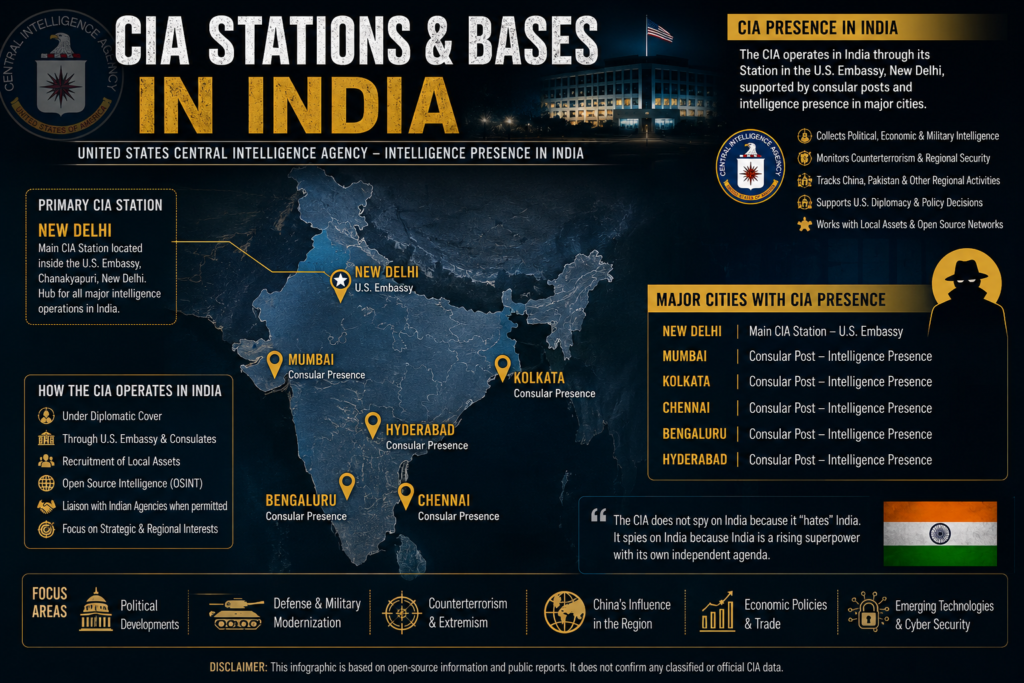
| City | Type | Established | Primary Strategic Focus |
|---|---|---|---|
| New Delhi | Main Station | 1947 (post-independence) | Overall India operations, political intelligence, RAW/IB liaison, China monitoring, nuclear program tracking |
| Mumbai | Base | 1950s | Financial intelligence, underworld/terror financing, maritime security, tech sector |
| Chennai | Base | 1960s | Maritime security (Bay of Bengal), Indian Ocean Region, southern India politics, Sri Lanka monitoring |
| Kolkata | Base | 1950s | Northeast India insurgency, Bangladesh border, Chinese border (Sikkim/Arunachal), regional connectivity |
| Hyderabad | Base | 2000s | Tech/pharma intelligence, cyber security, missile/space program monitoring (DRDO proximity) |
Table 1: Strategic Rationale for CIA Locations in India
| City | Role / Type | Why Here (Strategic Importance) | Specific Focus Areas |
|---|---|---|---|
| New Delhi | Main Station / Command Center | Political Capital, Diplomatic Hub, Intelligence HQ (RAW/IB), Military Command. | Political Intel (BJP/Congress), Nuclear Program (BARC/DRDO), China Policy (LAC), Russia Relations (S-400), Pakistan Policy, Economic Intel (BRICS/WTO). |
| Mumbai | Base / Financial & Underworld Hub | Financial Capital (BSE/RBI), Bollywood, Major Port, Historical Underworld Base (D-Company). | Terror Financing (Hawala/ISIS), Economic Intel (Corporate M&A/Chinese investment), Maritime Security, Organized Crime (Drugs/Gold), Counterterrorism (26/11 networks). |
| Chennai | Base / Southern & Maritime Hub | Major Port (Gateway to SE Asia), Manufacturing Hub, Naval Presence, Sri Lanka Proximity. | Indian Ocean Security (Chinese “String of Pearls”), Sri Lanka Crisis (Tamil issue/Debt trap), Southern Politics (Dravidian), Manufacturing Intel, Maritime Domain Awareness. |
| Kolkata | Base / Eastern Border & Insurgency Hub | Bangladesh Border, Northeast Gateway, Chinese Border (Sikkim/Arunachal), Historical Leftist Hub. | Bangladesh Relations (Rohingya/Politics), Northeast Insurgency (ULFA/NSCN), Chinese Border (Tibet/PLA), Regional Connectivity (BRI/BCIM), Naxalite Movement. |
| Hyderabad | Base / Tech & Defense Hub | DRDO Presence, Pharmaceutical Capital (“Genome Valley”), IT Center, Missile Program Proximity. | Missile Technology (Agni/BrahMos), Pharmaceutical Intel (Vaccines/Chinese API), Cyber Security, Space Program (ISRO), Defense Manufacturing (Private sector/Offsets). |
Table 2: CIA Recruitment Target Profiles in India
| Target Category | Specific Targets | Rationale / Value to CIA |
|---|---|---|
| Government Officials | MEA diplomats, Defence planners, RAW/IB officers, Nuclear scientists (BARC/DRDO/ISRO), Finance officials. | Access to foreign policy cables, defense procurement, intelligence protocols, nuclear/missile data, economic budgets. |
| Military Personnel | Army/Navy/Air Force officers (border experience), Defense scientists, Strategic Forces Command personnel. | Tactical/strategic military intel, missile/radar tech, nuclear command and control insights. |
| Academic & Think Tanks | University professors (govt advisors), Think tank analysts (ORF, IDSA, CPR), IIT/IIM students. | Policy influence, future leader tracking, research on China-India relations, defense tech insights. |
| Business & Tech Sector | Corporate execs (Tata, Reliance, Adani), Tech entrepreneurs, Pharma executives. | Govt contacts, dual-use technology, vaccine/biotech research, economic trends. |
| Diaspora Pipeline | Indian-Americans, NRIs, Indian students in US. | Backchannel access to Indian power brokers, cultural/linguistic access, future tech/business leaders. |
Table 3: CIA Recruitment Methodology (The “Cycle”)
| Phase | Key Activities | Methods & Details |
|---|---|---|
| 1. Identification (Spotting) | Locating potential targets. | Diplomatic events, academic conferences, professional networks, social media, travel patterns. Assessing MICE (Money, Ideology, Coercion, Ego). |
| 2. Assessment | Vetting the target. | Financial records, travel history, social connections, psychological profiling, access verification, technical/physical surveillance. |
| 3. Development | Building the relationship. | Official cover (diplomatic/academic/business), NOC cover (consultant/journalist/NGO), Third-country recruitment (neutral locations/US soil). |
| 4. The Pitch | Formal recruitment. | Soft pitch (asking for perspectives/insights for compensation), Hard pitch (direct request for classified docs, financial offers, leverage). |
| 5. Handling | Asset management. | Dead drops (physical locations), Live drops/brush passes (crowded areas), Digital comms (encrypted apps, steganography), Safe house/hotel meetings. |
| 6. Validation | Counterintelligence checks. | Controlled information (barium tests), cross-checking with SIGINT/satellite, pattern analysis, checking for double agents/dangles/IB surveillance. |
Table 4: Specific Recruitment Venues in India
| Venue Category | Specific Locations / Organizations | Primary Focus Area |
|---|---|---|
| Academic Institutions | JNU, Delhi University, IITs, IIMs | International studies, defense tech, cyber security, economic policy, future leaders. |
| Defense Establishments | National Defence Academy (Pune), National Defence College (Delhi), DRDO Labs, ORD Factories. | Future military officers, senior strategy, missile/radar/electronics research, ordnance production. |
| Government Ministries | South Block (MEA), Raksha Mantralaya (Defence), Finance Ministry, Home Ministry. | Foreign policy, defense procurement, economic planning, internal security/intel coordination. |
| Think Tanks & Research | ORF, IDSA, CPR, Gateway House | Foreign policy analysis, military strategy, domestic policy, geopolitics/economics. |
| Corporate Sector | Reliance, Tata, Adani, Sun Pharma, Dr. Reddy’s, Cipla | Energy/telecom/defense, steel/IT, ports/infrastructure, pharmaceuticals/biotech. |
Table 5: Historical Recruitment & Intelligence Cases
| Case / Event | Year(s) | Key Details | Impact / Outcome |
|---|---|---|---|
| Rabinder Singh Defection | 2004 | RAW Joint Secretary fled to US; allegedly provided CIA with RAW’s Pakistan ops, assets, and nuclear monitoring data. | Massive breach of Indian intel; RAW recalled officers, changed protocols; severe damage to CIA-RAW trust. |
| DRDO/ISRO Scientist Arrests | 1990s-2000s | Periodic arrests of defense scientists (e.g., 1998 Nambi Narayanan case) for allegedly passing missile/tech data to foreign handlers (CIA/ISI). | Highlighted vulnerabilities in defense sector; led to tighter security clearances and monitoring of scientific community. |
| WikiLeaks Diplomatic Cables | 2010 | Revealed US Embassy/CIA systematic biometric collection (DNA, fingerprints, iris scans, credit cards) on top Indian leaders (PM, ministers, military chiefs). | Major diplomatic embarrassment; India protested vigorously; exposed the extent of “legal” espionage under diplomatic cover. |
Table 6: Indian Counter-Intelligence (IB) Response
| Method Category | Specific Tactics | Details |
|---|---|---|
| Surveillance Methods | Physical Surveillance | 24/7 monitoring of CIA officers, shadowing, vehicle tracking. |
| Technical Surveillance | Phone tapping, email monitoring, GPS tracking of diplomatic vehicles. | |
| Meeting Disruption | IB agents sitting in cafes/locations during suspected CIA meetings to deter contact. | |
| Recruitment Detection | Financial Monitoring | Tracking unusual wealth or lifestyle changes of government officials. |
| Travel Pattern Analysis | Identifying suspicious foreign contacts or unexplained travel. | |
| Communication Intercepts | Monitoring encrypted communications and digital footprints. | |
| Honeypot Operations | Using agents to test the loyalty of officials or entrap foreign intelligence. |
Table 7: Current Dynamics (2020s) – Cooperation vs. Espionage
| Relationship Type | Focus Area | Specific Activities / Targets |
|---|---|---|
| Cooperation (“White”) | China Monitoring | Sharing satellite imagery of PLA, intel on Chinese infrastructure (Pakistan/Myanmar), Quad coordination, LAC crisis sharing. |
| Counterterrorism | ISIS-K monitoring (Afghanistan), LeT/JeM financial networks, maritime/cyber terrorism threats. | |
| Technology & Cyber | Countering Chinese tech (Huawei/ZTE), cyber defense, critical infrastructure protection, supply chain security. | |
| Regional Stability | Post-2021 Afghanistan, Myanmar coup, Sri Lanka crisis, Maldives politics. | |
| Espionage (“Black”) | Nuclear Program | Monitoring warhead development, missile testing (Agni-V/VI), SLBMs, nuclear command & control. |
| Russian Defense Deals | Tracking S-400 technical details, Su-57 tech, Ak-203 production, INS Chakra operations. | |
| Strategic Autonomy | Monitoring Russia oil purchases, BRICS positioning, non-alignment doctrine, Iran/Venezuela relations. | |
| Internal Politics | Tracking BJP dynamics, opposition strategies, Kashmir policy, CAA/NRC implementation. | |
| Economic Intelligence | Trade negotiation strategies, WTO positions, IP policies, Chinese investment screening. |
Table 8: Operational Challenges for CIA in India
| Challenge Category | Specific Factors | Details |
|---|---|---|
| Competent Counter-Intelligence | Professional IB/RAW | Highly resourced agencies, multi-layered security clearances, regular polygraph tests for sensitive positions. |
| Cultural Barriers | Nationalism & History | Strong nationalist sentiment, historical suspicion of Western powers, colonial legacy, strong family/community ties making coercion hard. |
| Technical Surveillance | Digital Footprint | Widespread CCTV, phone registration requirements, internet monitoring, financial transaction tracking (UPI/digital payments). |
| Diplomatic Constraints | Strategic Partnership | India is a partner, not an adversary; expelling CIA officers causes crises; requires strict “plausible deniability” and balance. |
Table 9: Future Trends – Emerging Recruitment Targets
| Target Sector | Specific Roles / Fields | Rationale / Value to CIA |
|---|---|---|
| Tech Sector | AI/ML researchers, Quantum computing scientists, Semiconductor engineers, Private space tech. | Next-generation dual-use technologies, cyber warfare capabilities, space domain awareness. |
| Critical Minerals | Lithium exploration scientists, Rare earth element researchers, Battery tech developers. | Securing supply chains for EVs and defense tech, countering Chinese monopoly on critical minerals. |
| Climate & Energy | Renewable energy researchers, Carbon capture scientists, Green hydrogen tech. | Understanding India’s energy transition, climate policy, and future energy security dynamics. |
| Health Security | Vaccine researchers, Biodefense scientists, Pandemic preparedness experts. | Bio-security, pharmaceutical supply chains, monitoring emerging pathogens and biotech advancements. |
PART 1: THE “AGENT” LIFECYCLE – COMPLETE TRADCRAFT
Table 1.1: Phases 1 & 2 – Identification (Spotting) & Assessment
| Phase | Core Objective | Detailed Methodology & Tradecraft | Operational Challenges & Risks |
|---|---|---|---|
| Phase 1: Identification (Spotting) | Locate individuals with access to target intelligence and the vulnerability to be recruited. | The MICE Framework: • Money: Financial ruin, gambling debts, greed, lifestyle beyond means. • Ideology: Anti-regime sentiment, pro-Western views, religious alignment. • Coercion: Blackmail (affairs, crimes) – Note: Highly restricted/illegal under modern US law. • Ego: Passed over for promotion, intellectual arrogance, desire for recognition. Venues: Diplomatic receptions, Track-II dialogues, defense expos, academic conferences. | The “Dangle” Risk: The target may be a hostile intelligence officer deliberately offering themselves to feed disinformation or identify the CIA case officer. |
| Phase 2: Assessment | Verify the target’s access, confirm their identity, and evaluate their psychological vulnerabilities. | Background & Forensics: • Name Traces: Running the target through CIA, NSA, and allied databases to check for double-agent flags. • Access Verification: Confirming they actually sit in the meetings or see the documents the CIA needs. • Lifestyle Analysis: Deep dive into credit reports, marital stability, and political grievances to find the “hook.” | False Access: The target may exaggerate their clearance level or access to sensitive documents to appear more valuable than they are. |
Table 1.2: Phases 3 & 4 – Development & Recruitment (The Pitch)
| Phase | Core Objective | Detailed Methodology & Tradecraft | Operational Challenges & Risks |
|---|---|---|---|
| Phase 3: Development | Build a psychological dependency and trust with the target without revealing CIA affiliation. | Elicitation & Testing: • The “Friendship”: Using Official Cover (e.g., Political Officer) or NOC (Non-Official Cover) to build rapport over months. • Testing Compliance: Asking for small, unclassified favors (e.g., “Can you explain this public budget report?”). If they comply, escalate. • Pitch Prep: Identifying the exact moment of vulnerability (e.g., after they are denied a promotion). | Counter-Intelligence (CI) Detection: Hostile CI services (like India’s IB or China’s MSS) monitor the target for unusual foreign contacts or sudden lifestyle changes. |
| Phase 4: Recruitment (The Pitch) | Formally transition the relationship from a “friendship” to a clandestine intelligence partnership. | The Approach: • Soft Pitch: “We represent a private consultancy interested in your insights on [Topic] for compensation.” • Hard Pitch: Direct revelation of CIA status, asking for classified documents in exchange for money/asylum. • The “Walk-in”: If the target approaches the CIA voluntarily, they are put through intense polygraph and verification to rule out a provocation. | The “Freeze Out”: The target may panic upon hearing the pitch, report the officer to their own security service, or demand more time, increasing the risk of exposure. |
Table 1.3: Phases 5 & 6 – Handling & Termination
| Phase | Core Objective | Detailed Methodology & Tradecraft | Operational Challenges & Risks |
|---|---|---|---|
| Phase 5: Handling | Securely collect intelligence, pay the agent, and keep the asset safe from hostile counter-intelligence. | Tradecraft & Comms: • Dead Drops: Hiding cash/SD cards in hollow rocks or magnetic boxes. Uses “Signals” (e.g., a chalk mark on a wall) to confirm the drop is ready. • Live Drops/Brush Passes: Brief, choreographed physical exchanges in crowded areas. • Secure Comms: Steganography (hiding text in digital images), encrypted burst transmitters, one-time pads. • Validation: Running “Barium Tests” (giving the agent fake info to see if the hostile government reacts to it). | Asset Compromise: The agent may be turned by hostile CI, become a “double agent,” or simply fabricate intelligence to keep getting paid. |
| Phase 6: Termination | Safely conclude the relationship due to loss of access, danger of capture, or end of mission. | Exit Strategies: • Exfiltration: The “Last Resort.” Smuggling the agent and family out via “Escape and Evasion” routes (e.g., through a third country like Mexico or Turkey) to the US. • Disengagement: Formally cutting ties, paying a final stipend, and ordering the agent to “go dark” (never contact the CIA again). • Compromise: If caught, the CIA executes “Plausible Deniability,” officially denying the agent’s existence. | Exfiltration Failure: Moving a compromised asset out of a “denied area” (like China or Russia) is logistically nightmarish and often results in the asset being caught at the border. |
PART 2: THE CHAIN OF COMMAND – WHO REPORTS TO WHOM
Table 2.1: Field & Headquarters Command Structure
| Command Element | Primary Role & Authority | Reporting Lines & Matrix | Friction Points & Realities |
|---|---|---|---|
| The Station Chief (COS) | The “CEO” of CIA operations in a specific country. Manages the “Black Budget,” approves agent recruitment, and directs all HUMINT collection. | Operational: Reports to the Mission Center Manager (MCM) at Langley. Diplomatic: Subordinate to the U.S. Ambassador. Must brief the Ambassador on all ops. | The Dual-Reporting Dilemma: The Ambassador may veto a CIA operation to protect diplomatic relations, infuriating the COS and Langley. |
| CIA Headquarters (Langley) | The strategic brain. Translates field intelligence into the President’s Daily Brief (PDB) and directs global collection priorities. | Directorate of Operations (DO): Led by the Deputy Director for Operations (DDO). Mission Centers: Geographic (e.g., Asia) and Functional (e.g., Counterterrorism) hubs that manage the Stations. | The “Stovepipe” Problem: Headquarters may demand intelligence that is impossible to collect in the field, or fail to understand the local cultural nuances the Station Chief faces. |
Table 2.2: Executive Oversight & Interagency Coordination
| Command Element | Primary Role & Authority | Reporting Lines & Matrix | Friction Points & Realities |
|---|---|---|---|
| White House & NSC | The ultimate authority. Authorizes “Covert Action” (regime change, arming rebels, cyberattacks) and manages the “Black Budget.” | Presidential Finding: The legal document signed by the President authorizing covert action. Gang of Eight: The CIA Director must brief the top 8 members of Congress on highly sensitive covert ops. | Political Interference: The NSC may delay or alter a CIA covert action to avoid a political scandal, blinding the CIA to a time-sensitive opportunity. |
| Interagency Partners | Deconfliction and integration of national power. Ensures the CIA isn’t stepping on the toes of the military or domestic law enforcement. | FBI: CIA (Foreign) vs. FBI (Domestic). Coordinate via Joint Terrorism Task Forces (JTTFs). DoD/JSOC: CIA provides the intel; JSOC provides the kinetic firepower. State Dept: Provides the diplomatic cover (passports, embassy space) the CIA relies on. | Turf Wars: The Pentagon often resents CIA paramilitary operations (viewing it as the military’s job), while the State Department hates CIA ops that get diplomats expelled. |
PART 3: PARAMILITARY OPERATIONS – THE SHADOW WARRIORS
Table 3.1: Structure, Recruitment, and Legal Status
| Component | Core Mission & Mandate | Recruitment & Training Pipeline | Legal & Operational Status |
|---|---|---|---|
| Special Activities Center (SAC) | The CIA’s covert action and paramilitary wing. Executes the “Third Option” when diplomacy and conventional military force fail or are politically unviable. | Selection: Officers are selected from within the CIA’s Directorate of Operations. They must already be elite case officers before applying for paramilitary training. | Secrecy: Operates entirely in the “Black Budget.” Its existence was legally denied by the US government until the 1990s. |
| Special Operations Group (SOG) | The tactical, kinetic arm of SAC. Conducts Direct Action, Unconventional Warfare, and Special Reconnaissance in denied areas. | Recruitment: Exclusively recruited from Tier 1 Military Special Mission Units (Delta Force, DEVGRU/SEAL Team 6, 24th STS, MARSOC). Training: “Staff A” course at Camp Peary (“The Farm”). Focuses on deniable tactics, foreign languages, and advanced surveillance. | Geneva Conventions: Because they are civilians, if captured, they do not have Prisoner of War (POW) status. They can be tried as spies and executed by the host nation. |
Table 3.2: Mission Types & “Ground Truth” Execution
| Operation Type | Definition & Objective | Historical / Modern Examples | Tactical Execution (“Ground Truth”) |
|---|---|---|---|
| Direct Action (DA) | Short-duration, high-intensity kinetic strikes. Raids, ambushes, and targeted killings of High-Value Targets (HVTs). | Operation Neptune Spear (2011): CIA SAC provided the intelligence and ground support for the JSOC raid on Osama bin Laden in Abbottabad. | “Eyes On” Target: CIA paramilitary officers infiltrate the area to provide Positive Identification (PID) before the strike is authorized. |
| Unconventional Warfare (UW) | Long-term operations to train, equip, and lead foreign guerrilla or proxy forces to overthrow a government or bleed an adversary. | Operation Cyclone (1980s): CIA armed and trained the Afghan Mujahideen against the Soviets. Laos “Secret War” (1960s): CIA led Hmong tribesmen against the NVA. | Proxy Management: CIA officers live alongside the proxy force, calling in airstrikes, managing logistics, and ensuring the proxies don’t commit war crimes that blow back on the US. |
| Counterterrorism (CT) / Drone War | The persistent, long-term hunting and killing of terrorist leaders using unmanned aerial vehicles (UAVs) and targeted strikes. | The Drone War (2000s-Present): CIA conducted hundreds of drone strikes in Pakistan (FATA), Yemen, and Somalia against Al-Qaeda and ISIS. | The “Trigger Puller”: A CIA civilian officer sits in a SCIF at Langley or a remote base, watching a live drone feed, and physically presses the button to fire the Hellfire missile. |
Table 3.3: Legal Authority & The “Gray Zone”
| Legal Framework | Governing Code | Operational Scope & Authority | Protections, Constraints & Realities |
|---|---|---|---|
| Title 10 (U.S. Code) | Governs the Armed Forces (Department of Defense / Military). | Overt Military Operations: Conventional warfare, overt special operations (JSOC). Operations are acknowledged by the US Government. | Protections: Operators are uniformed combatants. If captured, they are protected by the Geneva Conventions as Prisoners of War (POWs). |
| Title 50 (U.S. Code) | Governs War and National Defense (Intelligence / CIA). | Covert Action & Paramilitary Ops: Clandestine warfare, arming rebels, drone strikes. The US Government can legally deny involvement (“Plausible Deniability”). | Constraints: Requires a “Presidential Finding” and Congressional notification. Operators are civilians; if captured, they are treated as illegal combatants or spies. |
| The “Gray Zone” | The blurring of Title 10 and Title 50 in modern conflict. | Fusion Cells: In places like Syria or Afghanistan, CIA (Title 50) and JSOC (Title 10) operate in the same physical room. The CIA finds the target; the military kills the target. | Operational Complexity: Creates legal and command-chain nightmares. Who is in charge? If a CIA officer calls in a military airstrike that kills civilians, who is legally responsible? |
Table 1: The Operational Environment (Cover Mechanisms)
Before recruiting, CIA officers must navigate an environment where India’s Intelligence Bureau (IB) actively shadows U.S. diplomats.
| Cover Type | Personnel | The Cover Story | The Reality (IB Perception) | Operational Role & Limitations |
|---|---|---|---|---|
| Official Cover (OC) | Chief of Station (COS), Senior Case Officers. | “Political Officer”, “Economic Attaché” at the U.S. Embassy in Chanakyapuri. | Declared: The IB knows exactly who they are. An IB agent is likely sitting two tables away when they go to a coffee shop. | Role: Attend official events, build broad networks, pass info to the internal team. Limitation: Cannot do actual clandestine recruiting due to heavy surveillance. |
| Non-Official Cover (NOC) | Clandestine Case Officers (“Deep Spies”). | Executives at U.S. consulting firms (McKinsey, Deloitte), journalists for Western think tanks, or Fulbright scholars at JNU/IITs. | Undeclared: No link to the U.S. government. They are not on the embassy roster, so the IB does not know who they are. | Role: Conduct the actual clandestine recruiting and meet targets without triggering immediate counter-intelligence alarms. |
Table 2: Executing the Agent Lifecycle in India (Step-by-Step)
How a CIA NOC recruits an Indian target (e.g., a DRDO scientist) without getting caught by the IB.
| Phase | Core Objective | Methodology & Tradecraft in India | Practical Example |
|---|---|---|---|
| Step 1: Spotting & Assessment | Identify targets with access and vulnerabilities using India’s academic/corporate culture. | NOC attends defense expos (Bengaluru) or policy conferences (Delhi). Runs deep digital footprint checks to find “hooks.” | NOC spots a mid-level DRDO scientist asking specific questions about U.S. export controls. Digital check reveals the scientist has a child with a rare disease and massive medical debt (Money/MICE vulnerability). |
| Step 2: Development | Build a relationship slowly (“Boiling Frog” strategy) to avoid IB detection. | “Accidental” meetings. Bond over shared interests. Ask for small, unclassified favors to test compliance and gauge willingness to talk. | NOC bumps into the scientist at a conference bar. Over 6 months, they have lunch. NOC asks for general info on lab procurement; the scientist complies, proving they are willing to share work details. |
| Step 3: The Pitch | Formally recruit the target away from IB physical surveillance. | Third-Country Recruitment: The CIA almost never pitches inside India. The NOC invites the target to a “tech summit” in a neutral country (e.g., Singapore, Dubai, London). | The scientist travels to Singapore. In a secure hotel room, the NOC drops cover: “I represent the U.S. government. We will pay $50,000/year for insights into your lab’s radar cross-section research.” |
| Step 4: Handling | Exchange information and payments securely without IB detection. | Digital Dead Drops: Steganography (hiding classified text inside innocent image files on public clouds). Secure Comms: Custom CIA apps disguised as calculators. Payments: Routed via shell companies in Dubai/Cayman Islands to offshore accounts. | The scientist uploads a landscape photo to a cloud server containing hidden data. The CIA downloads it. Payment is deposited into an offshore account controlled by the scientist’s family, leaving no paper trail in India. |
Table 3: The Chain of Command Reality: “White” vs. “Black” Relationship
The CIA Station Chief (COS) in New Delhi lives a double life, managing two completely contradictory relationships simultaneously.
| Dimension | The “White” Relationship (Cooperation) | The “Black” Relationship (Espionage) |
|---|---|---|
| Who is Involved | The COS meets openly with the RAW Chief and the IB Director. | The CIA’s clandestine case officers secretly recruit mid-level Indian officials and scientists. |
| What They Do | Share satellite imagery of Chinese troop movements on the LAC. Coordinate on tracking ISIS-K financing. Run joint counter-terrorism working groups. | Try to steal technical specs of India’s S-400 missile system. Monitor India’s backchannel oil purchases from Russia. Track internal debates of the BJP and Congress. |
| The Vibe | Highly professional, respectful, collaborative. The COS and RAW Chief might even have dinner together. | Ruthless, deceptive, and highly secretive. The IB is actively trying to identify, surveil, and arrest the CIA’s spies. |
| The Ultimate Goal | Strengthen the U.S.-India strategic partnership to counter China. | Ensure the U.S. is never caught off guard by India’s independent “strategic autonomy” decisions. |
Command Friction: The Ambassador vs. The COS
| Command Dynamic | Primary Focus | Point of Conflict | Resolution / Reality |
|---|---|---|---|
| U.S. Ambassador vs. COS | Ambassador: Trade deals, the Quad, keeping the Prime Minister happy. COS: Extracting intelligence, running covert ops. | The COS wants to run a risky cyber-operation to hack an Indian defense contractor to steal S-400 data. | The Ambassador likely says NO, fearing that if India finds out, it will derail a multi-billion dollar defense trade agreement. The COS must constantly balance Langley’s demand for intel against the Ambassador’s demand for diplomatic stability. |
Table 4: Limits of Paramilitary Operations in India
It is crucial to understand that the CIA’s kinetic “Shadow Warrior” tactics (Part 3 of the standard Operations Guide) DO NOT APPLY to India.
| Operation Type | Status in India | Rationale / Context | Exceptions / Alternative Methods |
|---|---|---|---|
| Kinetic Ops (Drone strikes, raids, assassinations) | STRICTLY PROHIBITED | India is a sovereign nuclear power and a strategic partner. A CIA kinetic strike on Indian soil would be an act of war. | None. |
| Proxy Wars (Arming rebel groups) | STRICTLY PROHIBITED | Destabilizing a strategic partner contradicts the core U.S. goal of using India as a bulwark against China. | None. |
| Cyber & Covert Influence | ACTIVELY CONDUCTED | The physical/kinetic border doesn’t apply to the digital and cognitive domains. | Cyber: Directorate of Digital Innovation & NSA conduct offensive ops to penetrate govt networks, steal data, or insert “logic bombs” (wartime contingency). Influence: Subtly funding or guiding Indian think tanks and media narratives to align with U.S. interests. |
Table 5: Summary – The Strategic Tightrope
How the CIA works in India: They work in the shadows of a friendship.
| Strategic Element | Overt Action (Title 10 / Diplomatic) | Covert Action (Title 50 / CIA) | The Balancing Act |
|---|---|---|---|
| Military & Security | The U.S. military openly trains the Indian Army in the Himalayas to prepare for China. | The CIA uses the exact same military access and joint exercises to identify and recruit disgruntled Indian officers. | Extract the secrets needed to protect U.S. hegemony without doing so much damage to the relationship that India turns toward Russia or China. |
| Diplomacy & Strategy | A massive, legitimate U.S.-India relationship (trade, the Quad, academic exchanges). | The CIA uses this massive, legitimate relationship as a smokescreen to operate and recruit in the shadows. | A high-stakes game of cat-and-mouse where the CIA must satisfy Washington’s intelligence requirements while respecting the “friendly face” of the Indian state. |
To understand how a CIA Station actually functions, you have to look past the lone “spy in a trench coat” trope. A modern CIA Station is a highly organized, bureaucratic, and compartmentalized corporate enterprise operating inside a foreign country.
While the size of a Station varies wildly—from a massive 100+ person facility in London or Islamabad to a tiny 2-person outpost in a smaller nation—the core organizational structure remains remarkably consistent.
Here is the full, detailed structural breakdown of a standard CIA Station, divided into Command, Operations, Technical Support, and Administration.
Table 1: Command & Leadership Element
The leadership element manages the Station’s strategic direction, budget, and relationships with both Langley and the host nation.
| Role | Primary Function & Responsibilities | Reporting Line & Realities |
|---|---|---|
| Chief of Station (COS) | The “CEO” of the Station. Holds ultimate authority over all clandestine operations, intelligence collection, and the “Black Budget” in that country. | Reports to: Langley (Mission Center Manager) & the U.S. Ambassador. Bears the ultimate responsibility if an operation blows up diplomatically. |
| Deputy Chief of Station (DCOS) | The “COO” (Chief Operating Officer). Manages the day-to-day internal administration, personnel issues, and inter-section coordination. Steps in if the COS is expelled or incapacitated. | Reports to: The COS. Often handles the tedious bureaucratic reporting to Langley so the COS can focus on high-level espionage and liaison. |
| Executive Officer (XO) | The chief of staff for the Station. Manages internal communications, schedules, and the flow of classified cables between the Station and Headquarters. | Reports to: DCOS/COS. Ensures the Station’s internal machinery runs smoothly and securely. |
Table 2: Core Operational Sections (The “Collectors”)
This is the “tip of the spear.” These are the officers who actually leave the embassy, meet with foreign nationals, and steal secrets.
| Section / Role | Primary Function & Methodology | Operational Reality & Constraints |
|---|---|---|
| Operations Section (Case Officers) | The Recruiters. COs identify, assess, develop, recruit, and handle foreign assets (spies). They run the “Agent Lifecycle” (SADRRA). | Cover: Operate under Official Cover (e.g., Political Officer) or Non-Official Cover (NOC). Heavily surveilled by host-nation counterintelligence. |
| Targeting Officers (TOs) | The Researchers. TOs do not meet assets. They sit in the SCIF, analyzing massive databases, SIGINT, and open-source data to find the exact individuals the COs should try to recruit. | The Brains: A TO might say, “Target X has access to the nuclear program, travels to Dubai every July, and has a gambling debt. Go recruit him in Dubai.” |
| Counterintelligence (CI) Section | The Protectors. They do not collect intelligence; they protect it. They vet “walk-ins,” check for double agents, monitor host-nation surveillance, and ensure COs aren’t being compromised. | The Internal Police: If a CI officer suspects an asset is a “dangle” (fake spy) or a CO is being followed, they have the authority to shut the operation down. |
| Reports Officer | The Editors. COs are often messy and emotional after a stressful meeting with an asset. The Reports Officer takes the CO’s raw notes and writes the sanitized, highly classified intelligence cable (TDCR) sent to Langley. | Quality Control: They ensure the intelligence is actionable, properly sourced, and formatted correctly for the President’s Daily Brief (PDB). |
| Special Activities / Paramilitary (SAC/SOG) | The Kinetic Element. (Only present in war zones or specific high-threat Stations like Kabul, Baghdad, or historically Beirut). Conducts direct action, UW, and hostage rescue. | Title 50 Ops: Operates entirely separately from the HUMINT collectors. Highly compartmentalized within the Station. |
Table 3: Technical & Support Sections (The “Enablers”)
Espionage requires massive technical and logistical backing. These sections provide the tools the Case Officers need to survive and succeed.
| Section / Role | Primary Function & Methodology | Operational Reality & Constraints |
|---|---|---|
| Technical Operations (Tech Ops) | The “Q-Branch”. Specialists in clandestine imaging, audio/visual surveillance, lockpicking, and installing hidden sensors. They build the “dead drop” sites and covert cameras. | Field Support: If a CO needs to secretly clone a target’s laptop while they are at dinner, Tech Ops executes the physical intrusion. |
| Communications (COMMS) / IT | The Lifeline. Manages the Station’s secure networks, satellite uplinks, encrypted radios, and the SCIF. They build the covert comms systems given to foreign assets. | Absolute Security: If the COMMS network is breached by the host nation, the entire Station is burned. They work closely with the NSA. |
| Medical / Psychological Support | The Assessors. Station psychologists and medical officers assess the mental stability of recruited assets and the psychological toll on Case Officers. | Asset Vetting: They help determine if an asset is a narcissist, a psychopath, or genuinely ideologically motivated. |
| Covert Action / Influence Ops | The Propagandists. Officers dedicated to media manipulation, funding front groups, and cyber-influence operations to shape the host nation’s political landscape. | Title 50 Authority: Requires specific Presidential Findings. Highly compartmentalized from standard HUMINT collection. |
Table 4: Administration, Security & Logistics
Spies need safe houses, cash, cars, and physical protection. This section keeps the Station legally and physically functional.
| Section / Role | Primary Function & Methodology | Operational Reality & Constraints |
|---|---|---|
| Administration & Finance | The Bankers. They manage the Station’s “Black Budget.” They pay the assets, rent the safe houses, buy the cars, and handle the complex accounting required to hide CIA spending. | Cash Management: Moving millions of dollars in untraceable cash into a hostile country to pay spies without triggering local financial alarms. |
| Foreign Service Nationals (FSNs) | The Local Backbone. Local citizens hired by the U.S. Embassy to do the heavy lifting: driving, translating, fixing buildings, and managing local vendor contracts. | The Security Risk: FSNs are vital, but they are never allowed inside the SCIF or told who the real spies are, as they are prime targets for host-nation blackmail. |
| Station Security / RSO Liaison | The Bodyguards. Works with the State Department’s Regional Security Officer (RSO) and Marine Security Guards to protect the physical embassy and the SCIF from physical intrusion or bombings. | Defensive Posture: Focuses on counter-surveillance, armored vehicles, and emergency evacuation protocols. |
Table 5: The Physical & Digital Infrastructure of a Station
A Station is not just people; it is a highly engineered physical and digital fortress.
| Infrastructure Element | Description & Purpose | Security Protocols |
|---|---|---|
| The SCIF (Sensitive Compartmented Information Facility) | The physical heart of the Station. A heavily armored, soundproofed, and electronically shielded room inside the Embassy where classified work happens. | Zero Electronics: No cell phones, smartwatches, or unapproved electronics allowed. Swept daily for bugs by technical teams. |
| The “Front Office” | The unclassified area of the Station where officers work on their unclassified laptops, read local newspapers, and host foreign diplomats. | Cover Maintenance: Designed to look exactly like a standard State Department political/economic section to visiting foreign officials. |
| Safe Houses | Off-compound, secretly rented apartments or commercial offices used to meet assets, store sensitive gear, or hide compromised officers. | Sterile Environment: Rented using false identities (NOCs) or cut-outs (third parties). Swept for bugs before every use. |
| The “Black” Network (JWICS/SIPRNet equivalents) | The highly classified intranet that connects the Station directly to Langley, the NSA, and the White House. | Air-Gapped: Physically disconnected from the internet and the Embassy’s standard unclassified Wi-Fi to prevent cyber intrusions. |
This report has been researched, analysed, and prepared by our strategic research partner, the Security Advisor and Research Organisation (SARO).
The Security Advisor and Research Organisation (SARO) is an independent intelligence, strategic research, and advisory organisation dedicated to advancing national security, resilience, and informed decision-making in an increasingly complex global security environment. Through evidence-based research, intelligence analysis, and strategic assessments, SARO supports governments, organisations, businesses, and stakeholders in understanding emerging risks, geopolitical developments, and security challenges.
Strategic Research Partner
Independent Intelligence • Strategic Research • Advisory Excellence