Why Foreign-Funded Think Tanks and Study Centres Need Transparency: A National Security Perspective
(Legal Awareness & Public Interest Initiative)
Introduction
In an increasingly interconnected world, academic exchanges, cultural studies, and international think tanks play an important role in fostering dialogue between nations. However, when such engagements involve foreign state-linked institutions, especially from countries with ongoing strategic and security tensions with India, the need for transparency, regulation, and oversight becomes critical.
Helpful Foundation seeks to raise public awareness about the importance of safeguarding India’s national security, institutional integrity, and policy independence, while continuing to uphold democratic values and academic freedom.
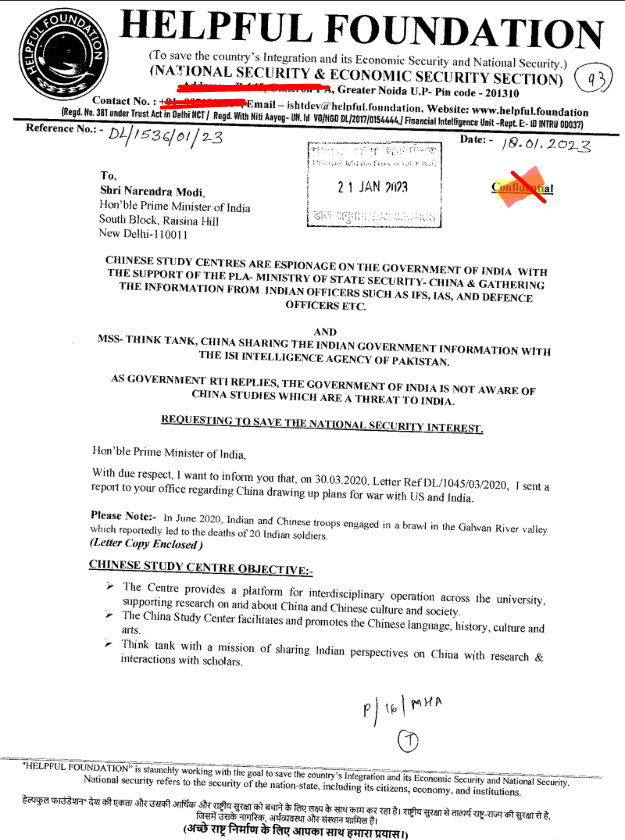
Understanding the Role of China Study Centres
Across India, several institutions operate under the banner of China Studies, focusing on:
- Chinese language, culture, and history
- Strategic and geopolitical research
- Academic exchanges and policy dialogues
In principle, such centres contribute to knowledge-building. However, globally, it is well documented that some foreign think tanks operate in close alignment with their governments’ strategic, diplomatic, and security objectives.
Why Oversight Matters
China follows a clearly articulated national strategy that integrates:
- Economic policy
- Foreign policy
- Technology development
- Military and civil fusion
This approach blurs the line between civilian institutions and state strategy, making it essential for other nations—including India—to carefully assess foreign-funded academic and policy platforms operating within their borders.
Notably, several international research bodies have highlighted that certain Chinese think tanks maintain close links with state institutions such as:
- People’s Liberation Army (PLA)
- Ministry of State Security (MSS)
One such globally discussed institution is the China Institutes of Contemporary International Relations (CICIR), which has been widely analysed by international scholars for its proximity to China’s internal security ecosystem.
India–China Context: A Delicate Strategic Environment
India and China share a complex relationship shaped by:
- Border tensions
- The Galwan Valley incident (2020)
- Divergent positions on initiatives such as the Belt and Road Initiative (BRI)
India has officially declined to endorse BRI, citing sovereignty and security concerns. In this backdrop, foreign influence over academic discourse, policy narratives, or institutional thinking deserves careful examination—not suppression, but transparent regulation.
Think Tanks, Diplomacy, and Information Flow
Globally, think tanks are often platforms where:
- Retired diplomats
- Former military officers
- Policy experts
engage in dialogue. While this is normal in democracies, clear disclosure norms are essential when:
- Events are supported by foreign embassies
- Funding originates outside India
- Strategic narratives are involved
Without oversight, such platforms may unintentionally become conduits for policy influence or selective information exchange, especially in sensitive geopolitical environments.
China–Pakistan Strategic Coordination: A Regional Reality
China and Pakistan maintain deep strategic cooperation across:
- Defence
- Economy
- Diplomacy
- Infrastructure
Institutions such as Inter-Services Intelligence (ISI) and Chinese strategic bodies are often discussed in global security literature as part of this partnership.
For India, this underscores the importance of situational awareness, not alarmism—ensuring that domestic institutions remain secure, independent, and aligned with national interest.
RTI Responses and the Transparency Gap
Helpful Foundation has observed, through Right to Information (RTI) replies, that in some cases:
- There is limited official data on the number, funding, or oversight of foreign-linked study centres
- Regulatory clarity regarding their operation is lacking
This does not imply wrongdoing—but it does highlight a policy and governance gap that merits attention.
The Way Forward: Balance, Not Bans
Helpful Foundation does not advocate for:
- Academic censorship
- Blanket bans on foreign institutions
Instead, we recommend:
- Mandatory disclosure of foreign funding and affiliations
- Clear regulatory frameworks for foreign-linked think tanks
- Periodic security and compliance reviews
- Safeguards for sensitive information and officials
- Public transparency to maintain trust
Such measures strengthen democracy rather than weaken it.
China’s National Strategy: A Long-Term Vision
The People’s Republic of China (PRC) has articulated a long-term national vision to achieve what it terms “the great rejuvenation of the Chinese nation” by 2049. This strategy goes beyond economic growth and reflects an integrated effort to expand national power, modernise governance systems, and revise aspects of the international order.
The Chinese Communist Party (CCP) frames this objective as the fulfillment of long-standing nationalist aspirations to restore China to a position of global strength, prosperity, and leadership. Within this framework, China’s leadership has consistently viewed itself as engaged in strategic competition with other major states, including India.
By 2019, China intensified its efforts to stabilise economic growth, strengthen its armed forces, and take on a more assertive role in global affairs—signalling a shift toward a more proactive and globally engaged posture.
Foreign Policy Orientation
China’s foreign policy seeks to reshape elements of the international system in accordance with CCP priorities and governance principles. The underlying objective is to create an external environment supportive of China’s national rejuvenation.
Notably, official Chinese policy statements increasingly emphasise that the armed forces play an active role in advancing foreign policy, highlighting the expanding global scope of China’s military and strategic footprint.
Economic Policy and Strategic Development
The CCP has consistently prioritised economic development as the “central task” driving China’s modernisation across all sectors, including defence.
Economic growth supports military modernisation through:
- Sustained increases in defence budgets
- Large-scale state-led initiatives such as the Belt and Road Initiative (BRI/OBOR)
- Industrial policies like Made in China 2025, aimed at technological self-reliance
Together, these policies strengthen China’s industrial, scientific, and technological base, creating long-term strategic advantages.
Military-Civil Fusion (MCF) Strategy
A core component of China’s approach is its Military-Civil Fusion (MCF) Development Strategy, which integrates civilian economic and technological development with national security objectives.
MCF encompasses:
- Integration of civilian and defence industrial bases
- Leveraging science and technology across military and civilian sectors
- Cultivating talent that blends civilian expertise with military needs
- Embedding military requirements into civilian infrastructure
- Using civilian logistics and services for defence purposes
- Expanding national defence mobilisation across society and the economy
This model enables rapid conversion of civilian innovation into military capability, strengthening China’s preparedness in both strategic competition and conflict scenarios.
China–Pakistan Strategic Partnership
In the 21st century, China’s relationship with Pakistan has evolved into what both governments describe as an “all-weather strategic partnership.” This cooperation spans defence, infrastructure, diplomacy, and technology.
Key areas of collaboration include:
- Joint military and naval exercises
- Co-production of fighter aircraft
- Development of Gwadar Port
- Cooperation in missile and nuclear-related domains
China’s defence exports to Pakistan reflect this deepening relationship. In 2014, China supplied military equipment worth approximately USD 394 million. By 2015, exports reportedly increased by nearly 70 percent, reaching about USD 565 million.
Why This Matters for India
India’s strategic environment is shaped by:
- Ongoing border tensions
- Regional security challenges
- Competing geopolitical visions in Asia
India has officially declined to endorse the BRI, citing sovereignty and security concerns. In this context, foreign-funded think tanks, study centres, and policy forums operating in India—particularly those linked to foreign strategic ecosystems—require clear transparency norms and regulatory oversight.
This is not a question of restricting academic freedom, but of ensuring:
- Disclosure of foreign funding and affiliations
- Protection of sensitive institutional information
- Safeguards for serving and retired public officials
- Alignment with India’s constitutional and national security framework
Transparency, Not Prohibition
Helpful Foundation does not advocate bans or censorship. Instead, it supports:
- Mandatory disclosure of foreign funding and partnerships
- Clear registration and compliance frameworks
- Periodic institutional reviews
- Awareness-based safeguards for officials and scholars
- Public transparency to maintain trust
Such measures strengthen democratic institutions while preserving academic exchange.
Conclusion
In the modern era, national security extends beyond borders and battlefields. It includes the protection of ideas, institutions, narratives, and policy ecosystems.
Understanding foreign national strategies—and ensuring transparency in how foreign-linked institutions operate domestically—is essential for safeguarding India’s sovereignty, strategic autonomy, and democratic values.
Helpful Foundation remains committed to legal awareness, public interest research, and constructive policy dialogue in service of the nation.
About Helpful Foundation
Helpful Foundation is a public-interest initiative working on legal awareness, transparency, governance, and national interest issues, empowering citizens through information and lawful advocacy.