
National Security Accountability in India
How National Security Decisions Are Taken Today!
- Strategic advice is coordinated by the National Security Advisor (NSA) (currently Shri Ajit Doval)
- Decisions are taken by the Prime Minister and the Cabinet Committee on Security.
- Operations are executed by security forces and agencies
The problem:
There is no law that clearly fixes who is accountable when preventable failures occur.
Why Citizens Must Know • Why Reform Is Necessary
India’s national security affects every citizen’s life, liberty, and future.
Yet, unlike other core areas of governance, national security decision-making operates without a clear legal accountability framework.
This page explains the issue in simple terms—not to blame individuals, but to highlight a systemic governance gap that needs reform.
What Is National Security Accountability?
National security accountability means:
- Clear legal responsibility for preventing security failures
- Defined institutional roles and duties
- Mandatory review after major incidents
- Parliamentary oversight and transparency within constitutional limits
In a democracy, power must always be matched with responsibility.
Where the Accountability Fails
1. No Statutory Framework
- The NSA post is not created by Parliament
- Roles, duties, and liability are not defined by law
2. No Mandatory Post-Incident Review
- After major security failures:
- No compulsory independent inquiry
- No binding reform mechanism
- No responsibility fixation
3. Weak Parliamentary Oversight
- Parliament receives limited information
- “National security” is often cited to avoid scrutiny
4. Diffused Responsibility
- Intelligence, Home, Defence, and PMO functions overlap
- Accountability becomes administratively diluted
Why This Matters to Citizens
When accountability is unclear:
- Preventable attacks may repeat
- Institutional learning is weak
- Public trust in governance erodes
- Fundamental Rights under Articles 14 and 21 are indirectly impacted
Security without accountability ultimately weakens democracy.
This Is Not About Individuals
This initiative does not target any person or office.
It focuses on institutional reform, asking a simple constitutional question:
Who is legally responsible when national security systems fail?
What Democratic Reform Looks Like
A strong accountability framework would include:
- A National Security Accountability Law
- Clearly defined statutory roles (including advisory positions)
- Mandatory post-incident review mechanisms
- Confidential but effective parliamentary oversight
- Periodic public reporting on preparedness (without compromising security)
Why Public Awareness Is Important
Reform begins with informed citizens.
Public understanding ensures:
- Constitutional balance
- Rule of law
- Responsible governance
- Stronger, safer national security systems
Our Objective
To encourage lawful, transparent, and accountable national security governance, fully consistent with the Constitution of India.
Strong security and strong democracy are not opposites—they require each other.
Support Constitutional Accountability
If you believe national security must be:
✔ Strong
✔ Law-based
✔ Accountable
Then, public awareness and civic engagement are essential.
This initiative is in the larger public interest and seeks systemic reform—not accusation.
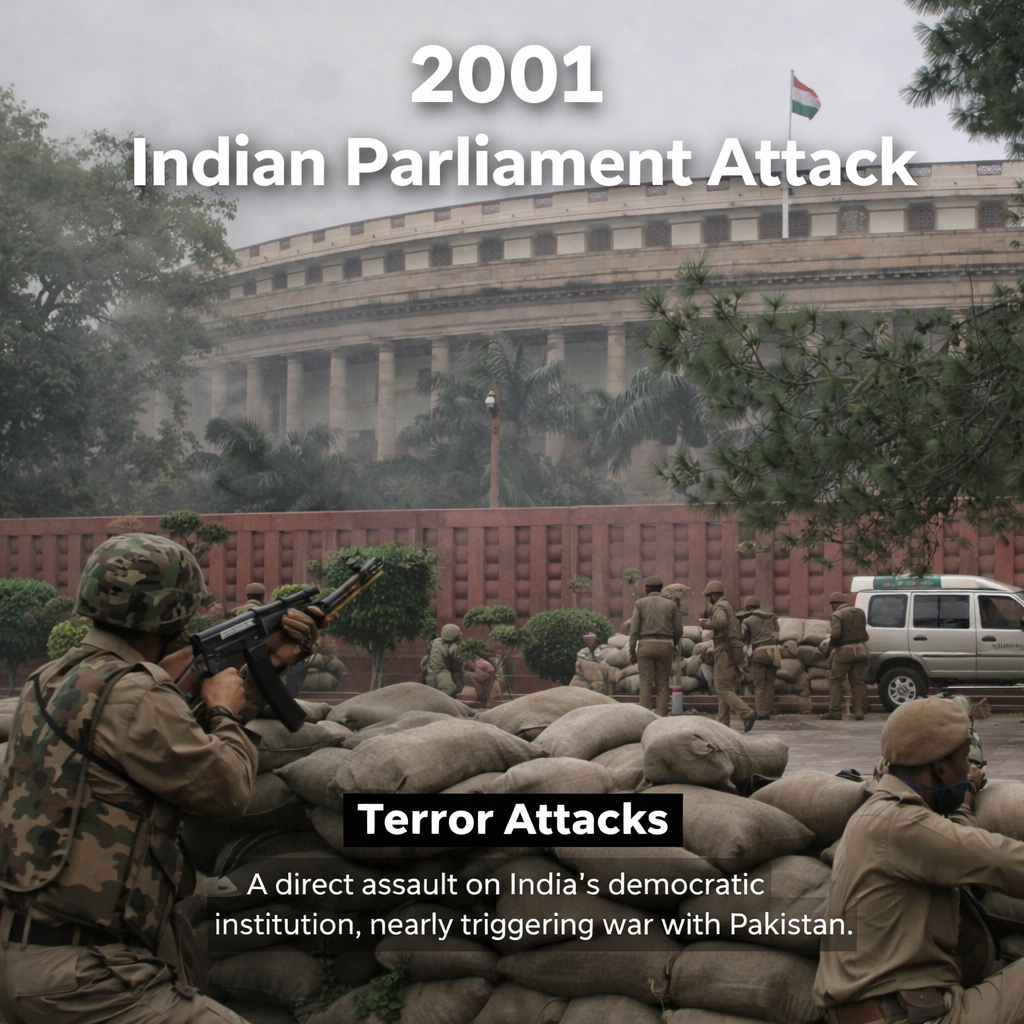
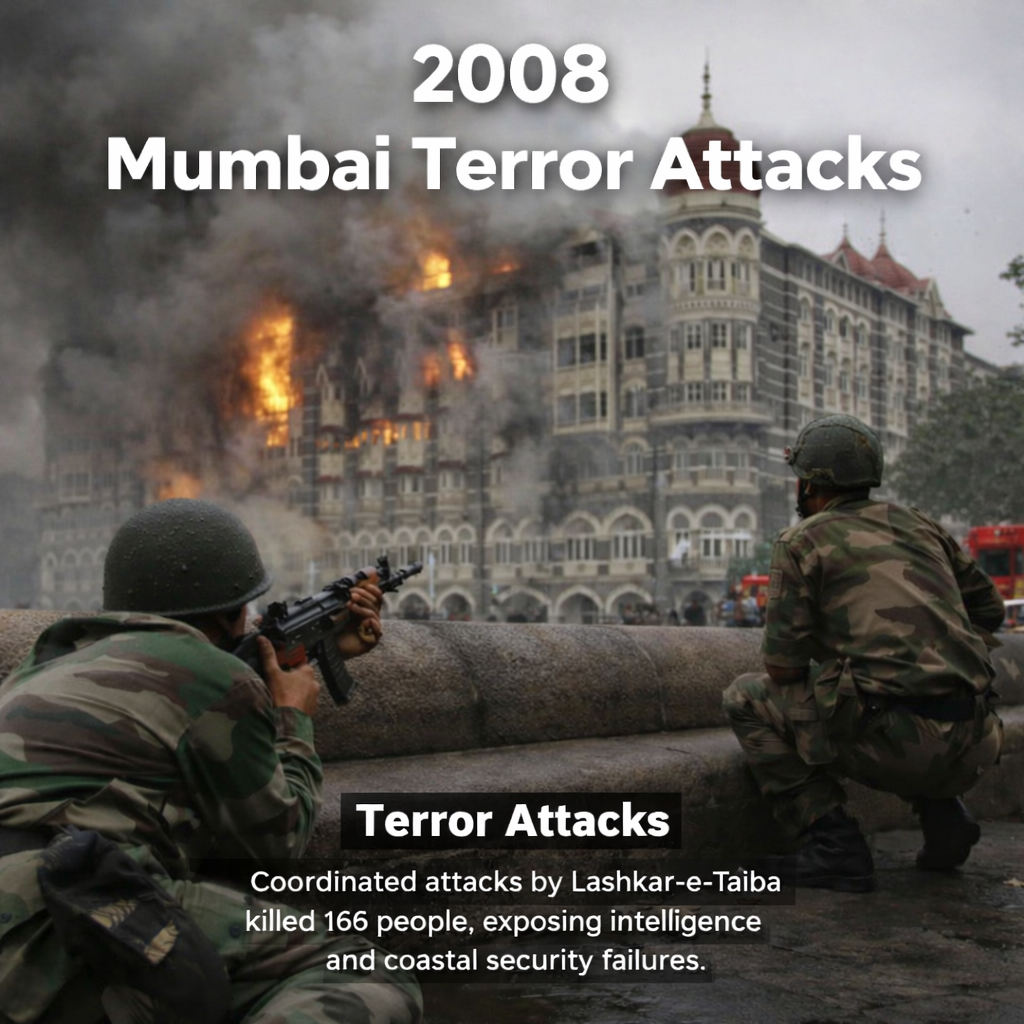
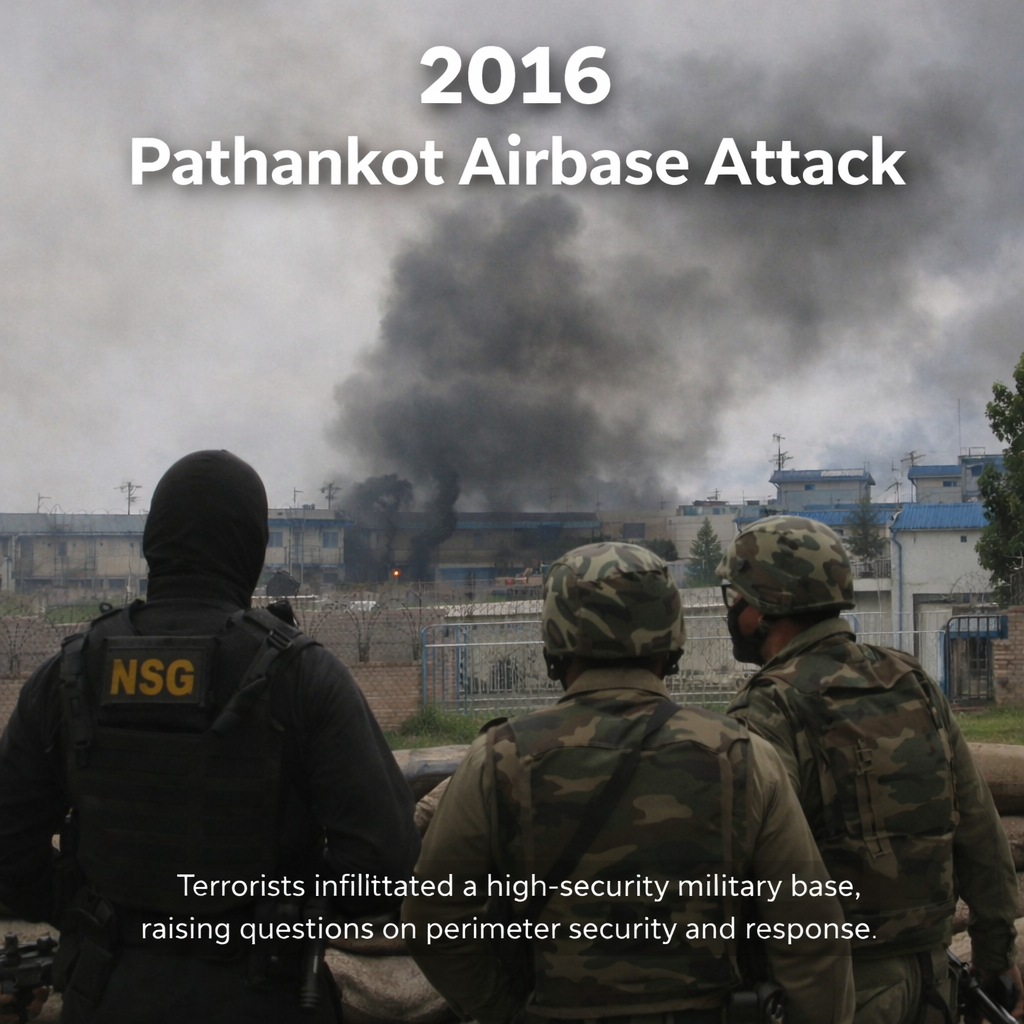
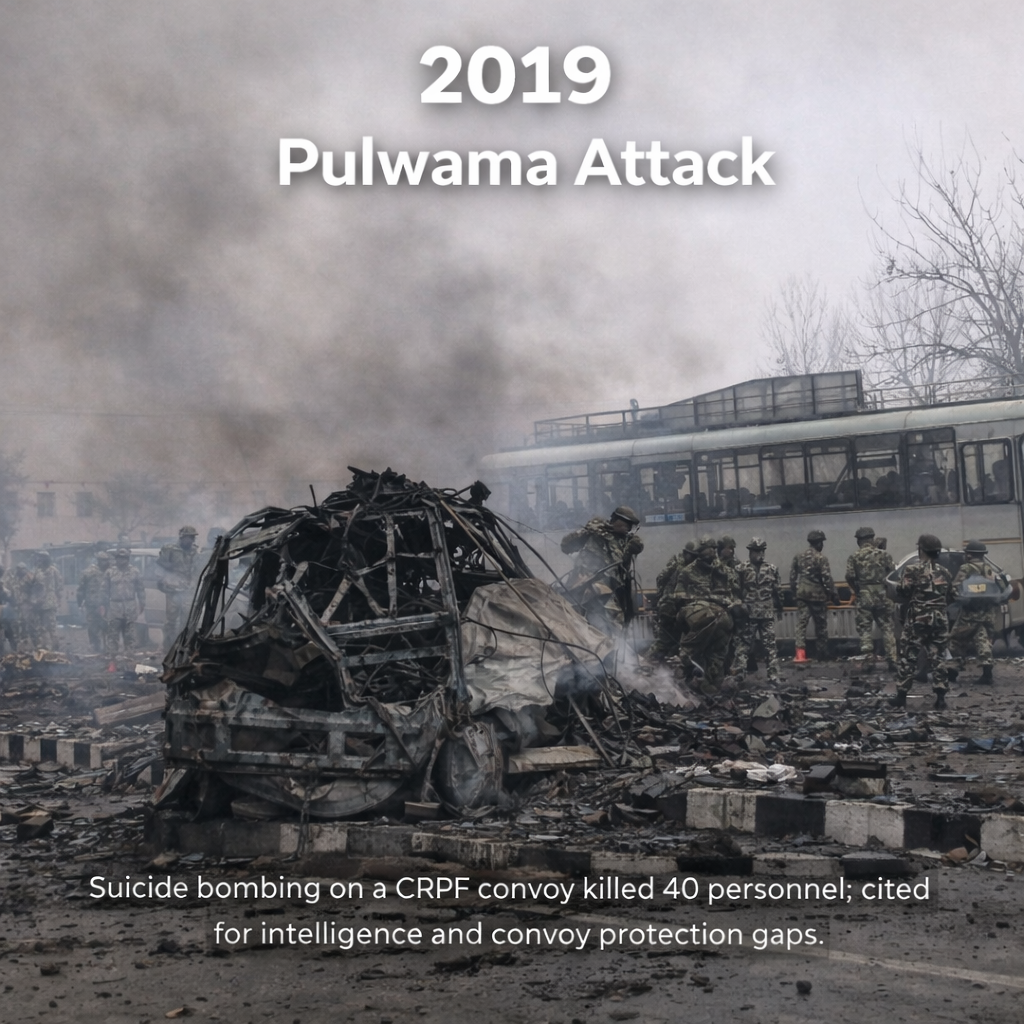
Major National Security Threat Incidents in India


OUR INITIATIVE
Helpful Foundation has initiated a Public Interest Litigation (PIL) before the Hon’ble Supreme Court of India to strengthen national security accountability, institutional transparency, and constitutional governance.
Support the PIL – Contribute Now
This initiative does not target any individual. It seeks systemic reform to ensure that preventable national security failures are addressed through lawful, transparent, and accountable mechanisms, in the larger public interest.
WHY IS THIS PIL NECESSARY
National security today extends beyond borders and warfare. It includes:
- Internal security and public safety
- Intelligence coordination and preventive action
- Cyber, economic, and financial threats
- Institutional preparedness and response systems
Repeated incidents across the country indicate gaps in accountability, coordination, and oversight, despite the presence of multiple security institutions.
Citizens bear the consequences of such gaps—through loss of life, liberty, economic stability, and trust in governance.
This PIL seeks to ensure that constitutional responsibility is matched with institutional accountability.
WHAT THE PIL SEEKS (CORE OBJECTIVES)
Through this Public Interest Litigation, Helpful Foundation prays for:
- A National Security Accountability Framework
- Independent review mechanisms for major security lapses
- Clear institutional responsibility (not individual blame)
- Periodic reporting and transparency in preparedness systems
- Protection of citizens’ fundamental rights under Articles 14 and 21
The objective is reform, not accusation.
WHY PUBLIC SUPPORT MATTERS
Public Interest Litigation of this nature requires:
- Extensive legal research and drafting
- Constitutional law expertise
- Court filing, compliance, and follow-up
- Data analysis and policy documentation
Unlike private litigation, PILs serve the public at large, but are funded privately.
Your support enables this constitutional effort to proceed independently, responsibly, and without external influence.
HOW LACK OF NATIONAL SECURITY ACCOUNTABILITY AFFECTS EVERY INDIAN CITIZEN
National security failures are not abstract institutional lapses.
They translate into real, irreversible harm to ordinary citizens.
When accountability mechanisms are weak or absent:
• Lives are lost due to preventable intelligence, coordination, or response failures
• Families are destroyed, with no clarity on who was responsible or what failed
• Citizens’ liberty is compromised through arbitrary restrictions imposed after crises
• Economic stability suffers as attacks and security failures disrupt trade, travel, and livelihoods
• Public trust erodes, weakening confidence in governance and institutions
• The same mistakes recur, because lessons are never institutionally enforced
Despite the presence of multiple security agencies, no single authority is legally answerable when coordination fails. Responsibility becomes diffused, inquiries remain internal, and outcomes are rarely disclosed.
For citizens, this means:
• No right to know whether failures were preventable
• No assurance that corrective reforms were implemented
• No legal framework to demand institutional accountability
• No protection against repetition of the same lapses
This vacuum places citizens in a position of risk without remedy.
WHY THIS IS A CONSTITUTIONAL ISSUE — NOT A POLICY DEBATE
The Indian Constitution guarantees:
Article 21 – The right to life, safety, and personal security
Article 14 – Protection against arbitrariness in State action
When national security governance operates without enforceable accountability, these rights are directly impacted.
Security without accountability creates unchecked discretion.
Unchecked discretion undermines the rule of law.
A constitutional democracy cannot rely solely on intent or secrecy—it must rely on law, structure, and responsibility.
WHAT THIS PIL SEEKS TO SECURE FOR CITIZENS
This Public Interest Litigation seeks to ensure that:
• Preventable security failures are lawfully reviewed
• Institutional lapses are identified, not buried
• Responsibility is clearly fixed at the system level
• Preparedness and response mechanisms are periodically assessed
• Citizens’ fundamental rights are protected, not incidentally compromised
The objective is reform, not accusation.
The focus is on institutions, not individuals.
WHY PUBLIC SUPPORT IS CRITICAL
Public Interest Litigations that protect constitutional governance:
• Serve the entire population, not a private litigant
• Require extensive constitutional research and drafting
• Involve long-term court compliance and follow-up
• Are privately funded, without state sponsorship
Without public support, such accountability-driven constitutional efforts cannot proceed independently.
Your support ensures that this initiative remains:
• Citizen-driven
• Constitutionally grounded
• Legally responsible
• Free from political or external influence
CROWDFUNDING FOR CONSTITUTIONAL CAUSE
This campaign is a transparent, citizen-supported legal initiative.
Funds will be used strictly for:
- Supreme Court drafting and filing expenses
- Advocate and legal research costs
- Documentation, affidavits, and compliance work
- Statutory and procedural expenses
No funds are used for political activity, protests, or media trials.
OUR COMMITMENT TO TRANSPARENCY
Helpful Foundation commits that:
- All donations are used only for lawful legal purposes
- Donors receive periodic updates on case progress
- No donor influences legal strategy or prayers
- Full compliance with Indian laws and regulations
This is a constitutional accountability initiative, not a campaign against any authority.
WHO CAN SUPPORT
- Concerned citizens
- Legal professionals
- Policy researchers
- Retired officials and experts
- Anyone who believes that security must come with accountability
Support is open to individuals from India and abroad, subject to applicable laws.
HOW YOU CAN CONTRIBUTE
Option 1: Financial Contribution
Support the PIL through lawful donations to sustain legal proceedings.
Option 2: Knowledge & Research Support
Experts may contribute policy insights, reports, or legal research material.
Option 3: Awareness Sharing
Share this initiative responsibly, without sensationalism.
IMPORTANT DISCLAIMER
- This initiative does not disclose classified information
- It does not interfere with ongoing operations
- It does not accuse or defame any individual or institution
- All content is published in good faith and in the public interest
OUR MESSAGE
“A strong nation is built not only on security, but on accountability, constitutional discipline, and public trust.”
Support Constitutional Accountability
Your contribution strengthens institutional transparency and the rule of law.
Together, let us ensure that national security governance remains responsible, accountable, and citizen-centric.
Support the PIL – Contribute Now
WHY YOUR DONATION MATTERS
Helpful Foundation is pursuing a Public Interest Litigation (PIL) before the Hon’ble Supreme Court of India to strengthen national security accountability, institutional transparency, and constitutional governance.
This initiative serves the public at large and seeks systemic reform, not personal or political outcomes.
Your contribution directly supports the legal process, research, and compliance required to responsibly pursue this constitutional matter.
HOW YOUR DONATION WILL BE USED
All contributions will be utilised strictly and exclusively for lawful purposes connected with the PIL, including:
- Supreme Court drafting and filing expenses
- Legal research and documentation
- Advocate fees and court compliance costs
- Affidavits, annexures, and procedural requirements
No funds are used for political activity, protests, lobbying, or media campaigns.
TAX BENEFIT UNDER SECTION 80G
Donations made to Helpful Foundation are eligible for tax deduction under Section 80G of the Income Tax Act, 1961, subject to applicable provisions.
✔ Donation receipt will be issued
✔ PAN details will be mentioned on the receipt
✔ Receipt will be shared via email after confirmation
Donors are advised to consult their tax advisor for applicability based on individual circumstances.
ELIGIBILITY & MODE OF DONATION
✔ Donations Accepted
- Indian citizens
- Donations in INR
- Online transfer (UPI / Net Banking / Bank Transfer)
❌ Donations Not Accepted
- Anonymous donations
- Cash donations beyond permissible limits
- Donations that violate Indian law or regulatory norms
OUR TRANSPARENCY COMMITMENT
Helpful Foundation ensures that:
- Donations are recorded and accounted for as per the law
- Funds are used only for stated charitable objectives
- Donors receive timely acknowledgement and updates
- Financial records are maintained for audit and compliance
This initiative is conducted in good faith, with full legal responsibility.
MAKE A DONATION
Support a Constitutional Cause
Your contribution helps uphold accountability, transparency, and the rule of law.
Donate Now (INR)
Every contribution—big or small—strengthens this public-interest effort.
FREQUENTLY ASKED QUESTIONS
Is my donation refundable?
No. Donations are voluntary and non-refundable.
Will my donation influence the case?
No. Legal strategy and prayers remain independent and court-driven.
Will my name be made public?
No donor details are disclosed without consent.
Can I donate from outside India?
Only if compliant with applicable Indian laws. Please contact us before contributing.
LEGAL DISCLAIMER
- This donation does not create any client-lawyer relationship
- Contribution does not confer any legal right in the PIL
- Helpful Foundation retains full discretion over the legal conduct of the matter
- All activities comply with Indian laws and Supreme Court guidelines
FINAL NOTE
“Supporting public interest litigation is not charity—it is an investment in constitutional governance.”
Thank you for standing with Helpful Foundation in strengthening accountability and public trust.
WHY NATIONAL SECURITY ACCOUNTABILITY IN INDIA REMAINS WEAK
(A Structural & Institutional Analysis)
1. NO STATUTORY NATIONAL SECURITY ACCOUNTABILITY LAW
India does not have a dedicated law that:
- Defines national security accountability
- Fixes responsibility after major security failures
- Mandates independent post-incident review
Most national security decisions are taken through executive instructions, not enforceable statutes.
As a result, accountability remains discretionary, not legal.
2. ABSENCE OF INDEPENDENT OVERSIGHT MECHANISM
Unlike several democracies:
- There is no independent national security oversight body
- No permanent review commission for intelligence or security failures
- No mandatory public or parliamentary disclosure framework
Post-incident reviews, where they occur, are:
- Internal
- Confidential
- Non-binding
This creates a closed accountability loop.
3. INTELLIGENCE AGENCIES OPERATE WITHOUT A STATUTORY FRAMEWORK
Key intelligence agencies operate:
- Without a comprehensive parliamentary statute
- Without defined legal duties or penalties for omission
- Without an external audit or review authority
This results in:
- Limited transparency
- No enforceable duty to act on threat inputs
- No institutional consequence for failure to prevent foreseeable threats
4. DIFFUSED RESPONSIBILITY ACROSS MULTIPLE AUTHORITIES
National security functions are spread across:
- Multiple intelligence and enforcement agencies
- Prime Minister’s Office
- National Security Council Secretariat
- Ministry of Home Affairs
- Ministry of Defence
However:
- There is no single accountable authority for the coordination failure
- Responsibility becomes fragmented, making failure attribution difficult
This diffusion weakens the enforceability of accountability.
5. PARLIAMENTARY OVERSIGHT IS LIMITED
While Parliament has oversight powers:
- There is no standing Parliamentary Committee with full access to the national security functioning
- Security matters are often exempt from detailed legislative scrutiny
- Confidentiality is frequently cited to limit accountability
This reduces democratic checks without compromising secrecy.
6. JUDICIAL REVIEW IS REACTIVE, NOT PREVENTIVE
Courts can intervene:
- After damage has occurred
- When fundamental rights are violated
However:
- There is no preventive judicial framework for national security governance
- Courts rely on executive disclosures, often in sealed covers
This limits proactive accountability.
7. NO MANDATORY POST-INCIDENT ACCOUNTABILITY PROCESS
In many governance failures, there is:
- No compulsory timeline for inquiry
- No fixed remedial action framework
- No published findings
As a result:
- Lessons are not institutionalised
- Similar lapses recur
8. LACK OF CITIZEN-CENTRIC ACCOUNTABILITY
Citizens affected by security failures often face:
- No clear grievance mechanism
- No access to the findings of inquiries
- No legal right to demand systemic reform
This weakens public trust and constitutional confidence.
9. OVER-RELIANCE ON EXECUTIVE DISCRETION
National security accountability in India largely depends on:
- Internal discipline
- Administrative instructions
- Political will
Without statutory backing, such discretion:
- Cannot be judicially enforced
- Varies across governments
- Lacks continuity and consistency
WHY THIS MATTERS CONSTITUTIONALLY
Weak accountability directly impacts:
- Article 21 – Right to life and security
- Article 14 – Protection against arbitrariness
- Doctrine of Public Trust – State power held for citizens
A strong security system requires strong accountability, not secrecy without responsibility.
PURPOSE OF THE SUPREME COURT PIL
Helpful Foundation’s PIL seeks to:
- Strengthen institutional accountability without compromising security
- Introduce statutory and oversight safeguards
- Ensure that preventable failures are lawfully reviewed
- Reinforce constitutional governance
This is a reform-oriented constitutional initiative, not an adversarial campaign.
🇮🇳INDIA VS USA
National Security Accountability — A Comparative Gap Analysis
WHY A COMPARISON MATTERS
Comparative constitutional analysis helps identify structural strengths and weaknesses in governance systems.
This comparison does not question national intent or capability, but examines accountability mechanisms within democratic frameworks.
1. STATUTORY FRAMEWORK
🇮🇳India
- No comprehensive national security accountability statute
- Intelligence agencies largely function without parliamentary legislation
- Accountability relies on executive instructions
🇺🇸United States
- A clear statutory framework governing national security institutions
- Intelligence agencies operate under enacted laws
- Defined legal duties and oversight obligations
Gap: India lacks enforceable statutory accountability.
2. LEGISLATIVE OVERSIGHT
🇮🇳India
- No dedicated Parliamentary committee with full national security oversight
- Limited access to intelligence functioning
- Oversight is largely informal or post-facto
🇺🇸United States
- Permanent Congressional Committees on Intelligence
- Mandatory classified briefings
- Budgetary and operational scrutiny
Gap: Weak legislative supervision in India.
3. INDEPENDENT OVERSIGHT & AUDIT
🇮🇳India
- No independent oversight authority for security failures
- Internal reviews are confidential and discretionary
🇺🇸United States
- Inspectors General within security agencies
- Statutorily mandated audits and reports
- Independent review commissions after major failures
Gap: Absence of independent audit mechanisms in India.
4. POST-INCIDENT ACCOUNTABILITY
🇮🇳India
- No mandatory inquiry framework
- Findings rarely published
- No fixed responsibility matrix
🇺🇸United States
- Mandatory post-incident reviews
- Findings shared with Congress
- Institutional reforms follow inquiries
Gap: Lack of structured consequence management in India.
5. INTELLIGENCE GOVERNANCE
🇮🇳India
- Agencies not governed by comprehensive parliamentary law
- No defined statutory duties to act on intelligence inputs
🇺🇸United States
- The intelligence community is governed by federal statutes
- DNI ensures coordination and accountability
Gap: India lacks codified intelligence governance.
6. JUDICIAL OVERSIGHT
🇮🇳India
- Strong PIL jurisdiction, but reactive
- Reliance on sealed covers
- Limited preventive supervision
🇺🇸United States
- Specialised courts (e.g., FISA Court)
- Regular judicial oversight of intelligence activities
Gap: Limited structured judicial oversight in India.
7. TRANSPARENCY & REPORTING
🇮🇳India
- No statutory reporting obligation to Parliament
- Limited public disclosure
🇺🇸United States
- Annual threat assessments
- Declassified summaries
- Congressional reporting obligations
Gap: Minimal transparency norms in India.
8. FIXING RESPONSIBILITY
🇮🇳India
- Institutional failures often go unassigned
- Responsibility diffused across agencies
🇺🇸United States
- Clear departmental accountability
- Agency heads answer to Congress
Gap: Lack of consequence-oriented accountability in India.
9. CITIZEN PARTICIPATION & TRUST
🇮🇳India
- Citizens have no formal mechanism to demand accountability
- Reliance on litigation for redress
🇺🇸United States
- Public reporting and oversight improve trust
- Legal avenues supported by statutory disclosures
Gap: Weak citizen-centric accountability in India.
COMPARATIVE SUMMARY TABLE
| Parameter | 🇮🇳India | 🇺🇸USA |
|---|---|---|
| Accountability Law | ❌ None | ✔ Yes |
| Intelligence Statute | ❌ Limited | ✔ Comprehensive |
| Legislative Oversight | ❌ Weak | ✔ Strong |
| Independent Audit | ❌ Absent | ✔ Mandatory |
| Post-Incident Review | ❌ Discretionary | ✔ Compulsory |
| Judicial Supervision | ✔ Reactive | ✔ Structured |
| Transparency | ❌ Limited | ✔ Periodic |
| Responsibility Fixation | ❌ Diffused | ✔ Defined |
🇮🇳 India vs 🇬🇧 United Kingdom — Comparative Summary Table
| Parameter | 🇮🇳India | 🇬🇧United Kingdom |
|---|---|---|
| Accountability Law | ❌ No comprehensive intelligence accountability statute | ✔ Yes – Intelligence Services Act, Investigatory Powers Act |
| Intelligence Statute | ❌ Limited & fragmented (IB/RAW function via executive orders) | ✔ Comprehensive statutory framework governing MI5, MI6, GCHQ |
| Legislative Oversight | ❌ Weak (no permanent Parliamentary Intelligence Committee) | ✔ Strong – Intelligence and Security Committee of Parliament (ISC) |
| Independent Audit | ❌ Absent (no external statutory audit mechanism) | ✔ Mandatory – Independent Commissioners & Investigatory Powers Commissioner |
| Post-Incident Review | ❌ Discretionary, executive-controlled | ✔ Compulsory – statutory inquiries & commissioner reviews |
| Judicial Supervision | ✔ Reactive (courts intervene post-violation) | ✔ Structured & proactive – Judicial Commissioners authorize surveillance |
| Transparency | ❌ Limited (RTI exclusions; classified functioning) | ✔ Periodic & institutional – public ISC and IPCO reports |
| Responsibility Fixation | ❌ Diffused (no clear statutory liability chain) | ✔ Defined – agency heads, ministers, and commissioners accountable |
Comparative National Security Accountability
🇮🇳India vs 🇮🇱Israel
| Parameter | 🇮🇳India | 🇮🇱Israel |
|---|---|---|
| Dedicated National Security Accountability Law | ❌ No comprehensive statute | ✔ Yes (security & oversight laws) |
| Mandatory Post-Attack Inquiry | ❌ Not compulsory | ✔ Mandatory after major failures |
| Independent Review Commission | ❌ Ad-hoc / executive controlled | ✔ Statutory & independent |
| Legislative Oversight on Intelligence Agencies | ❌ Limited & opaque | ✔ Strong Knesset oversight |
| Fixation of Institutional Responsibility | ❌ Diffused / unclear | ✔ Clearly identified institutions |
| Time-Bound Public Reporting | ❌ Not mandated | ✔ Defined timelines |
| Judicial Oversight | ✔ Reactive (case-specific) | ✔ Structured & continuous |
| Transparency to Citizens | ❌ Minimal disclosures | ✔ Public summaries released |
| Accountability for Intelligence Failure | ❌ Rare / non-systemic | ✔ Routine & documented |
| Victim-Centric Redress & Recognition | ❌ Limited | ✔ Institutionalized |
| Implementation of “Lessons Learnt” | ❌ No tracking mechanism | ✔ Mandatory follow-up reviews |
CONSTITUTIONAL IMPLICATION FOR INDIA
Weak accountability affects:
- Article 21 — Right to life and security
- Article 14 — Protection against arbitrariness
- Rule of Law — No authority without responsibility
The goal is not imitation, but adaptation of best practices within India’s constitutional framework.
HOW THE SUPREME COURT PIL ADDRESSES THIS GAP
Helpful Foundation’s PIL seeks:
- A statutory accountability framework
- Independent oversight compatible with national security
- Clear institutional responsibility
- Strengthened parliamentary and judicial checks
KEY MESSAGE
“National security is strongest where power is balanced with accountability.”
FREQUENTLY ASKED QUESTIONS
Is This Initiative Anti-Government or Anti-Security?
Q1. Is Helpful Foundation’s PIL anti-government?
No.
This initiative is not against the Government, any ministry, or any individual office-holder.
The PIL is directed at strengthening constitutional governance, not opposing the executive. It seeks systemic reform, not personal accountability or political outcomes.
Courts have consistently held that constructive judicial review strengthens democracy, not weakens it.
Q2. Is this initiative anti-national or anti-security?
Absolutely not.
The PIL is founded on the principle that national security becomes stronger—not weaker—when accountability is clear, lawful, and institutionalised.
Security without accountability risks:
- Repetition of preventable failures
- Loss of public trust
- Arbitrary decision-making
Accountability ensures preparedness, coordination, and credibility.
Q3. Does this PIL interfere with security operations?
No.
The PIL:
- Does not seek disclosure of classified information
- Does not interfere with ongoing operations
- Does not question tactical or field-level decisions
All prayers are policy-oriented and forward-looking, respecting operational confidentiality.
Q4. Does this PIL accuse any individual or officer?
No.
The PIL:
- Names no individual
- Seeks institutional accountability, not personal blame
- Avoids criminal allegations or disciplinary demands
It focuses on frameworks, systems, and governance structures.
Q5. Why approach the Supreme Court instead of the Government?
The Supreme Court is the constitutional guardian of fundamental rights.
Where:
- Issues affect citizens nationwide
- Multiple institutions are involved
- Constitutional standards require clarification
Approaching the Court is lawful, appropriate, and democratic.
Q6. Is this a political or activist campaign?
No.
This is:
- A legal and constitutional initiative
- Conducted through court proceedings
- Governed by judicial scrutiny and legal ethics
There are no political affiliations, slogans, or agendas involved.
Q7. Could accountability harm national security?
On the contrary.
Global experience shows that:
- Clear accountability improves coordination
- Independent oversight reduces institutional blind spots
- Transparent review strengthens deterrence and preparedness
Security and accountability are complementary, not conflicting.
Q8. Why should citizens support this initiative?
Because:
- National security impacts every citizen’s life and liberty
- Accountability protects both institutions and people
- Strong governance builds long-term national resilience
Public support ensures the PIL remains independent, responsible, and citizen-driven.
Q9. Will donors or supporters influence the case?
No.
- Donations do not confer legal rights
- Legal strategy remains independent
- The Court determines outcomes, not contributors
This maintains the integrity of the process.
Q10. What is the core message of this initiative?
“This initiative seeks to strengthen national security by reinforcing accountability, constitutional discipline, and public trust—without compromising secrecy or sovereignty.”