
India’s Monetary Economic System Explained (2026): Currency Circulation, Bank Write-offs & Economic Risks. RBI
By Helpful Foundation | Public Interest Research | Updated 2026
🔍 Introduction
India’s monetary system is a critical pillar of its economic stability. However, recent data from the Reserve Bank of India reveals important structural trends that deserve public attention.
RBI – With currency circulation crossing ₹41 lakh crore, gold reserves covering only a small fraction, and bank write-offs nearing ₹20 lakh crore, questions arise about:
- Monetary stability
- Public fund efficiency
- Economic risk exposure
This article provides a clear, data-driven, and legally grounded explanation of India’s monetary system in 2026.
📊 Key Highlights (Quick Summary)
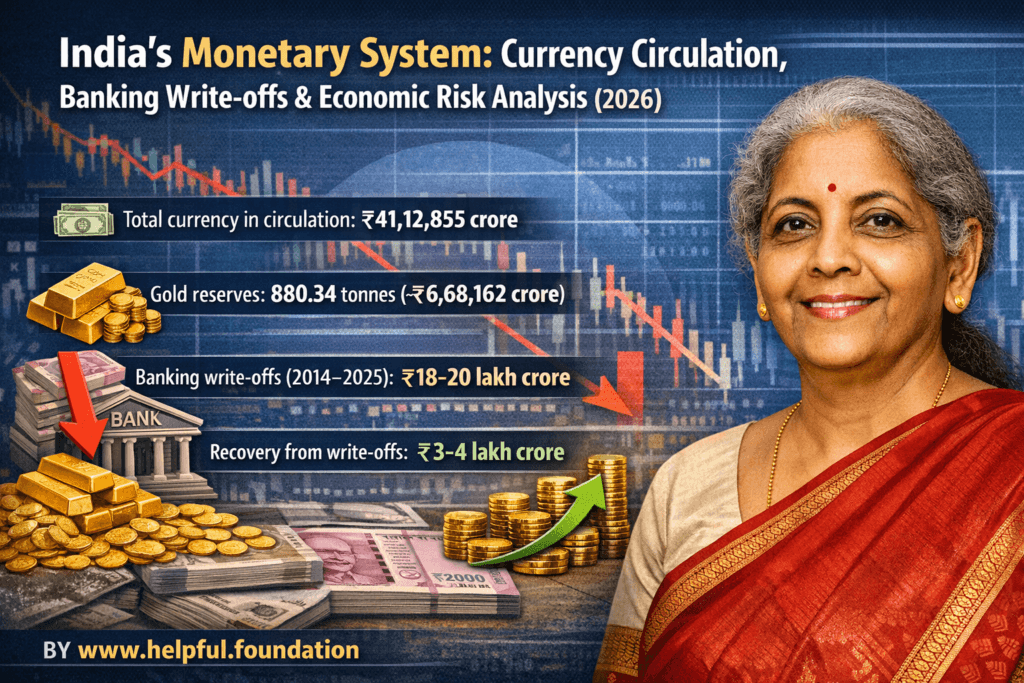
- 💰 Currency in circulation: ₹41,12,855 crore
- 🪙 Gold reserves: 880.34 tonnes (~₹6.68 lakh crore)
- 🏦 Bank write-offs (2014–2025): ₹18–20 lakh crore
- 🔁 Recovery rate: 15–20% only
👉 Core Insight:
India operates a fiat-based, cash-heavy economy with limited asset backing and low recovery efficiency.
💡 What is India’s Monetary System?
India follows a fiat currency system governed by the Reserve Bank of India Act, 1934.
✔️ What does “Fiat Currency” mean?
- Money is not backed by gold or physical assets
- Value depends on:
- Government authority
- Public trust
- Economic performance
👉 In simple terms:
The system works because people believe in it and accept it.
💰 Currency Circulation in India: Why is it So High?
India’s total currency circulation has reached ₹41 lakh crore, with ₹500 notes forming nearly 85% of total value.
📌 What does this indicate?
- Strong reliance on cash transactions
- Slower shift toward digital payments
- Significant money outside banking channels
⚠️ Why it matters:
High cash circulation can:
- Reduce financial transparency
- Encourage informal transactions
- Limit policy effectiveness
🪙 Gold Reserves vs Currency: A Critical Gap
India holds approximately ₹6.68 lakh crore worth of gold reserves.
📊 Comparison:
- Currency: ₹41 lakh crore
- Gold: ₹6.68 lakh crore
👉 Coverage Ratio: ~16%
📌 Key Insight:
- Majority of money is not asset-backed
- Stability depends on:
- Economic growth
- Government credibility
- Monetary discipline
🏦 Bank Write-offs in India: Where Did the Money Go?
Between 2014 and 2025, Indian banks wrote off approximately ₹18–20 lakh crore in loans.
🔁 Recovery Status:
- Only 15–20% recovered
📌 What does “write-off” mean?
- Loans removed from balance sheets
- Recovery efforts may continue
- But chances of full recovery are low
⚠️ Concern:
- Large portion of public money remains unrecovered
- Raises questions about:
- Lending practices
- Enforcement efficiency
- Financial accountability
📉 Economic Impact: Why You Should Care
🔹 1. Inflation Risk
More money in circulation can lead to:
- Higher demand
- Rising prices
👉 Result: Inflation
🔹 2. Loss of Purchasing Power
- Same income buys fewer goods
- Cost of living increases
🔹 3. Weak Monetary Control
When cash stays outside banks:
- RBI policies become less effective
- Interest rate changes have limited impact
🔹 4. Investment Impact
Economic imbalance may:
- Reduce investor confidence
- Affect long-term growth
📊 Cash Economy vs Digital Economy
| Factor | Cash Economy | Digital Economy |
|---|---|---|
| Transparency | Low | High |
| Tracking | Difficult | Easy |
| Tax Compliance | Lower | Higher |
📌 Conclusion:
A cash-heavy system can:
- Encourage unreported transactions
- Reduce tax efficiency
- Expand the informal economy
⚖️ Legal Perspective: Is This System Valid?
Under the Reserve Bank of India Act, 1934:
- Currency issuance is fully legal
- No requirement of gold backing exists
📌 Legal Insight:
While legally valid, excessive currency expansion may indirectly affect:
- Public interest
- Economic balance
- Financial fairness
🚨 Economic Risks in India’s Monetary System
🔴 Key Risk Factors:
- High cash circulation
- Low recovery of bank loans
- Limited transparency
⚠️ Combined Impact:
- Monetary instability risk
- Fiscal inefficiency
- Public trust concerns
🌍 Global Comparison: Is India in Danger?
India is not in crisis, unlike countries such as Venezuela, which have experienced hyperinflation.
✔️ India’s Strengths:
- Strong institutions
- Controlled inflation (relative)
- Stable governance structure
⚠️ However:
- Structural risks exist
- Continuous monitoring is essential
📊 Structural Imbalance Explained
India’s financial system shows a three-part imbalance:
| Component | Status |
|---|---|
| Currency Circulation | Very High |
| Gold Backing | Low |
| Recovery Efficiency | Weak |
👉 This combination indicates systemic stress, not immediate crisis.
ECONOMIC SECURITY ASSESSMENT REPORT 2026
✅ Final Conclusion
India’s monetary system remains stable but structurally challenged.
🔴 Key Takeaway:
High currency circulation + limited asset backing + low recovery efficiency
= Long-term economic risk if not managed properly
📢 About Helpful Foundation
Helpful Foundation is dedicated to:
Advocating public interest issues
Promoting legal awareness
Supporting RTI and transparency initiatives