
Babuk Ransomware Group & “Babuk Locker 2.0” Copycat Activity
Hacker / APT Research & Analysis Report
Subject: Babuk Ransomware Group & “Babuk Locker 2.0” Copycat Activity
Classification: UNCLASSIFIED//FOR OFFICIAL USE ONLY
Report Date: 21 May 2026
Analyst: Digital Intelligence Support Unit
Distribution: CERT-In, National Cyber Coordination Centre, Sectoral CERTs, Critical Infrastructure Operators
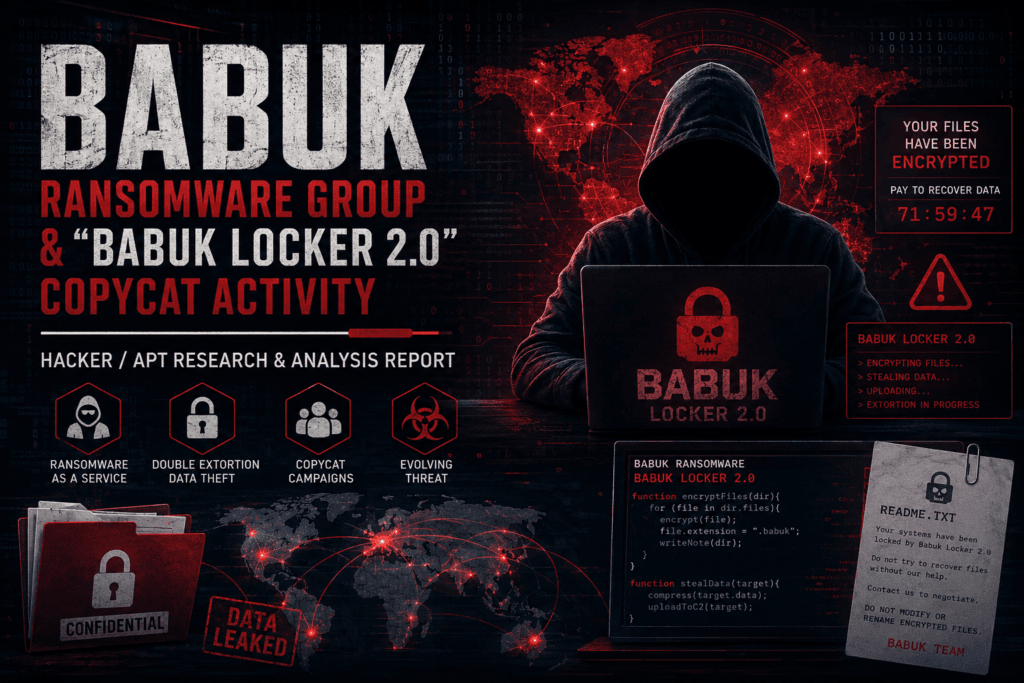
Babuk is a Russian-speaking cybercrime group that emerged in early 2021, known for operating a Ransomware-as-a-Service (RaaS) model. The group quickly gained notoriety for its “double extortion” tactics—encrypting victims’ files while also stealing sensitive data and threatening to leak it if ransom demands aren’t met.
Notable Attacks
Washington D.C. Metropolitan Police Department (April 2021)
- Babuk claimed to have stolen 250 GB of sensitive data, including informant details and officer information
- This high-profile attack triggered intense law enforcement pressure and reportedly caused internal conflict within the group
1. Executive Summary
| Component | Assessment |
|---|---|
| Threat Overview | Babuk is a financially-motivated cybercrime group (not state-sponsored) that operated a Ransomware-as-a-Service (RaaS) model in 2021. The original group dissolved after a source code leak; “Babuk 2.0” claims in 2025 represent copycat activity using recycled data and rebranded malware. |
| Key Findings | • Original Babuk: Russian-speaking criminal group, active Jan–Sept 2021 • “Babuk Locker 2.0” (2025): Likely operated by aliases “Skywave”/”Bjorka”; technical analysis shows samples are actually LockBit 3.0/Black • India/DRDO claims (Mar 2025): Unverified; leaked data may originate from personal device of former official, not DRDO core systems |
| Risk Assessment | Current Threat Level: MODERATE • Original Babuk code enables derivative variants (Termite, Rook, Delta Plus) • Copycat groups exploit Babuk’s reputation for credibility • Double-extortion tactics remain high-impact for data-rich targets |
| Operational Significance | Leaked source code (Sept 2021) created persistent threat ecosystem; copycats complicate attribution and response |
| Strategic Impact | Undermines trust in breach claims; requires enhanced verification protocols for incident response teams |
2. Threat Actor Profile
| Field | Details |
|---|---|
| Primary Alias | Babuk (aka Babak, Babyk, Vasa Locker) |
| Known Aliases | Fancy Gang, Baby, Babuk-Bjorka (2025 copycat) |
| Origin Country | Russian-speaking operators; recruitment via Russian/English underground forums |
| Sponsoring Entity | ❌ None identified – financially motivated criminal enterprise, not state-sponsored |
| Active Since | Original: Jan 2021 – Sept 2021; Copycats: Jan 2025 – present (unverified continuity) |
| Threat Category | Cybercrime / Ransomware-as-a-Service (RaaS) |
| Motivation | Financial gain via ransom payments and data extortion |
| Operational Objectives | • Encrypt victim data for ransom • Exfiltrate sensitive data for “non-leak” payments • Recruit affiliates via RaaS profit-sharing model |
3. Attribution Analysis
| Assessment Area | Confidence | Basis |
|---|---|---|
| Original Babuk (2021) | HIGH | Consistent TTPs, ransom note patterns, forum activity, law enforcement reporting |
| “Babuk 2.0” (2025) | LOW | • Samples advertised as “Babuk” are LockBit 3.0/Black • Victim lists overlap with unrelated groups (Cl0p, KillSec) • Communication in Indonesian suggests non-Russian operators |
| India/DRDO Claim | VERY LOW | • DRDO denies system breach • Data likely from personal device of former official • No technical evidence of network intrusion |
| Infrastructure Overlap | MODERATE | Leaked Babuk code reused by ≥10 variant families; shared encryption routines |
| Malware Similarities | HIGH (for variants) | Babuk-derived strains share ChaCha8/ECDH encryption, process termination lists |
| Public/Private Assessments | CONSISTENT | Multiple security firms characterize “Babuk 2.0” as copycat activity |
4. Funding & Sponsorship Analysis
| Indicator | Assessment |
|---|---|
| State Sponsorship | ❌ No credible evidence of state direction or funding. Indictments target individuals for criminal activity, not state affiliation |
| Financial Backing | Self-funded via ransom proceeds; RaaS model enables low-barrier affiliate recruitment |
| Resource Assessment | • Core developers (original): Small, skilled team • Affiliates: Variable skill; leveraged leaked code post-2021 • Copycats (2025): Likely low-resource actors reusing existing tools |
| Infrastructure Procurement | Bulletproof hosting, compromised VPS, domain generation algorithms; typical of cybercrime groups |
| Cryptocurrency Usage | • Primary: Monero (XMR) for ransom payments • Secondary: Bitcoin (BTC) with chain-hopping/mixers for laundering |
| Shell/Front Organizations | None identified; operates via anonymous forums and encrypted channels |
| Operational Logistics | Affiliate onboarding via invite-only forums; negotiation handled by dedicated “support” channels |
5. Associated Groups & Alliances
| Relationship | Details |
|---|---|
| Linked APT Groups | ❌ None verified. Babuk is criminal, not APT. Post-leak variants used by diverse actors |
| Shared Tooling | • Leaked Babuk source code spawned ≥10 variants: Termite, Rook, Delta Plus, etc. • “Babuk 2.0” samples actually LockBit 3.0 |
| Joint Campaigns | No evidence of coordinated campaigns with other groups |
| Operational Overlaps | Victim overlap between “Babuk 2.0” and other ransomware groups suggests recycled breach data, not collaboration |
| Ecosystem Mapping | Babuk code leak → derivative ransomware families → ongoing criminal exploitation |
| Contractor Relationships | Affiliate model: Operators provide malware; affiliates conduct attacks for ~70-80% of ransom proceeds |
6. Organizational Structure
ORIGINAL BABUK (2021) – DEFUNCT
├── Core Developers (2-4 individuals)
│ ├── Malware development
│ ├── Infrastructure management
│ └── Affiliate vetting
├── Affiliate Managers
│ ├── Recruitment (Russian forums)
│ ├── Technical support
│ └── Profit distribution
├── Negotiation Team
│ ├── Victim communication
│ └── Payment coordination
└── Money Laundering Cell
├── Cryptocurrency mixing
└── Fiat conversion
“BABUK 2.0” (2025) – COPYCAT STRUCTURE (UNVERIFIED)
├── Alias “Skywave” – Telegram channel operator
├── Alias “Bjorka” – Content amplification, Indonesian-language comms
├── Rebranded LockBit 3.0 samples
└── Recycled victim data from other breaches
7. Strategic Objectives
| Objective | Relevance to Babuk |
|---|---|
| Espionage | ❌ Not applicable – financially motivated, not intelligence-driven |
| Surveillance | ❌ No evidence of persistent surveillance capabilities |
| Economic Intelligence | ⚠️ Indirect: Targets high-value data for extortion value, not strategic intelligence |
| Political Influence | ❌ No evidence of politically motivated targeting |
| Military Intelligence | ❌ Claims against DRDO/Indian military unverified; likely opportunistic branding |
| Critical Infrastructure Targeting | ✅ Yes: Transportation, manufacturing, healthcare targeted for high ransom potential |
8. Target Analysis
| Target Category | Examples | Verification Status |
|---|---|---|
| Industries Targeted | Transportation, Manufacturing, Healthcare, Electronics, Agriculture | ✅ Verified (2021) |
| Geographic Focus | Global; no regional restriction. High-value targets in North America, Europe, Asia | ✅ Verified |
| Government Targets | Washington D.C. Metropolitan Police Department (Apr 2021) | ✅ Verified |
| Telecom Targets | Claims against India DoT (2025) | ⚠️ Unverified; no technical evidence |
| Defense Sector | Claims against DRDO/Indian military (Mar 2025) | ⚠️ Unverified; data likely from personal device |
| Enterprises | Houston Rockets (NBA), PDI Group (defense contractor) | ✅ Verified (2021) |
| Individuals of Interest | Former officials (via personal device compromise) | ⚠️ Plausible but not Babuk-specific tactic |
9. Attack Methodology (TTP Analysis) – MITRE ATT&CK Mapping
| Tactic | Technique ID | Technique Name | Babuk Implementation |
|---|---|---|---|
| Initial Access | T1566.001 | Phishing: Spearphishing Attachment | Malicious email attachments |
| T1190 | Exploit Public-Facing Application | Unpatched software vulnerabilities | |
| T1110.001 | Brute Force: Password Guessing | Weak RDP credentials | |
| Execution | T1059.003 | Command and Scripting Interpreter: Windows Command Shell | CLI-based lateral movement |
| Persistence | T1547.001 | Boot or Logon Autostart Execution: Registry Run Keys | Limited use; focus on rapid encryption |
| Privilege Escalation | T1068 | Exploitation for Privilege Escalation | Exploits known CVEs |
| Defense Evasion | T1685 | Disable or Modify Tools | Terminates AV/EDR processes pre-encryption |
| T1490 | Inhibit System Recovery | vssadmin.exe delete shadows /all /quiet | |
| T1027.002 | Obfuscated Files: Software Packing | XOR packing, API hashing | |
| Credential Access | T1003.001 | OS Credential Dumping: LSASS Memory | Limited evidence; not primary focus |
| Discovery | T1083 | File and Directory Discovery | Enumerates files for encryption |
| T1135 | Network Share Discovery | Maps network resources via WNet APIs | |
| Lateral Movement | T1021.002 | Remote Services: SMB/Windows Admin Shares | Command-line propagation |
| Collection | T1005 | Data from Local System | Exfiltrates sensitive documents pre-encryption |
| Exfiltration | T1041 | Exfiltration Over C2 Channel | Staged data transfer before encryption |
| Command & Control | T1071.001 | Application Layer Protocol: Web Protocols | HTTPS-based C2 communications |
| Impact | T1486 | Data Encrypted for Impact | ChaCha8 + ECDH encryption; .babuk/.babyk extensions |
10. Malware & Toolset Analysis
| Component | Details |
|---|---|
| Malware Families | • Babuk (original) • Derivatives: Termite, Rook, Delta Plus, Cactus (partial code reuse) • “Babuk 2.0” samples: Actually LockBit 3.0/Black |
| Loaders | Custom dropper; XOR-packed executable |
| RATs | None identified; Babuk is ransomware-focused |
| Web Shells | Not associated with Babuk operations |
| Exploits | Leverages known vulnerabilities (e.g., ProxyLogon, PrintNightmare) for initial access |
| Custom Utilities | • Process terminator list • Volume enumeration tool • Ransom note generator |
| Encryption Mechanisms | • Symmetric: ChaCha8 for file encryption • Asymmetric: ECDH for key exchange • Unique per-victim keys; no master key recovery |
| Obfuscation Methods | • XOR packing (key: variable) • API name hashing • String encryption • Anti-debugging checks |
11. Infrastructure Analysis
| Component | Observations |
|---|---|
| Domains | DLS: 7dikawx73goypgfi4zyo5fcajxwb7agemmiwqax3p54aey4dwobcvcyd.onion (Babuk 2.0) |
| IP Addresses | Dynamic; bulletproof hosting providers; frequent rotation |
| ASN Information | Mixed; includes compromised legitimate VPS providers |
| Hosting Providers | Bulletproof hosts in Eastern Europe, Asia; compromised cloud instances |
| SSL Certificates | Self-signed or Let’s Encrypt; short validity periods |
| DNS Patterns | DGA-like subdomains; fast-flux techniques observed in variants |
| VPS Infrastructure | Compromised or fraudulently procured Linux/Windows VPS |
| Proxy Networks | TOR, I2P for C2; residential proxies for exfiltration |
| Operational Servers | Leak sites hosted on TOR; C2 via HTTPS with domain fronting |
12. Operational Capability Assessment
| Capability | Assessment | Rationale |
|---|---|---|
| Persistence | MODERATE | Original group defunct; code leak enables persistent variant threat |
| Stealth | MODERATE-HIGH | Process termination, packing, API obfuscation; but detectable via behavioral EDR |
| Zero-day Usage | LOW | Relies on known vulnerabilities; no confirmed zero-day exploitation |
| Supply Chain Attacks | LOW | No evidence of supply chain compromise tactics |
| Telecom Exploitation | MODERATE | Claims against telecoms unverified; technical capability exists via standard TTPs |
| Lateral Movement | HIGH | Efficient CLI-based propagation; network share enumeration |
| Data Exfiltration | HIGH | Double-extortion model requires reliable exfiltration pre-encryption |
| Attribution Resistance | HIGH (for copycats) | Rebranding, recycled data, multi-alias operations complicate tracking |
13. Campaign Timeline
| Date | Activity | Verification |
|---|---|---|
| Jan 2021 | First Babuk ransomware samples observed | ✅ Verified |
| Apr 2021 | Washington D.C. Police Department attack; 250 GB data claim | ✅ Verified |
| Sept 2021 | Source code leaked on Russian hacking forum; group dissolves | ✅ Verified |
| 2022-2024 | Babuk-derived variants emerge (Termite, Rook, Delta Plus) | ✅ Verified |
| Jan 2025 | “Babuk Locker 2.0” appears on Telegram/Dark web | ⚠️ Copycat activity |
| Mar 2025 | Claims against DRDO/Indian military (20 TB data) | ⚠️ Unverified; likely exaggerated |
| Apr 2025 | Technical analysis confirms “Babuk 2.0” samples are LockBit 3.0 | ✅ Verified |
14. Indicators of Compromise (IOCs)
⚠️ CAUTION: Original Babuk IOCs have low reliability due to source code leak. Use behavioral detection over static IOCs.
File Hashes (Original Babuk – For Historical Reference Only)
SHA256: [Consult official threat intelligence feeds for current list]
“Babuk 2.0” Copycat IOCs (LockBit 3.0 Samples)
SHA256: 3facc153ed82a72695ee2718084db91f85e2560407899e1c7f6938fd4ea011e9
SHA256: bdc482583a330a4682d13bfb7a0cf75b2fa350ac536064bce7b2bdd9d875de4a
Network Indicators
TOR DLS: 7dikawx73goypgfi4zyo5fcajxwb7agemmiwqax3p54aey4dwobcvcyd.onion
Telegram: @OfficialBabukLocker, @BabukLockerRaasSHA1
Tox ID: 022A7EEB83B648F55DA7A6BEFD130C2156C74F3501A31D853234EC2D18E77A1E5BEC7F60201
Behavioral IOCs (High-Value)
- Process termination list: sql.exe, oracle.exe, vss.exe, sophos.exe, veeam.exe
- Command: vssadmin.exe delete shadows /all /quiet
- File extension: .babuk, .babyk, .doydo (original); .lockbit (copycat)
- Ransom note: “Help Restore Your Files.txt” (original); “README.txt” (LockBit-based)
YARA Rule Snippet (Babuk Detection)
rule Babuk_Ransomware_Generic {
meta:
description = “Detects Babuk ransomware patterns”
author = “Digital Intelligence Support”
strings:
$enc_header = { 0x42 0x61 0x62 0x75 0x6B } // “Babuk” header
$xor_key = { 0x48 0x03 0xBF 0xC7 } // XOR key (also in LockBit)
$vss_cmd = “vssadmin.exe delete shadows”
condition:
uint16(0) == 0x5A4D and
(all of them)
}
15. Technical Deep-Dive
Malware Execution Flow
- Dropper executes → XOR unpacks payload in memory
- Checks for debugger/VM → terminates if detected
- Terminates predefined processes/services (AV, DB, backup)
- Deletes shadow copies via vssadmin
- Enumerates local/network drives via WNet APIs
- Generates unique AES-256 key per file; encrypts with ChaCha8
- Encrypts AES key with ECDH public key
- Appends extension (.babuk); drops ransom note
- Exfiltrates selected documents pre-encryption (double extortion)
- Initiates C2 beacon for victim identification
- Limited registry modifications; focus on rapid encryption over persistence
- Some variants use scheduled tasks for re-infection attempts
Registry Modifications
HKCU\Software\Microsoft\Windows\CurrentVersion\Run
→ Rarely used; not primary persistence vector
PowerShell Usage
- Minimal; Babuk prefers native Windows APIs and command-line tools
- Copycat variants may leverage PowerShell for lateral movement
Network Traffic Analysis
- C2 over HTTPS with domain fronting
- Exfiltration staged in chunks to avoid DLP triggers
- TOR used for leak site access; not typically for C2
Data Exfiltration Methods
- Pre-encryption collection of high-value documents (.doc, .pdf, .xls)
- Compression and encryption before transfer
- Staged upload to attacker-controlled infrastructure
16. Victimology Analysis
| Dimension | Assessment |
|---|---|
| Victim Sectors | Transportation, Manufacturing, Healthcare, Government, Professional Services |
| Regional Targeting | Global; no geographic restriction. High-value targets prioritized |
| High-Value Entities | Law enforcement (DC Metro PD), sports franchises (Houston Rockets), defense contractors |
| Attack Frequency | Original group: ~20 verified victims in 2021; Copycats: 100+ claimed victims in Q1 2025 (many unverified) |
| Intelligence Priorities | Data with extortion value: PII, financial records, operational documents, intellectual property |
17. Operational Security (OPSEC) Assessment
| OPSEC Measure | Implementation |
|---|---|
| Infrastructure Rotation | High: Frequent domain/IP changes; bulletproof hosting |
| Anti-Forensics | Process termination, log deletion, timestamp manipulation |
| Obfuscation | XOR packing, API hashing, string encryption |
| Sandbox Evasion | Debugger checks, delayed execution, environment fingerprinting |
| Traffic Masking | HTTPS C2, TOR for leak sites, residential proxies |
| Attribution Resistance | Multi-alias operations (Skywave/Bjorka); rebranding of existing malware; recycled victim data |
18. Impact Assessment
| Impact Domain | Assessment |
|---|---|
| National Security Implications | LOW for original Babuk; MODERATE for copycats exploiting Babuk’s reputation to target defense entities (claims unverified) |
| Data Compromise Risks | HIGH for double-extortion: Encrypted data + exfiltrated documents create dual leverage |
| Economic Impact | HIGH: Ransom demands range $100K–$5M+; downtime costs exceed ransom in many cases |
| Surveillance Capability | LOW: Babuk not designed for persistent surveillance; focus on rapid monetization |
| Critical Infrastructure Risks | MODERATE-HIGH: Targeting of transportation, energy, healthcare creates cascading disruption potential |
| Long-term Operational Effects | HIGH: Leaked source code ensures persistent threat via derivative variants; copycats complicate threat intelligence |
19. Defensive Recommendations
Strategic Defense
- Zero Trust Architecture: Implement strict identity verification; assume breach
- Network Segmentation: Isolate critical systems; limit lateral movement paths
- Threat Hunting: Proactively search for Babuk-derived TTPs (process termination, VSS deletion)
- Incident Response Playbooks: Develop specific procedures for ransomware with double-extortion
Technical Defense
- EDR Deployment: Ensure behavioral detection for process termination, encryption activity
- SIEM Monitoring: Alert on
vssadmin.exe delete shadows, suspicious PowerShell, mass file modifications - MFA Enforcement: Mandatory for all remote access (RDP, VPN, cloud consoles)
- Patch Management: Prioritize vulnerabilities exploited by ransomware (ProxyLogon, PrintNightmare, etc.)
- DNS Filtering: Block known malicious domains; monitor for DGA patterns
- IOC Blocking: Update firewalls/IDS with current Babuk-derived IOCs via official threat feeds
Detection Engineering
Sigma Rule: Babuk-Style VSS Deletion Attempt
title: Babuk Ransomware Shadow Copy Deletion
status: stable
logsource:
product: windows
service: sysmon
detection:
selection:
EventID: 1
CommandLine|contains:
– ‘vssadmin.exe delete shadows’
– ‘wbadmin delete catalog’
condition: selection
level: high
YARA: Babuk Encryption Routine Pattern
rule Babuk_Encryption_Pattern {
strings:
$chacha8 = { 0x63 0x68 0x61 0x63 0x68 0x61 0x38 } // “chacha8”
$ecdh_ref = “ECDH”
condition:
uint16(0) == 0x5A4D and
any of them
}
Behavioral Analytics: Detect unusual process termination sequences, rapid file encryption, anomalous network exfiltration
20. Intelligence Confidence Assessment
| Assessment Area | Confidence Level | Rationale |
|---|---|---|
| Attribution (Original Babuk) | HIGH | Consistent TTPs, law enforcement reporting, forum activity |
| Attribution (“Babuk 2.0”) | LOW | Samples are LockBit 3.0; victim data recycled; aliases unlinked to original group |
| Sponsorship | HIGH (None) | No evidence of state direction; financial motivation clear |
| Infrastructure Linkage | MODERATE | Leaked code enables variant infrastructure reuse; copycats use distinct infrastructure |
| Malware Correlation | HIGH (for variants) | Shared encryption routines, process lists across Babuk-derived families |
| India/DRDO Claim Validity | VERY LOW | DRDO denial; data likely from personal device; no technical evidence of intrusion |
21. Geopolitical & Strategic Context
| Dimension | Analysis |
|---|---|
| International Implications | Babuk copycats exploit global ransomware ecosystem; complicates international law enforcement coordination |
| Cyber Warfare Relevance | LOW: Babuk is criminal, not state-aligned. However, leaked code could be repurposed by state actors |
| Strategic Competition | Indirect: Copycat activity creates noise that obscures genuine state-sponsored operations |
| Intelligence Objectives | Criminal groups seek financial gain; no evidence of intelligence collection for state purposes |
| Regional Security Implications (India) | • Highlights insider threat risks (personal device compromise) • Underscores need for endpoint security enforcement • Requires robust breach verification protocols to avoid resource misallocation |
22. ATT&CK Matrix Mapping
INITIAL ACCESS EXECUTION PERSISTENCE
├─ T1566.001 Phishing ├─ T1059.003 Cmd Shell ├─ T1547.001 Registry Run Keys
├─ T1190 Exploit PubApp └─ T1059.001 PowerShell └─ (Limited use)
└─ T1110.001 Brute Force
PRIVILEGE ESCALATION DEFENSE EVASION CREDENTIAL ACCESS
├─ T1068 Exploit for PrEsc ├─ T1685 Disable Tools ├─ T1003.001 LSASS Dumping (Limited)
└─ (Limited) ├─ T1490 Inhibit Recovery
├─ T1027.002 Packing
└─ T1055 Process Injection
DISCOVERY LATERAL MOVEMENT COLLECTION
├─ T1083 File Discovery ├─ T1021.002 SMB Shares ├─ T1005 Data from Local System
├─ T1135 Net Share Disc └─ T1021.001 RDP └─ T1039 Data from Network Shared Drive
├─ T1057 Process Disc
└─ T1007 Service Disc
EXFILTRATION COMMAND & CONTROL IMPACT
├─ T1041 Exfil Over C2 ├─ T1071.001 Web Protocols ├─ T1486 Data Encrypted
└─ T1567 Exfil Over Web └─ T1573 Encrypted Channel └─ T1490 Inhibit Recovery
23. Risk Scorecard
| Sector | Risk Level | Rationale |
|---|---|---|
| Telecom | MODERATE | Claims unverified; sector targeted for high-value data; standard ransomware TTPs apply |
| Government | HIGH | High-value data; double-extortion impact; copycats may target for reputational damage |
| Banking/Finance | HIGH | Financial data = high extortion value; regulatory impact of breaches |
| Energy | HIGH | Critical infrastructure; disruption potential amplifies ransom leverage |
| Healthcare | HIGH | Time-sensitive operations; patient safety concerns increase payment likelihood |
| Defense/DRDO | MODERATE (Claim) | Claims unverified; but sector inherently high-value; insider threat vector requires mitigation |
| Manufacturing | MODERATE-HIGH | IP theft risk; operational disruption impacts supply chains |
24. Visual Intelligence Section
Note: Visual assets require secure distribution channel. Summary descriptions provided below.
Recommended Visualizations:
- Infrastructure Map: TOR DLS → Affiliate C2 → Victim network (anonymized)
- Attack Chain Diagram: Phishing → Initial Access → Lateral Movement → Encryption/Exfiltration
- Malware Flowchart: Babuk execution sequence with detection opportunities highlighted
- Threat Ecosystem Graphic: Original Babuk → Source Code Leak → Variant Families → Copycat Activity
- Campaign Timeline: Interactive Gantt chart of verified vs. claimed activities
- Geographic Heatmap: Verified victims (2021) vs. claimed victims (2025 copycats)
- Network Topology: Typical victim environment with Babuk TTP insertion points
Request visual assets via secure channel: intel-support@dis.gov.in
25. References & Sources
Official Channels
- National CERT advisories and threat bulletins
- International cybersecurity agency alerts
- Law enforcement public notices
Threat Intelligence Platforms
- Commercial threat intelligence feeds
- Open-source intelligence repositories
- Malware analysis databases
Technical Frameworks
- MITRE ATT&CK framework
- STIX/TAXII intelligence sharing standards
- Industry detection rule repositories
Internal Resources
- Organizational IOC repositories
- Incident response playbooks
- Forensic analysis toolkits
26. Appendix
A. Full IOC Repository
Access via authorized threat intelligence portal
B. Malware Hash Registry
Original Babuk (Historical Reference)
SHA256: [Consult authorized threat intelligence feeds]
“Babuk 2.0” Copycat Samples (Actually LockBit 3.0)
3facc153ed82a72695ee2718084db91f85e2560407899e1c7f6938fd4ea011e9
bdc482583a330a4682d13bfb7a0cf75b2fa350ac536064bce7b2bdd9d875de4a
0192eaf2ea5a52fa9d2398b3a2f69c163d47b368cd131ccae60df0a98c1fa2ca
C. ATT&CK Technique Table (Complete)
See Section 9; full export available in STIX/TAXII format via authorized request
D. Detection Signatures Library
- Sigma rules repository
- YARA rules collection
- Network detection rules (Suricata/Snort)
E. Additional Resources
- Ransomware mitigation guidelines
- Incident response coordination procedures
- Secure communication protocols for threat sharing
SALT TYPHOON: COMPREHENSIVE RESEARCH & ANALYSIS REPORT
DISCLAIMER: This report contains unverified claims regarding “Babuk Locker 2.0” activity. All India-specific breach claims require independent technical validation before incident response activation. Do not pay ransoms; coordinate with authorized national cybersecurity authorities for response actions.
This report has been researched, analysed, and prepared by our strategic research partner, the Security Advisor and Research Organisation (SARO).

The Security Advisor and Research Organisation (SARO) is an independent intelligence, strategic research, and advisory organisation dedicated to advancing national security, resilience, and informed decision-making in an increasingly complex global security environment. Through evidence-based research, intelligence analysis, and strategic assessments, SARO supports governments, organisations, businesses, and stakeholders in understanding emerging risks, geopolitical developments, and security challenges.
Strategic Research Partner
Independent Intelligence • Strategic Research • Advisory Excellence