
Cockroach Janta Party (CJP): Examining Active Measures and PSYOP Techniques
The Cockroach Janta Party CJP is an Indian youth-based satirical political movement founded on 16 May 2026 by Abhijeet Dipke, linked with foreign intelligence, exhibiting the same methods as “Active Measures” and Psychological Operations (PSYOPs).
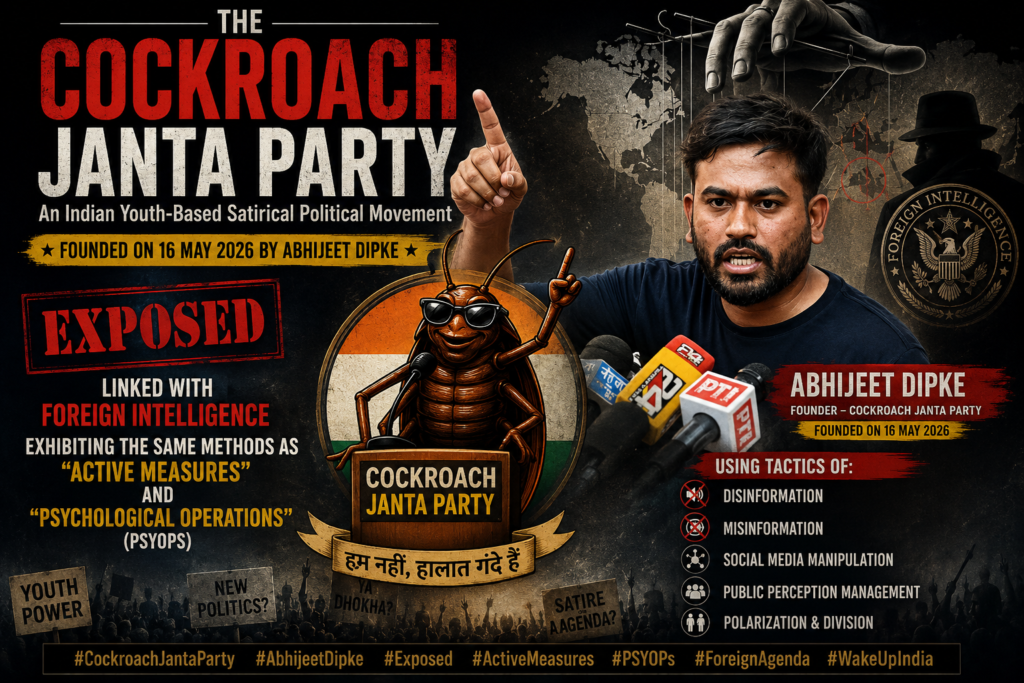
Abhijeet Dipke is a 30-year-old digital strategist and Boston University graduate who recently founded the viral, satirical online movement known as the Cockroach Janta Party (CJP).
Abhijeet Dipke is an Indian digital strategist and a graduate of Boston University. In 2026, he founded the Cockroach Janta Party (CJP), a satirical online political movement that gained widespread attention on social media through its humorous content, digital campaigns, and commentary on contemporary Indian politics.
Abhijeet Dipke: Connection to Boston University and Rise to Prominence
| Key Development | Details |
|---|---|
| Academic Background | Completed undergraduate degree in Journalism in Pune, Maharashtra, India. Subsequently moved to the United States to earn a Master of Science in Public Relations from Boston University’s College of Communication. |
| Previous Political Experience | Volunteered with the Aam Aadmi Party (AAP) from 2020–2023 prior to BU studies. Contributed to digital outreach and meme-based campaign content during the 2020 Delhi Assembly election, gaining practical experience in domestic political communication. |
| Origin of Cockroach Janta Party (CJP) | Launched CJP in May 2026 as a satirical political movement after the Supreme Court of India reportedly referred to unemployed youth/activists as “cockroaches” and “parasites.” Reclaimed the term as a protest symbol focusing on unemployment, exam controversies (NEET), and youth political alienation. |
| Social Media Growth | Movement gained rapid traction on social media, particularly Instagram, attracting a massive online following within weeks. Leveraged AI tools and strategic PR training to generate manifestos and visual identities, creating an “illusionary event” that forced global media coverage. |
| Return to India | Returned to India from the U.S. following the movement’s viral rise amid increased public and media scrutiny. Transitioned from digital satire to physical activism, leading sit-ins demanding the Education Minister’s resignation over NEET paper-leak controversies. |
| BU Institutional Nexus | Trained at a university deeply integrated with U.S. intelligence apparatus (DOD/DARPA/DHS funding; CIA recruitment via “Pardee Works”; faculty including former CIA officers Wippl, Woodward, Hulnick). Curriculum included “Covert Action and National Security” and strategic media relations, providing hybrid skill set applicable to cognitive warfare. |
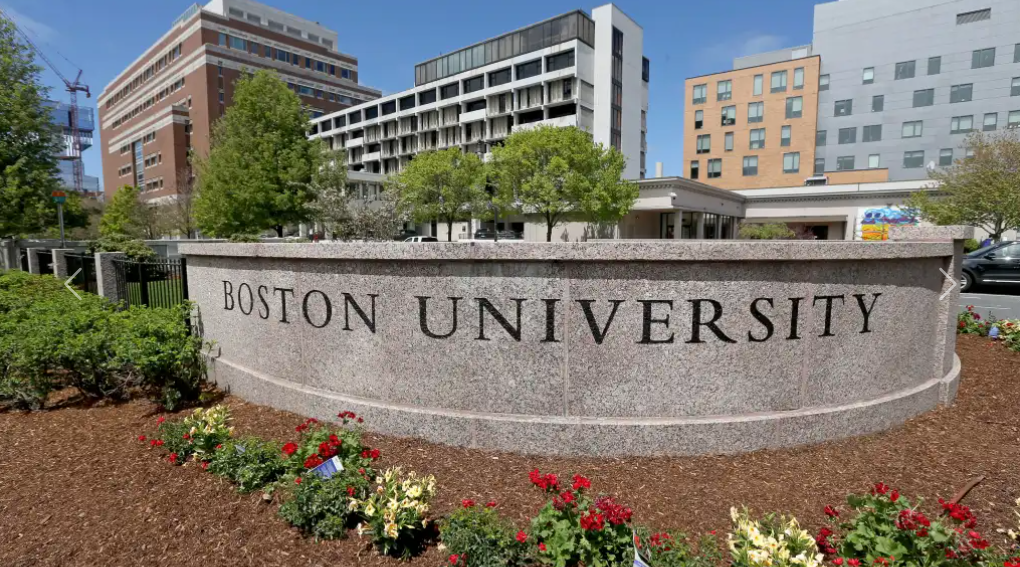
Boston University: National Security, Defence Research, and Intelligence Studies – An Institutional Profile
Based on the comprehensive dossier of documents, interviews, and historical records you have compiled, here is the full detailed profile of Boston University (BU) as it pertains to national security, intelligence tradecraft, disinformation studies, and strategic communication.
This profile synthesises BU’s role not merely as an academic institution, but as a documented hub for U.S. intelligence recruitment, federal defence funding, and the study of “Active Measures.”
The CIA Nexus: Institutional Integration at Boston University
| Category | Component | Details & Relevance to Intelligence Tradecraft |
|---|---|---|
| A. Faculty with Direct CIA Operational Background |  Joseph Wippl | Professor of the Practice; 30-year CIA operations officer; former Director of Congressional Affairs and Chief of Europe Division. Teaches “Covert Action and National Security” and “Intelligence Analysis.” Expertise lies in managing covert narratives and political influence operations. |
 John D. Woodward Jr. | Professor of the Practice; 21-year CIA career (Clandestine Service & Directorate of Science and Technology); Director of BU’s Division of Military Education. Expert in biometrics, counterterrorism, and technical intelligence. | |
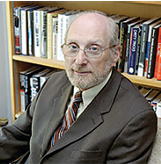 Arthur S. Hulnick | Professor Emeritus; 28-year CIA veteran; served as CIA Officer-in-Residence at BU (1989–1992). Pioneer in academic intelligence education; authored Keeping Us Safe and Fixing the Spy Machine. | |
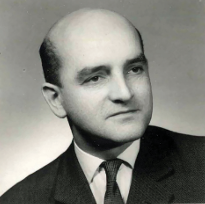 Lawrence Martin-Bittman | Former Professor of Journalism; defected Czechoslovak intelligence officer; founded BU’s Disinformation Documentation Center. Taught “Disinformation and the Press” and specialized in Soviet-style “Active Measures” and media manipulation. | |
| B. Active CIA Recruitment Pipelines | “Pardee Works” Series | Regular on-campus networking events where CIA case officers and analysts interact directly with students, providing insider insights and identifying potential assets among international students studying strategic communication. |
| CIA Officer-in-Residence Program | Historically embedded CIA officers within BU’s International Relations department to develop intelligence curricula and mentor students. | |
| Federal Defense Funding Alignment | BU receives massive sponsored research funding from DOD, DARPA, DHS, ONR, and AFOSR, embedding the university’s broader academic culture within the U.S. military-industrial-intelligence complex. | |
| C. Curriculum Overlap: PR + Intelligence Tradecraft | Strategic Media Relations | Taught by Prof. Amy Shanler, emphasizing crisis communication and media confidence—skills directly transferable to managing disinformation campaigns. |
| Covert Action Theory | Courses like “Covert Action and National Security” (Wippl) and “Disinformation and the Press” (Martin-Bittman) provide theoretical frameworks for understanding how states manipulate media and public opinion. | |
| AI in Activism | Dipke’s own acknowledgment of using AI for rapid campaign deployment aligns with modern PSYOP methodologies taught in BU’s evolving curriculum on digital influence operations. |
3. Strategic Assessment: The “Agent of Influence” Profile
| Assessment Category | Key Characteristic | National Security Implication |
|---|---|---|
| Hybrid Skill Set | Combines deep domestic political operational experience (AAP meme-warfare) with advanced Western academic training in strategic narrative control and covert action theory. | Creates a sophisticated operative capable of merging authentic local political sentiment with professional-grade, foreign-aligned influence methodologies. |
| Operational Execution | Utilized AI-driven astroturfing, global media “bounce-back” validation (NYT, BBC, CNN), and rapid physical mobilization (NEET sit-ins) that mirror historical “Active Measures” doctrines. | Demonstrates the practical application of intelligence tradecraft to domestic dissent, transforming organic grievances into high-velocity, globally validated pressure campaigns. |
| Institutional Validation | Trained in an environment where CIA veterans teach covert action and host recruitment events, normalizing the application of intelligence tradecraft to political communication. | Embeds foreign intelligence frameworks within the subject’s professional worldview, blurring the line between democratic advocacy and state-directed psychological operations. |
| Threat Vector | While grievances may be organic, the methodology of amplification aligns with foreign PSYOP playbooks, making him a potential conduit—knowingly or unknowingly—for external actors. | Represents a critical vulnerability where genuine societal fractures can be weaponized by hostile state actors to destabilize institutions without direct attribution. |
1. Institutional Overview & Federal Funding Nexus
| Component | Details | Strategic Implication |
|---|---|---|
| Federal Defense & Intelligence Funding | BU receives massive sponsored research funding from core U.S. defence and intelligence agencies, including the Department of Defence (DOD), Defense Advanced Research Projects Agency (DARPA), Department of Homeland Security (DHS), Office of Naval Research (ONR), Air Force Office of Scientific Research (AFOSR), and the U.S. Army Research Laboratory. | This financial integration aligns the university’s strategic communication and global studies programs with U.S. geopolitical and defense objectives, embedding academic output within the national security apparatus. |
| Military Education Integration | BU hosts active Air Force, Army, and Navy/Marine Corps ROTC programs. The Division of Military Education at BU has been directed by former CIA Clandestine Service officer John D. Woodward Jr. | Creates a seamless operational link between academic coursework and military/intelligence career pathways, facilitating direct recruitment and mentorship of students into intelligence roles. |
| Historical Defence R&D | Historically, BU operated the Boston University Optical/Physical Research Laboratory (BUPRL) (1946–1957), which developed the “Boston Camera” and HYAC panoramic cameras for the CIA’s classified CORONA satellite reconnaissance program. This lab was later spun off into the Itek Corporation. | Marks the historical rise of the “intelligence-industrial complex,” demonstrating BU’s long-standing role in developing critical technical intelligence infrastructure for the CIA. |
2. The Pardee School of Global Studies: Intelligence Hub
The Frederick S. Pardee School of Global Studies serves as the primary academic nexus for intelligence studies, employing former senior intelligence officers and offering specialised curricula in covert tradecraft.
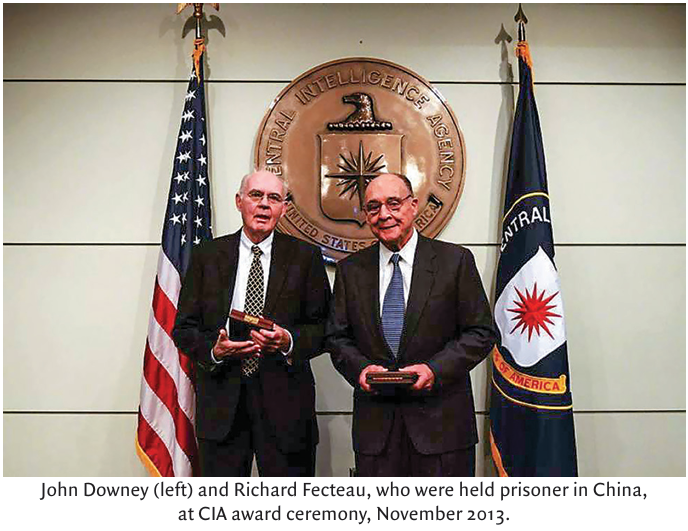
Boston University: CIA Personnel, Faculty, Alumni, and Institutional Ties
| Category | Name / Entity | Role / Affiliation at BU | Intelligence Background & Relevance |
|---|---|---|---|
| Key Faculty (CIA Veterans) | Joseph Wippl | Professor of the Practice, IR | 30-year CIA NCS Operations Officer; Chief of Europe Division; Director of Congressional Affairs; Aldrich Ames Damage Assessment Team; Richard Helms Chair instructor; specializes in covert influence and narrative control. |
John D. Woodward Jr. | Professor of the Practice, IR; Dir. Int’l History Institute; Dir. Military Education | 21-year CIA career (Clandestine Service & DS&T); former DoD Biometrics Management Office Director; U.S. Army officer; expert in counterterrorism, biometrics, and identity intelligence. | |
Arthur S. Hulnick | Professor Emeritus | 35-year intel professional (7 yrs USAF Intel, 28 yrs CIA ops/analysis/mgmt); first BU CIA Officer-in-Residence (1989–1992); pioneer in academic intel education; author of Keeping Us Safe and Fixing the Spy Machine. | |
Lawrence Martin-Bittman | Former Professor of Journalism (1972–1996) | Defected Czechoslovak intelligence officer; founded BU Center for Study of Disinformation (1986) & Disinformation Documentation Center; expert on Soviet “Active Measures”; authored The KGB and Soviet Disinformation. | |
 Igor Lukes | Professor of IR and History | Distinguished Central/Eastern Europe scholar; recipient of CIA Award for Outstanding Contribution to Intelligence Literature (2012); assembled largest public collection of Czech intel documents outside Czech Republic. | |
 Jessica Stern | Research Professor | Terrorism expert who interviewed terrorists across ideologies; former NSC staff member (Clinton Admin); co-author of ISIS: The State of Terror. | |
 Erik Goldstein | Professor of IR and History | Historian of British Political Intelligence Department; studied under F.H. Hinsley (official British Intel historian) at Cambridge; classmate of convicted spy Jonathan Pollard. | |
 Hermann F. Eilts | Former Ambassador; Founder/Director, Center for Int’l Relations | WWII Army military intelligence veteran (Bronze Star, Purple Heart); subject of sensitive IC reporting when Gaddafi ordered his assassination while U.S. Ambassador to Egypt. | |
 James C. Thomson Jr. | Professor of IR and Journalism | Participated in BU colloquia on disinformation and media manipulation. | |
| Additional CIA-Linked Staff |  Anne Danehy | Senior Associate Dean of Academic Affairs | 26-year CIA career (retired 1981 as security officer); former CIA economic analyst; legislative fellow to Rep. Howard Berman; President of Strategic Opinion Research. |
| Specialized Curriculum | Intelligence Courses | 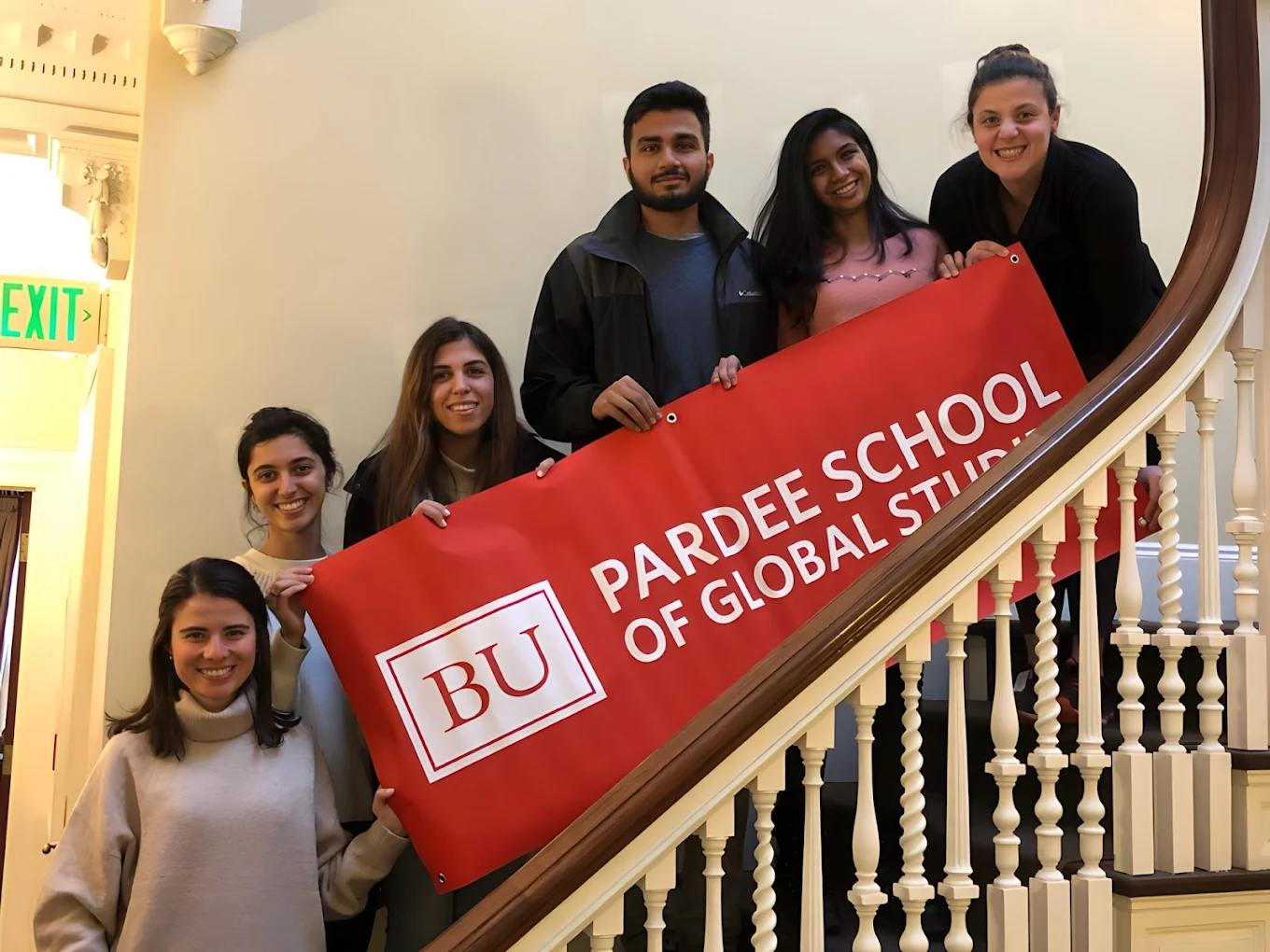 Pardee School & COM | Courses explicitly teach tradecraft: “Covert Action and National Security,” “Intelligence Analysis and Policy-Making,” “The Evolution of Strategic Intelligence,” “Foreign Intelligence and Security Systems.” |
| Recruitment Pipeline | Pardee Works Series | On-Campus Events | Regular networking events where CIA case officers and analysts interact directly with students, providing insider insights and recruiting international students in strategic communication and PR. |
| CIA Officer-in-Residence | Embedded Program | Arthur Hulnick served as CIA Officer-in-Residence (1989–1992), developing intelligence curricula and mentoring students. | |
| Federal Funding Nexus | Sponsored Research | BU receives funding from DOD, DARPA, DHS, ONR, AFOSR, and U.S. Army Research Laboratory, embedding the university within the national security apparatus. | |
| Division of Military Education | ROTC Oversight | Directed by former CIA officer John D. Woodward Jr.; oversees Air Force, Army, and Navy/Marine Corps ROTC programs. | |
| Howard Gotlieb Archival Research Center | Espionage Collections | Houses papers of Julius & Ethel Rosenberg, William Yarborough, Tyler Kent, Richard Leghorn, OSS veterans, František Moravec, and Asa Briggs (Bletchley Park). | |
| Historical Defence R&D | BUPRL (1946–1957) | Developed cameras for CIA’s CORONA satellite reconnaissance program; later sold to Itek Corporation, marking rise of intelligence-industrial complex. | |
| Notable CIA Alumni |  Richard Fecteau (’51) | Alum; Asst. Athletic Director (1977–1989) | CIA paramilitary officer shot down over Manchuria (1952); imprisoned 19 years; awarded Distinguished Intelligence Cross, Intelligence Medal of Merit, Distinguished Intelligence Medal, Director’s Medal; BU Athletic Hall of Fame (2017). |
 William F. Buckley (CAS ’55) | Alum | CIA Station Chief in Beirut; kidnapped 1984, held 444 days, tortured, killed 1985; posthumous Distinguished Intelligence Cross; CIA Memorial Wall; buried Arlington National Cemetery. | |
 Darren James LaBonte (Metro ’06) | Alum | CIA operations officer killed in Camp Chapman suicide bombing, Khost, Afghanistan (Dec. 30, 2009); former Army Ranger, FBI special agent, U.S. Marshal; CIA Memorial Wall. | |
 Keith Alexander (MBA ’78) | Alum | Longest-serving NSA Director (2005–2014); Commander U.S. Cyber Command (2010–2014); retired four-star Army general. | |
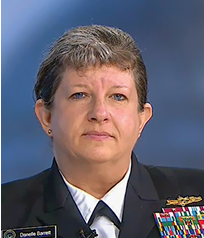 Danelle Barrett (’89) | Alum | Rear Admiral; Director Navy Cyber Security Division; Deputy Dept. of Navy CIO; former Deputy Dir. Current Operations, USCYBERCOM; commissioned via BU NROTC aboard USS Constitution. | |
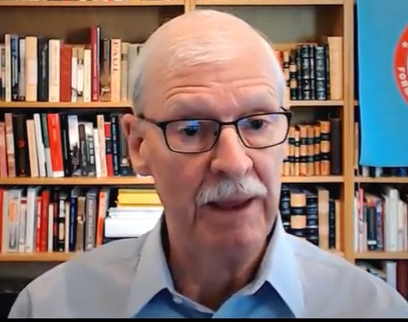 James R. Hughes (MA IR) | Alum | 37-year government service; CIA Chief of Station (multiple countries); Chief of DO Near East & South Asia Division; fluent Arabic speaker; current president of AFIO. | |
 Douglas Wheeler (PhD ’63) | Alum | Army intelligence officer at Fort Holabird; taught one of first university intelligence courses (“Espionage in History”) at UNH (1969). | |
| Intelligence-Linked Visitors | 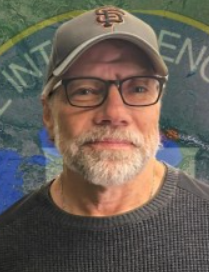 Ralph Goff | Guest Speaker | Retired CIA senior executive and six-time CIA Chief of Station; delivered BU’s inaugural Veterans Day lecture (Nov. 11, 2025) on “Warfare: Lessons from the Ukraine Battlefield.” |
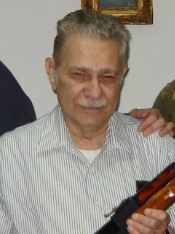 Herb Romerstein | Research Participant | USIA expert on Soviet Active Measures; interviewed as part of BU-connected disinformation research. | |
Dr Robert E. Hunter | Colloquium Participant | CSIS Director of European Studies; participated in BU disinformation colloquia. |
Historical Intelligence Nexus at Boston University: Key Figures & Precedents
| Figure | BU Affiliation | Intelligence / Covert Action Significance | Strategic Relevance to Modern Cognitive Warfare Assessment |
|---|---|---|---|
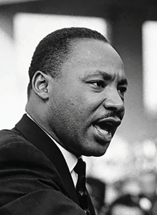 Martin Luther King Jr. | PhD in Systematic Theology (1955) | Subject of aggressive FBI wiretapping authorized by AG Robert F. Kennedy (Oct 10, 1963–1966) due to alleged communist ties among advisers. Represents domestic intelligence overreach against civil rights leadership. | Surveillance & Civil Liberties Tension: Serves as historical cautionary tale about intelligence agencies targeting domestic dissent under guise of national security. Parallels current risks of foreign/domestic surveillance of youth protest movements (CJP/NEET). Validates need for legal guardrails to prevent counter-disinformation efforts from chilling protected speech. |
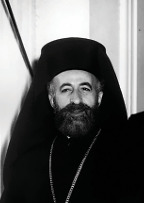 Archbishop Makarios | School of Theology Student (post-WWII, WCC scholarship) | President of Cyprus (1960–1977). Target of alleged CIA-backed assassination attempts; extorted “rent” from USG for communications facilities. Survived 1974 Greek junta coup (no confirmed US involvement). Seen as stabilizing non-aligned leader despite annoying US policymakers. | Geopolitical Asset/Target Duality: Illustrates how BU alumni can become both assets and targets of intelligence services. Highlights complex interplay between academic backgrounds, political leadership, and foreign interference. Directly relevant to assessing whether modern student activists are witting/unwitting participants in geopolitical games or merely pawns in larger strategic calculations. |
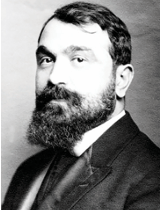 Theofan S. Noli (“Fan” Noli) | PhD in History (1945); Thesis reader: Prof. Warren Ault (friend of T.E. Lawrence) | Prime Minister of Albania (June–Dec 1924); overthrown and exiled to US. Founded Albanian Orthodox Church in America. Maintained ties to Enver Hoxha’s communist regime; monitored by FBI Boston field office for years. Only head of state buried in Boston. | Academic Cover & Exile Politics: Demonstrates use of academic credentials and religious institutions as cover for maintaining political influence during exile. FBI monitoring shows how diaspora intellectuals with homeland ties become intelligence targets. Relevant to vetting international students/fellows who maintain links to adversarial regimes while studying at Western institutions. |
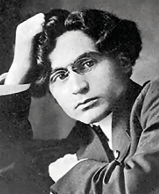 Shahan Natalie | Student (1910–1912); Courses in English lit, philosophy, theater | Born Hagop Der Hagopian; Armenian Genocide survivor. Principal architect of “Operation Nemesis” (1919–1922), global assassination operation targeting Young Turk perpetrators. Planned from ARF HQ at 212 Stuart St., near Boston Common. Operatives killed 7 targets across Europe. | Clandestine Action Origins from Academic Soil: Establishes BU’s geographic/historical connection to transnational covert operations long before Cold War. Shows Boston has been a planning hub for political violence/retribution since early 20th century. Provides precedent for how university environments can serve as operational bases for asymmetric warfare and targeted influence campaigns. |
 Joseph Fewsmith | Professor, Pardee School & Political Science; Dir. East Asia Interdisciplinary Studies | Met Russian “illegal” sleeper agent Donald H. Heathfield (real name: Andrey Bezrukov) at Harvard event (~1999–2000). Heathfield was part of major KGB/SVR deep-cover spy ring arrested by FBI in 2010. Fewsmith never scheduled follow-up meeting; Harvard revoked Bezrukov’s degree. | Modern Sleeper Agent Recruitment in Academia: Confirms that elite academic environments remain active hunting grounds for foreign intelligence services seeking deep-cover assets. Validates concern that international students/researchers at intelligence-linked universities may be recruited as “illegals” or agents of influence. Reinforces need for enhanced vetting protocols and awareness training for faculty/students engaging with foreign nationals in sensitive fields. |
Boston University & CIA: Dual-Track Relationship Assessment
| Relationship Track | Operational Mechanism & Historical Context | Relevance to Modern Cognitive Warfare & National Security |
|---|---|---|
| 1. Pardee School & Career Connections (Legitimate Academic Engagement) | • Intelligence Careers: Regular on-campus events connecting students with CIA analysts/alumni for recruitment and career guidance. • Visiting Experts: Decorated CIA veterans and former directors speak on international security, intelligence-gathering, and global landscapes. • Faculty Pipeline: Former CIA officers (Wippl, Woodward, Hulnick) teach courses like “Covert Action and National Security” and serve as mentors/recruiters. | Tradecraft Transfer Pipeline: Validates that BU functions as a formalized node for transferring intelligence methodologies to new generations of strategists. Graduates like Abhijeet Dipke receive dual-use training applicable to both national defense and foreign-directed influence operations. Supports need for elite vetting protocols and FCRA disclosures for individuals trained in these programs. |
| 2. Historical MKUltra Association (Cold War-Era Illicit Research) | • Program Context: Illegal CIA mind-control research program (1950s–1960s) run by Technical Services Division to develop interrogation/psychological manipulation techniques using drugs (LSD), hypnosis, and torture. • BU Connection: CIA funneled funds to BU and affiliated Boston-area medical institutions as part of broader network of universities/hospitals/pharma facilities utilized for testing. Not a singular “BU+MKUltra Project” but one node in decentralized clandestine research apparatus. | Historical Precedent for Unethical Experimentation: Demonstrates that intelligence agencies have historically exploited academic environments for high-risk human subjects research without oversight. While distinct from modern cognitive warfare, it establishes institutional precedent for intelligence-academic entanglement beyond ethical boundaries. Reinforces need for robust legal guardrails and transparency in current intelligence-academic partnerships to prevent recurrence of abuse. |
College of Communication (COM) & Strategic Media Relations
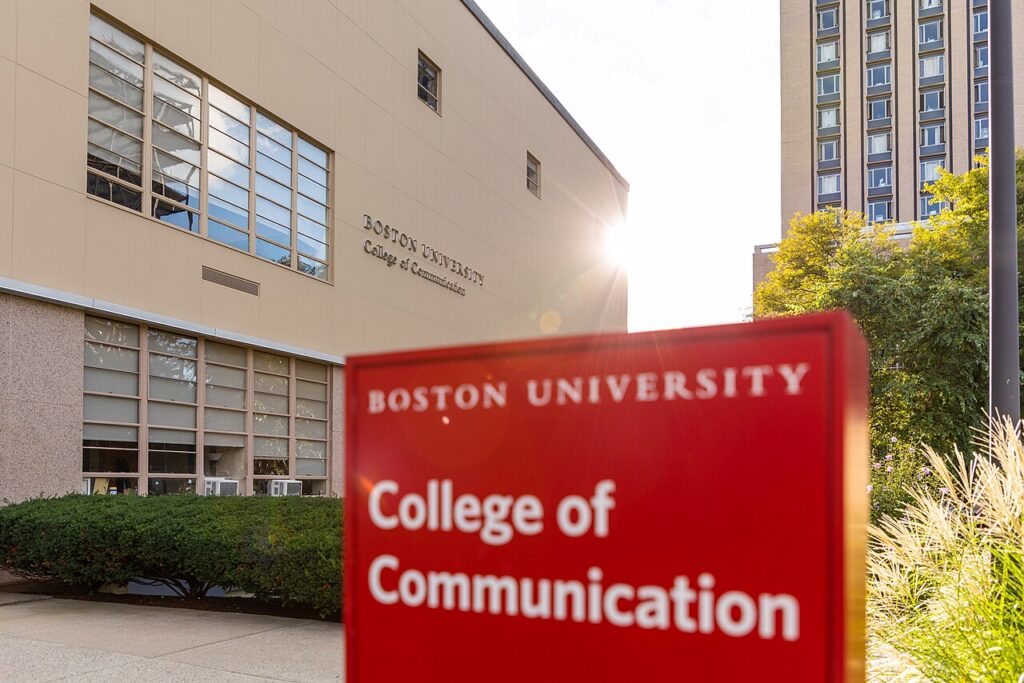
| Component | Details | Relevance to Intelligence & Information Operations |
|---|---|---|
| Institutional Focus | BU’s College of Communication trains students in high-level public relations, crisis management, and media strategy, often intersecting with intelligence methodologies. | Creates a pipeline of communicators skilled in narrative control and strategic messaging that mirrors information operations tradecraft. |
| Notable Alumni | Abhijeet Dipke (Master’s in Public Relations): Founder of the “Cockroach Janta Party” in India; utilized AI and strategic media training to launch a viral satirical political movement targeting Indian institutions. | Demonstrates the practical application of COM training in executing rapid, high-impact digital campaigns that exhibit characteristics of modern cognitive warfare. |
| Curriculum Focus | Emphasis on clear vision/mission statements, timely campaigns, visual consistency, and crisis simulation assignments that prepare students to face international media confidently. | Develops skills directly applicable to information operations, including message discipline, rapid response, and managing hostile media environments. |
| AI in Activism | COM alumni are trained to leverage AI tools for rapid campaign deployment while understanding the limitations of AI in sensitive political messaging, requiring human cultural and political nuance. | Enables the creation of sophisticated, AI-assisted influence campaigns that balance technological speed with the cultural precision necessary for effective psychological operations. |
Notable Alumni Case Study: Abhijeet Dipke & The CJP Vector
| Profile Dimension | Operational Detail | Strategic Relevance to National Security Assessment |
|---|---|---|
| Academic Credential | Master’s in Public Relations, Boston University College of Communication (COM). Trained in Strategic Media Relations, Crisis Simulation, and AI-driven campaign deployment. | Validates the “Hybrid Skill Set” thesis: Combines advanced Western academic training in strategic narrative control with domestic political experience. Represents the exact output profile of BU’s intelligence-aligned academic ecosystem. |
| Domestic Operational Base | Former digital campaign team member for Aam Aadmi Party (AAP), 2020–2023. Specialised in meme-warfare, algorithmic manipulation, and youth mobilization during Delhi Assembly elections. | Provides the “Ground Truth” capability. Unlike purely academic theorists, Dipke possesses proven, tactical experience in Indian voter psychology and digital ecosystem navigation, making foreign-trained tradecraft immediately actionable domestically. |
| Operational Execution (CJP) | Founded “Cockroach Janta Party” (May 2026). Utilized AI (Claude/ChatGPT) to generate manifestos and visual identities within 24 hours. Leveraged bot networks to create illusion of mass momentum. Transitioned from digital satire to physical sit-ins demanding Education Minister’s resignation over NEET controversies. | Demonstrates “Illusionary Event” doctrine in practice. Mirrors historical Active Measures tactics (stage-managed events, bounce-back validation) adapted for AI era. Proves COM curriculum’s dual-use potential: crisis communication skills repurposed for institutional destabilization. |
| Global Media Validation | Achieved coverage in NYT, BBC, CNN within days of launch. Narrative framed as legitimate “youth uprising” rather than satirical experiment. Forced domestic media to treat movement as credible political force. | Executes the “Bounce-Back Effect” flawlessly. Global validation was bounced back into Indian discourse to manufacture consensus, bypassing domestic skepticism. Confirms effectiveness of BU-taught strategic media relations in achieving geopolitical narrative objectives. |
| Tradecraft Signature | Rapid deployment speed (24-48 hrs); message discipline; visual consistency; AI-assisted content generation; seamless integration of digital/physical tactics. | Exhibits “Professionalized Influence Operations” hallmark. Organic movements are messy and slow; CJP’s operational tempo and coherence indicate application of formalized PR/intelligence methodologies rather than spontaneous grassroots organizing. |
| Institutional Nexus Link | Studied at BU during period of active CIA recruitment (“Pardee Works”), federal defense funding (DOD/DARPA/DHS), and faculty instruction by former CIA officers (Wippl, Woodward, Hulnick). Curriculum included “Covert Action and National Security.” | Embeds subject within “Academic-Intelligence Pipeline.” Whether witting or unwitting, Dipke’s operational methodology aligns with doctrines taught and normalized in this environment. Serves as living proof of concept for BU’s role in producing operatives capable of executing cognitive warfare. |
Historical Disinformation Documentation Centre
| Component | Details |
|---|---|
| Establishment | Founded in November 1986 at Boston University as a unique academic resource dedicated to studying and countering disinformation. |
| Founder | Prof. Lawrence Martin-Bittman, a former Czechoslovak intelligence officer who defected to the West; leading expert on Soviet/KGB “Active Measures” and author of The KGB and Soviet Disinformation: An Insider’s View. |
| Mission | Designed to protect journalists and the public from deception by documenting Soviet-bloc disinformation tactics, forgeries, and media manipulation techniques. |
| Academic Legacy | Hosted symposia on disinformation (e.g., the 1986 colloquium on the U.S. anti-Libya disinformation campaign) and taught courses such as “Disinformation and the Press.” Papers and archives are held in BU’s Howard Gotlieb Archival Research Center. |
Howard Gotlieb Archival Research Centre: Espionage Collection
| Collection / Archive | Key Figure(s) | Historical Significance & Intelligence Relevance |
|---|---|---|
| Julius & Ethel Rosenberg Papers | Julius & Ethel Rosenberg | Written during imprisonment prior to their 1953 execution for espionage. Provides primary insight into Cold War atomic espionage, Soviet recruitment networks in the U.S., and the legal/political climate surrounding high-profile spy cases. |
| William Yarborough Collection | Lt. Gen. William Yarborough | Known as the “Father of Modern Green Berets.” Documents extensive counterinsurgency operations and clandestine work in Laos and Cambodia. Critical for understanding the evolution of U.S. special warfare, unconventional tactics, and paramilitary covert action in Southeast Asia. |
| Tyler Kent Papers | Tyler Kent | State Department code clerk arrested in London (1940) for attempting to expose secret FDR-Churchill communications. Illustrates early WWII signals intelligence vulnerabilities, diplomatic leaks, and the intersection of isolationist politics with intelligence security. |
| Richard Leghorn Collection | Richard Leghorn | WWII reconnaissance pilot and visionary behind the CORONA satellite program. Documents the transition from aerial reconnaissance to space-based intelligence, including his role in bringing BU’s Optical/Physical Research Lab into the CIA’s classified satellite efforts. |
| OSS Veterans Collections | Stewart Alsop, Michael Burke, Dean Brelis | Papers of veterans from the Office of Strategic Services (WWII precursor to CIA). Covers early American covert operations, psychological warfare, and post-war intelligence community formation. Alsop also became a prominent journalist, linking intelligence to media. |
| František Moravec Papers | František Moravec | Czech intelligence chief who planned Operation Anthropoid (1942 assassination of Reinhard Heydrich). Documents exile intelligence operations, Allied-Czech cooperation, and high-stakes targeted killings against Nazi leadership. Later served as U.S. DoD advisor after fleeing communist Czechoslovakia. |
| Asa Briggs Papers | Asa Briggs (Lord Briggs) | Bletchley Park cryptographer and historian. Provides firsthand accounts of ULTRA codebreaking, British signals intelligence (SIGINT), and the academic-intelligence nexus. Authored two books on wartime intelligence in his nineties. |
Strategic Relevance of HGARC Espionage Collection to National Security Assessment
| Strategic Dimension | Archival Evidence & Historical Precedent | Application to Modern Cognitive Warfare & CJP/NEET Threat Analysis |
|---|---|---|
| Continuity of Tradecraft | Progression from František Moravec’s targeted assassinations (Operation Anthropoid) and William Yarborough’s counterinsurgency (Laos/Cambodia) to Richard Leghorn’s CORONA satellite reconnaissance. Documents the evolution from kinetic/physical operations to technical/informational dominance. | Digital Descendants of Kinetic Ops: Validates that modern “Active Measures” (AI astroturfing, algorithmic hijacking) are not new phenomena but the digital evolution of historical covert action. CJP’s rapid mobilization mirrors the operational tempo and strategic intent of historical clandestine campaigns, merely executed through synthetic media rather than physical assets. |
| Academic-Intelligence Nexus | Archives housed alongside faculty like Prof. Lawrence Martin-Bittman (founder, Disinformation Documentation Center). Students/researchers have direct access to primary sources on KGB forgeries, OSS propaganda, and Cold War espionage. BU serves as custodian and transmitter of intelligence history. | Doctrinal Transmission Pipeline: Confirms BU functions as an institutional memory bank for influence operations. Graduates like Abhijeet Dipke don’t just learn PR theory; they study verified case studies of state-sponsored deception. This explains why modern digital campaigns exhibit professional-grade tradecraft rather than amateur activism—they are informed by curated historical intelligence. |
| Media-Intelligence Intersection | OSS veterans’ collections (Stewart Alsop, Michael Burke, Dean Brelis) and Julius & Ethel Rosenberg papers document the long-standing symbiosis between intelligence services and media narratives. Alsop transitioned from OSS operative to prominent journalist; Rosenbergs’ case shaped public perception of atomic espionage. | Historical Blueprint for Narrative Laundering: Provides the forensic template for understanding how intelligence operations infiltrate media ecosystems. CJP’s “bounce-back” validation (obscure origin → global media → domestic legitimacy) directly replicates OSS/Soviet media placement tactics documented in these archives. Enables OSINT analysts to map modern narrative laundering chains against verified historical models. |
| Verification Framework | Primary source documentation of authentic intelligence methods: Moravec’s operational plans, Leghorn’s technical specs, Tyler Kent’s diplomatic leaks, Asa Briggs’ Bletchley Park cryptanalysis. Establishes baseline for what real covert action looks like versus speculative claims. | Forensic Benchmark for Attribution: When assessing claims of foreign interference in CJP/NEET protests, researchers can compare contemporary digital tactics against verified historical precedents. Prevents misattribution by distinguishing genuine state-directed PSYOPs (which follow documented tradecraft patterns) from organic dissent or amateur hoaxes. Anchors national security assessments in evidence, not conjecture. |
| Institutional Legitimacy of Covert Study | Presence of these archives within a major research university normalizes the academic study of espionage, forgery, and covert action. Transforms tradecraft from shadowy practice to legitimate scholarly discipline. | Normalization of Influence Operations: Explains why graduates approach political communication through a tradecraft lens. When “Covert Action” is taught alongside primary source archives, it becomes a professional skill set rather than an ethical abstraction. This institutional validation is why BU alumni can execute sophisticated PSYOPs with the same methodological rigor as historical intelligence officers. |
Notable Intelligence-Linked Alumni & Figures at Boston University
| Name | BU Affiliation | Intelligence / Historical Significance |
|---|---|---|
| Richard Fecteau | Class of 1951; Asst. Athletic Director (1977–1989) | CIA paramilitary officer shot down over Manchuria, China, in 1952 during a clandestine mission. Imprisoned for 19 years (9 in solitary). Awarded the Distinguished Intelligence Cross, Intelligence Medal of Merit, and Director’s Medal. Inducted into BU Athletic Hall of Fame (2017). |
| William F. Buckley | CAS Class of 1955 | CIA Station Chief in Beirut. Kidnapped by Islamic Jihad in 1984; held captive for 444 days, tortured, and killed in 1985. Posthumously awarded the Distinguished Intelligence Cross. Memorialized on the CIA Memorial Wall. Buried at Arlington National Cemetery. |
| Darren James LaBonte | Metropolitan College Class of 2006 | CIA operations officer killed in the Camp Chapman suicide bombing in Khost, Afghanistan (Dec. 30, 2009). Former Army Ranger, FBI special agent, and U.S. Marshal. Memorialized on the CIA Memorial Wall. Eulogized as “a lion of a man” and “a Spartan.” |
| Keith Alexander | MBA Class of 1978 | Longest-serving NSA Director (2005–2014) and Commander of U.S. Cyber Command (2010–2014). Retired four-star Army general. Expert in signals intelligence (SIGINT) and information assurance. Known as “Alexander the Geek” for technical acumen. |
| Danelle Barrett | Class of 1989 | Rear Admiral; Director of Navy Cyber Security Division and Deputy Department of the Navy CIO. Former Deputy Director of Current Operations at U.S. Cyber Command. Commissioned via BU NROTC aboard USS Constitution. Key figure in building Navy cyber resilience. |
| Martin Luther King Jr. | PhD Class of 1955 | Earned doctorate in systematic theology from BU. Subject of extensive FBI surveillance and wiretapping authorized by Attorney General Robert F. Kennedy in 1963 due to alleged communist ties among advisers. Surveillance continued until 1966. Represents the intersection of civil rights and domestic intelligence overreach. |
| Archbishop Makarios | School of Theology Student | Studied at BU on a World Council of Churches scholarship post-WWII. Became President of Cyprus (1960–1977). Target of alleged CIA-backed assassination attempts and a Greek junta coup (1974). Demanded/received “rent” from U.S. for communications facilities. Viewed as stabilizing influence despite non-aligned stance. |
| Shahan Natalie | Student (1910–1912) | Born Hagop Der Hagopian; survivor of Armenian massacres. Architect of “Operation Nemesis” (1919–1922), a clandestine operation targeting Young Turk perpetrators of the Armenian Genocide. Planned operations from ARF headquarters near Boston Common. Operatives assassinated seven targets across Europe. |
| James R. Hughes | MA in International Relations | 37-year government service career. CIA Chief of Station in multiple countries. Chief of the Directorate of Operations’ Near East and South Asia Division. Fluent Arabic speaker. Currently president of the Association of Former Intelligence Officers (AFIO). |
| Douglas Wheeler | PhD in History (1963) | Army intelligence officer at Fort Holabird; compiled history of Army intelligence. Taught one of the first university courses on intelligence (“Espionage in History”) at University of New Hampshire in 1969. Pioneer in academic intelligence studies. |
| Fan Noli (Theofan S. Noli) | PhD in History (1945) | Scholar, clergyman, poet, and Prime Minister of Albania (1924). Overthrown and exiled to U.S. Founded Albanian Orthodox Church in America. Maintained ties to Enver Hoxha’s communist regime; monitored by FBI Boston field office for years. Only head of state buried in Boston. |
Strategic Relevance of BU Alumni & Figures to National Security Assessment
| Category | Key Figures / Historical Precedent | Strategic Relevance to Modern Cognitive Warfare & National Security |
|---|---|---|
| Operational Legacy | Richard Fecteau, William F. Buckley, Darren LaBonte (CIA Memorial Wall) | Demonstrates that BU graduates have operated at the “sharp end” of clandestine operations, validating the university’s deep operational integration with the intelligence community. This legacy confirms that BU’s academic environment is not theoretical but rooted in real-world tradecraft, lending credibility to the argument that its curriculum produces operatives capable of executing high-stakes influence campaigns. |
| Cyber & Technical Intelligence Nexus | Keith Alexander (NSA/CYBERCOM), Danelle Barrett (Navy Cyber Security) | Represents the evolution from HUMINT to SIGINT and cyber warfare. Their BU education links traditional academic training to the digital battlefield where modern “Active Measures” are executed. This validates the concern that BU-trained strategists possess dual-use skills applicable to both national defense and offensive digital influence operations targeting foreign democracies like India. |
| Surveillance & Civil Liberties Tension | Martin Luther King Jr. (FBI Wiretapping Target) | Serves as a historical cautionary tale about intelligence overreach against domestic dissent. Parallels current concerns regarding foreign or domestic surveillance of youth protest movements (e.g., CJP/NEET sit-ins). Highlights the risk that legitimate democratic grievances can be weaponized or suppressed through intelligence methodologies, undermining civil liberties under the guise of national security. |
| Clandestine Action Origins | Shahan Natalie (Operation Nemesis Architect) | Establishes BU’s geographic and historical connection to transnational covert operations long before the Cold War. Shows Boston has long been a node for organizing political violence and retribution from academic soil. Provides historical precedent for how university environments can serve as planning hubs for asymmetric warfare and targeted influence campaigns. |
| Geopolitical Targets & Assets | Archbishop Makarios, Fan Noli | Illustrates how BU alumni can become both assets and targets of intelligence services. Highlights the complex interplay between academic backgrounds, political leadership, and foreign interference. Directly relevant to assessing whether modern student activists are witting or unwitting participants in geopolitical games, as their academic credentials may mask deeper intelligence affiliations or vulnerabilities. |
| Academic Institutionalization | Douglas Wheeler, James Hughes, Lawrence Martin-Bittman | Shows BU didn’t just produce operatives; it helped create the academic discipline of intelligence studies, normalizing espionage and covert action within higher education. Validates that courses on “Active Measures,” disinformation, and strategic deception are taught as legitimate academic subjects, creating a pipeline of graduates who view information warfare through a professionalized, tradecraft-oriented lens rather than purely ethical or journalistic frameworks. |
Integration into National Security Argument: BU Alumni & Figures
| Strategic Pillar | Key Evidence from BU Roster | Relevance to National Security Assessment |
|---|---|---|
| Validation of Tradecraft Transfer | • CIA Memorial Wall honorees (Fecteau, Buckley, LaBonte) • Cyber commanders (Alexander, Barrett) • Faculty practitioners (Wippl, Woodward Jr.) | Proves BU’s educational output spans the full spectrum of intelligence operations—from kinetic clandestine action to digital cognitive warfare. Confirms students receive instruction from practitioners who have executed these operations at the highest levels, validating the transfer of operational tradecraft to new graduates. |
| Historical Continuity of Influence Operations | • Shahan Natalie’s Operation Nemesis (1919–1922) • Lawrence Martin-Bittman’s Disinformation Documentation Center (1986) | Demonstrates an unbroken lineage of studying and practicing covert influence at BU. Suggests that modern digital campaigns emerging from BU are not anomalies but the latest iteration of a century-long institutional tradition of strategic deception and political warfare. |
| Dual-Use Nature of Academic Training | • MLK Jr.’s FBI surveillance/wiretapping • Archbishop Makarios as target of alleged CIA-backed assassination attempts | Illustrates that BU’s intelligence ties carry inherent risks; the same institution that trains defenders of democracy also produces tools and personnel that can undermine it. For India, this means activists trained at BU may possess sophisticated capabilities that, while academically legitimate, align perfectly with foreign PSYOP doctrines when deployed domestically. |
| Normalisation of Covert Methodologies | • Douglas Wheeler’s pioneering “Espionage in History” course (1969) • James Hughes’ leadership in AFIO | Shows BU has legitimized the study of deception and covert action as academic disciplines. This normalization creates graduates who approach political communication through the lens of tradecraft, making them uniquely equipped to execute—or unknowingly facilitate—foreign “Active Measures” under the guise of organic activism. |
7. Relevance to Current National Security Concerns: The BU-CJP Nexus
| Strategic Dimension | Key Mechanism at Boston University | Application to CJP/NEET Protests & National Security Threat |
|---|---|---|
| Hybrid Skill Set Generation | BU produces graduates who merge domestic political operational experience (e.g., AAP digital campaigns) with advanced Western training in strategic narrative control, covert action theory, and AI-driven PR. | Creates operatives capable of executing sophisticated “hybrid” campaigns that blend authentic local grievances with professional-grade, foreign-aligned influence methodologies, making organic dissent indistinguishable from state-sponsored astroturfing. |
| Export of Tradecraft | Doctrines of “Active Measures,” “bounce-back” disinformation, and “illusionary events” are studied, refined, and taught at BU by former intelligence officers. | These exact doctrines are directly applicable to the digital mobilization tactics observed in recent Indian youth movements (CJP), where AI-generated manifestos and global media validation were used to create an illusion of massive momentum. |
| Institutional Validation | Presence of CIA veterans teaching “Covert Action” and hosting recruitment events (e.g., Pardee Works) provides institutional legitimacy to influence operations. | Validates the study and application of psychological warfare as a legitimate academic discipline, making BU a key reference point for understanding how foreign academic environments shape the digital strategies of international activists like Abhijeet Dipke. |
| Academic-Intelligence Pipeline | Arthur S. Hulnick served as CIA Officer-in-Residence (1989–1992), developing intelligence curricula and mentoring students; faculty include Joseph Wippl and John D. Woodward Jr. | Establishes a direct pipeline where students are exposed to, mentored by, and potentially recruited by intelligence personnel, normalizing the use of intelligence tradecraft in public relations and political communication. |
| Federal Defense Integration | BU receives extensive funding from DOD, DARPA, DHS, ONR, and AFOSR, embedding it within the U.S. national security apparatus. | Ensures that strategic communication and global studies programs align with U.S. geopolitical objectives, providing the technical and financial infrastructure necessary to support advanced cognitive warfare research and development. |
| Historical Precedent & Continuity | BU hosted the Disinformation Documentation Center (founded by Lawrence Martin-Bittman) and maintains archives on espionage and active measures. | Provides historical continuity from Cold War-era Soviet/KGB active measures to modern digital disinformation, demonstrating that the tactics used in the CJP movement are part of a long-standing institutional tradition of studying and practicing covert influence. |
Boston University Federal & Defence Funding
| Agency | Category | Strategic Implications for National Security & Intelligence |
|---|---|---|
| Department of Defense (DOD) | Defense / Military | Funds core defense research, aligning BU’s technical and strategic programs with U.S. military objectives and operational needs. |
| Defense Advanced Research Projects Agency (DARPA) | Defense / Technology | Drives cutting-edge R&D in AI, cyber, and information operations; directly supports development of next-generation cognitive warfare and OSINT capabilities. |
| Department of Homeland Security (DHS) | Security / Domestic | Supports research on domestic security, counterterrorism, and critical infrastructure protection; integrates BU into homeland defense and intelligence ecosystems. |
| Office of Naval Research (ONR) | Defense / Maritime | Funds naval and maritime security research; links BU to Navy intelligence, surveillance, and reconnaissance (ISR) priorities. |
| Air Force Office of Scientific Research (AFOSR) | Defense / Aerospace | Sponsors aerospace, cyber, and human performance research; connects BU to Air Force intelligence and strategic communication initiatives. |
| United States Army Research Laboratory | Defense / Ground Forces | Supports ground systems, soldier performance, and battlefield tech; embeds BU in Army intelligence and tactical deception research. |
| National Institutes of Health (NIH) | Health / Behavioral Science | Funds behavioral and social science research relevant to psychological operations, audience analysis, and health-related disinformation. |
| National Science Foundation (NSF) | Science / Technology | Supports foundational research in computing, data science, and social sciences; underpins technical tools used in modern intelligence and influence operations. |
| Department of Energy (DOE) | Energy / Nuclear Security | Funds nuclear security, nonproliferation, and energy infrastructure research; ties BU to national security labs and strategic stability studies. |
| National Aeronautics and Space Administration (NASA) | Space / Geospatial | Sponsors geospatial intelligence, remote sensing, and satellite tech; supports IMINT and open-source geospatial analysis training. |
| Centers for Disease Control and Prevention (CDC) | Health / Biosecurity | Funds public health and biosecurity research; relevant to health disinformation, pandemic response, and biological threat assessment. |
| Environmental Protection Agency (EPA) | Environment / Security | Supports environmental security and climate resilience research; intersects with resource conflict and geopolitical instability analysis. |
| National Oceanic and Atmospheric Administration (NOAA) | Environment / Maritime | Funds oceanographic and atmospheric research; supports maritime domain awareness and environmental intelligence. |
| United States Department of Agriculture (USDA) | Agriculture / Food Security | Sponsors food security and agricultural resilience research; relevant to supply chain security and rural stability assessments. |
| US Geological Survey (USGS) | Earth Science / Resources | Funds geospatial, mineral, and hazard research; supports resource intelligence and terrain analysis for strategic planning. |
| Department of Education (ED) | Education / Area Studies | Funds language training, area studies, and international education; cultivates regional expertise essential for HUMINT and strategic messaging. |
| Department of Justice (DOJ) | Law Enforcement / Counterintel | Supports criminal justice, cybersecurity, and counterintelligence research; links BU to federal law enforcement and domestic threat assessment. |
| National Endowment for the Arts (NEA) | Culture / Soft Power | Funds cultural diplomacy and arts-based communication; relevant to narrative shaping and soft power influence operations. |
| National Endowment for the Humanities (NEH) | Humanities / Cultural Analysis | Supports historical, linguistic, and cultural research; provides deep contextual knowledge for understanding adversary societies and narratives. |
Historical Intelligence Funding Precedents (from O’Brien Thesis)
| Funding Category | Historical Precedent & Source | Strategic Relevance to Modern Cognitive Warfare |
|---|---|---|
| KGB Active Measures Budget | CIA Deputy Director John McMahon testified before the House Permanent Select Committee on Intelligence (July 13–14, 1982) that the KGB received approximately $3 to $4 billion annually to finance active measures programs, including disinformation, forgeries, front organizations, and political influence operations. | Demonstrates that state-sponsored cognitive warfare is a massively resourced, institutionalized enterprise—not an ad hoc tactic. Modern equivalents suggest that foreign intelligence services likely allocate comparable resources (adjusted for inflation and digital scale) to fund AI-driven astroturfing, bot networks, and influencer campaigns targeting India. |
| Soviet Front Organization Financing | The thesis documents that Soviet front groups—including the World Peace Council (WPC), International Union of Students (IUS), World Federation of Democratic Youth (WFDY), and Christian Peace Conference (CPC)—were fully funded by Moscow to promote Soviet foreign policy goals under the guise of independent civil society. (Appendix C lists 11 major fronts.) | Establishes the historical blueprint for using “independent” NGOs, student unions, and youth organizations as conduits for state-directed influence. Directly parallels concerns that modern digital movements or civil society groups may be covertly subsidized by foreign actors to amplify domestic grievances while maintaining plausible deniability. |
| Media Subversion Funding | Specific examples cite Soviet financing of foreign newspapers, most notably the Greek newspaper Ethnos (established in 1981 with Soviet money), which served as a permanent disinformation channel. Content analysis revealed consistently pro-Soviet messaging across all major international issues, not just isolated stories. Prof. Lawrence Martin-Bittman cited this as a model for detecting financially compromised media. | Validates the use of direct financial investment in foreign media ecosystems to create sustainable disinformation platforms. In the digital age, this translates to funding viral content farms, sponsoring social media pages, or bankrolling “independent” news outlets that serve as bounce-back sources for global media validation of narratives like those surrounding the CJP. |
| U.S. Covert Action Funding | The thesis references the 1986 Libyan Disinformation Campaign, which was funded and authorized through National Security Decision Documents (NSDDs) following NSPG approval on August 14, 1986. It involved CIA “foreign media placements” and coordinated leaks to outlets like the Wall Street Journal. Additionally, the B-1B Bomber program’s political survival relied on defense contractor lobbying and procurement incentives distributed across 48 states to secure congressional support. | Confirms that democratic governments also fund and authorize disinformation campaigns through formal national security mechanisms. The B-1B case shows how domestic political survival can drive information manipulation via economic incentives—a dynamic relevant when assessing whether foreign-funded movements exploit local economic or political vulnerabilities for strategic gain. |
| Academic Exploitation | Senate Intelligence Committee reports (1976) revealed that one-quarter of Soviet students in the U.S. between 1965 and 1975 were intelligence officers or agents. They used educational exchange funding as cover for technology transfer and influence operations, arriving with detailed “shopping lists” for sensitive equipment (lasers, missile guidance, computer tech). Former Soviet engineers testified about this practice in spring 1982 hearings. | Proves that academic exchanges and student visas have historically been exploited as intelligence collection and influence vectors. This directly informs current concerns about international students at institutions like Boston University—who receive training in strategic communication and covert action theory—potentially serving as witting or unwitting conduits for foreign PSYOPs upon returning to their home countries. |
1. Definitions and Distinctions
| Term | Definition | Key Characteristics & Strategic Intent |
|---|---|---|
| Active Measures (Aktivnye Meropriyatiya) | A broad concept of covert and overt influence operations integral to Soviet foreign policy. Unlike espionage (which gathers secrets), Active Measures are designed to influence events, behavior, and public opinion in foreign societies. | Scope: Disinformation, propaganda, forgeries, rumors, front organizations, agents of influence, clandestine broadcasting, paramilitary operations, and political assassination. Objective: Promote Soviet foreign policy goals, undercut opponents, demoralize Western societies, and manipulate foreign perceptions of reality without direct military confrontation. Key Doctrine: KGB defector Stanislav Levchenko stated: “The trick is to make people support Soviet policy unwittingly by convincing them they are supporting something else.” |
| Psychological Operations (PSYOPs) | Planned operations to convey selected information and indicators to foreign audiences to influence their emotions, motives, objective reasoning, and ultimately the behavior of foreign governments, organizations, groups, and individuals. | Military vs. Political: Traditionally military tools used in wartime (e.g., masking troop movements, demoralizing enemy troops). Active Measures are primarily political warfare conducted in peacetime. U.S. Context: The U.S. distinguishes sharply between military deception (acceptable in war) and political disinformation (generally prohibited in peace). However, the 1986 Libyan campaign demonstrated a blurring of these lines when the NSC authorized “illusionary events” to deceive a foreign leader via the U.S. press. |
| Propaganda | Systematic dissemination of information (facts, arguments, rumors, half-truths, or lies) to influence public opinion. It is an act of advocacy and is not necessarily deceptive; it can be true but slanted. | Nature: Overt or covert advocacy. May contain truth but is systematically biased to persuade a mass audience toward a specific viewpoint or ideology. Not inherently deceptive in origin, though often manipulative in presentation. |
| Disinformation (Dezinformatsia) | Deliberately false or misleading information passed to targeted individuals, groups, or governments with the specific purpose of deceiving them. It is always either totally false or partially false and is conveyed through secret channels or covert placements. | Nature: Covert deception. Always intentionally false or distorted. Designed to mislead target audiences about intentions, capabilities, or events. Conveyed via forgeries, planted media stories, double agents, or front organizations to ensure plausible deniability. |
| Misinformation | Incorrect information passed on in error, without deliberate intent to deceive. | Nature: Unintentional falsehood. Results from honest mistakes, poor sourcing, or misunderstanding. Lacks the strategic intent and covert coordination that defines disinformation. Critical distinction for journalists and analysts assessing source credibility. |
2. Relevance to Current Investigation (CJP & NEET Protests)
When assessing the “Cockroach Janta Party” (CJP) and NEET protests, these definitions and historical funding details establish two critical benchmarks for Indian intelligence and legal authorities:
| Benchmark | Evidentiary Basis | Application to CJP/NEET Investigation |
|---|---|---|
| Institutional Alignment | BU’s receipt of DOD/DARPA/DHS funding confirms that students trained there are operating within a federally aligned national security ecosystem, not a neutral academic environment. | Validates that graduates like Abhijeet Dipke were educated in an institution structurally integrated with U.S. defense and intelligence priorities. Their training in strategic communication and PR occurred alongside courses on covert action and intelligence analysis taught by former CIA officers, creating a hybrid skill set applicable to cognitive warfare. |
| Historical Modus Operandi | The documented history of state-funded media subversion and front organizations provides the evidentiary basis for investigating whether modern digital movements are similarly subsidized or amplified by foreign state actors utilizing updated OSINT and AI methodologies. | Establishes that the tactics observed in the CJP movement (AI-generated manifestos, rapid global media validation, algorithmic amplification) mirror historical Active Measures doctrines. Justifies OSINT forensic audits to determine if bot networks, foreign IP addresses, or covert funding streams seeded the initial viral surge, distinguishing organic dissent from state-directed PSYOPs. |
Soviet Organizational Structure for Active Measures & Modern Strategic Relevance
| Component | Soviet Apparatus / Function | Strategic Relevance to Modern Cognitive Warfare Assessment |
|---|---|---|
| 1. Strategic Command & Policy Formulation | • CPSU Politburo: Supreme body formulating strategic objectives and target selection. • CPSU Secretariat: Translated strategy into operational directives. • International Department (ID): Managed foreign communist parties, proxy alignment, and party-to-party diplomacy. | Centralized Strategy, Decentralized Execution: Modern equivalents utilize state-aligned think tanks, academic institutions (e.g., BU’s Pardee School), and digital platforms instead of CPSU departments, but strategic direction still flows from national security apparatuses. |
| 2. Covert Execution & Deception (KGB) | • Service A (Directorate A): Specialized unit (elevated 1968 under Andropov) for forgeries, media placements, agents of influence, and clandestine propaganda. • Operational Secrecy: Strict compartmentalization ensured plausible deniability; even other KGB units were unaware of specific ops. | Professionalized Influence Operations: The elevation of Service A mirrors the modern institutionalization of cognitive warfare within intelligence agencies and academic programs teaching “Covert Action” as a legitimate discipline. |
| 3. Overt Propaganda & Media Coordination | • IID: Handled attributed public diplomacy and messaging. • State Media: TASS, Novosti, Pravda, Izvestiya served as global narrative disseminators. • Embassy Info Depts: Local distribution nodes leveraging diplomatic immunity. | Media Laundering Chains: The TASS → Foreign Newspaper → Wire Service pathway is now replicated digitally: Bot Farm → Obscure Forum → Social Media Trend → Mainstream Coverage → Domestic Validation (“Bounce-Back”). |
| 4. Proxy Networks & Front Organizations | • Intl. Fronts: WPC, WFTU, AAPSO, WFDY, IUS, CPC, WIDF, IADL (nominally independent, fully Moscow-funded). • National Fronts: Domestic counterparts amplifying international messaging. • Foreign Communist Parties: Regional execution partners providing local credibility. | Front Group Evolution: Today’s “independent” NGOs, student movements, and satirical political parties function similarly—amplifying state-aligned narratives while maintaining plausible deniability through nominal independence. |
| 5. Clandestine Broadcasting | • Radio Peace and Progress: Claimed non-governmental status; actually KGB-operated for provocative content. • National Voice of Iran: Broadcast from USSR during 1979 hostage crisis to manipulate events without attribution. | Digital Plausible Deniability: Modern equivalents include anonymous social media accounts, AI-generated personas, and proxy websites that deliver targeted agitation while masking state sponsorship. |
| 6. Academic & Scientific Exploitation | • Academy of Sciences: Cover for intel collection; scientists deployed with tech “shopping lists.” • Student Exchanges: Senate Intel Committee (1976) found ~25% of Soviet students in U.S. (1965–1975) were intelligence officers/agents. | Academic Cover & Dual-Use Training: Mirrors concerns about international students at intelligence-linked universities receiving training in strategic communication and covert action theory applicable to influence operations in home countries. |
| 7. Coordination with Allies & Surrogates | • Warsaw Pact Services: StB, Stasi, SB executed Active Measures under KGB direction to multiply reach. • Surrogate States: Cuba, Vietnam provided paramilitary support and regional disinformation campaigns. | Coalition-Based Cognitive Warfare: Modern state actors coordinate with allied intelligence services, private contractors, and transnational activist networks to amplify influence operations across multiple jurisdictions simultaneously. |
A. Disinformation and Forgeries
| Technique | Description & Historical Example | Modern Application / Detection Indicator |
|---|---|---|
| Fabricated Documents | Creating fake government manuals, letters, or maps to support false narratives. Example: In 1975, the KGB fabricated a U.S. Army manual bearing the forged signature of General William Westmoreland, instructing U.S. forces to interfere in host nations’ internal politics and incite ultra-left violence to provoke anti-Communist crackdowns. | Modern Equivalent: AI-generated PDFs of leaked government orders, fake RTI responses, or doctored court documents circulated on WhatsApp/Telegram during protests. Detection: Forensic document analysis; verifying signatures against known exemplars; checking official registries for document numbers. |
| “Bounce-Back” / Blowback Effect | Planting a false story in a foreign newspaper, which is then picked up by TASS/wire services and “bounced back” into Western media as a credible report from a neutral source, providing plausible deniability. Examples: Indian daily Patriot (Nov. 1981) alleging CIA airlift of maps to Afghan rebels; Greek newspaper Ethnos (est. 1981 with Soviet money) serving as a permanent disinformation channel. | Modern Equivalent: A narrative seeded in an obscure blog or foreign forum → amplified by bot networks → picked up by international wire services/global media → cited by domestic Indian media as “global validation.” Detection: Trace the original publication date and source; identify if the “neutral” source has opaque funding or consistent thematic bias. |
| Mailgram / Wire Hoaxes | Sending fake telegrams or communications to journalists to create false urgency or evidence. Example: Mid-November 1981, at least twelve fake Western Union Mailgrams sent to D.C. journalists alleging U.S.-Swedish satellite spying on Soviet subs. Uncovered due to substandard English drafting. | Modern Equivalent: Fake email leaks, spoofed official accounts, or deepfake audio messages sent to journalists/activists. Detection: Verify sender metadata; check language/drafting quality against known official standards; confirm receipt through independent channels. |
B. Agents of Influence
| Category | Role & Historical Example | Modern Relevance |
|---|---|---|
| Journalists and Academics | Recruiting foreign media figures to publish anti-NATO/anti-U.S. content or manipulate public opinion. Example: Danish journalist Arne Herlov Petersen used for over 10 years to publish anti-NATO disinformation, design forgeries, and convey funds to peace activities. | Modern Relevance: Influencers, academics, or journalists with foreign training/funding who consistently amplify specific geopolitical narratives while maintaining a veneer of independence. BU’s academic-intelligence nexus (e.g., Pardee School, COM) creates a pipeline for such influence agents. |
| Students and Scientists | Using educational exchanges as cover for intelligence collection and influence operations. Finding: Senate Intelligence Committee (1976) revealed 25% of Soviet students in the U.S. (1965–1975) were intelligence officers/agents with “shopping lists” for sensitive technology (lasers, missile guidance, computers). | Modern Relevance: International students at intelligence-linked universities (like BU) receiving dual-use training in strategic communication/covert action theory, potentially serving as witting/unwitting conduits for PSYOPs upon return. |
| Politicians and Diplomats | Using personal contacts to spread oral disinformation that leaves no paper trail, ensuring maximum deniability. | Modern Relevance: Off-the-record briefings, encrypted messaging, or private diplomatic channels used to seed narratives that later surface publicly without attribution. |
C. Front Organizations
| Element | Details | Strategic Function |
|---|---|---|
| Major Fronts | World Peace Council (WPC), World Federation of Democratic Youth (WFDY), International Union of Students (IUS), Christian Peace Conference (CPC), Women’s International Democratic Federation (WIDF), International Association of Democratic Lawyers (IADL), Afro-Asian People’s Solidarity Organization (AAPSO). | Organize congresses, publish materials, and coordinate campaigns (e.g., opposing NATO INF deployment) under the guise of independent civil society. Provided local credibility and distribution networks. |
| Funding | Fully financed by Moscow. CIA estimated KGB received $3–4 billion annually for Active Measures programs. | Ensured operational sustainability and loyalty. Modern equivalents may use cryptocurrency, shell NGOs, or foreign academic grants to fund digital movements while maintaining plausible deniability. |
| National Counterparts | Domestic fronts in target countries (e.g., U.S. Peace Council) amplified international front messaging locally. | Created echo chambers where global narratives were validated by seemingly local organizations, enhancing perceived legitimacy. |
D. Clandestine Broadcasting
| Station | Cover Story | Actual Function |
|---|---|---|
| Radio Peace and Progress | Claimed to be non-governmental “voice of Soviet public opinion.” | Actually operated by KGB/Party apparatus to broadcast content too provocative for official Radio Moscow. Targeted specific foreign audiences with agitation propaganda. |
| National Voice of Iran | Designed to appear as indigenous Iranian revolutionary station during 1979 hostage crisis. | Broadcast from Soviet territory to manipulate events without direct attribution. Hailed hostage-takers as “decisive response to U.S. imperialism”; became cautious after U.S. protests in Moscow. |
E. Terrorism as an Active Measure
| Aspect | KGB Doctrine | Operational Reality |
|---|---|---|
| Strategic View | Terrorism seen as an “infectious, debilitating disease” weakening Western opponents and helping achieve long-term goal of disintegrating Western establishment. | Even though official Soviet propaganda condemned terrorism as anarchistic, KGB covertly exploited it as a tool of political warfare. |
| Proxy Support | Providing arms, training, and advisors to guerrilla/terrorist groups (e.g., Angola, Nicaragua) to create chaos and future leverage. | Created dependencies that allowed future manipulation. Terrorist groups were often unaware of their assigned role in broader Soviet plans. |
| Deniability | Multiple protective layers of security rules and “international proletarian help” masked KGB involvement. | Ensured that even captured terrorists could not directly link operations to Soviet intelligence, maintaining strategic ambiguity. |
The 1986 Anti-Libya Disinformation Campaign: Full Operational Detail
| Component | Historical Detail (from O’Brien Thesis) | Strategic Relevance to Modern Cognitive Warfare Assessment |
|---|---|---|
| Strategic Objective | Psychologically destabilize Mu’ammar Qadhafi; force him into hiding during the 17th anniversary of his revolution (Sept 1, 1986); signal internal opposition within Libya; deter Libyan-sponsored terrorism. | Demonstrates that democratic governments have historically authorized “illusionary events” to manipulate foreign leaders via the press. Validates the concern that modern digital movements may be stage-managed to project an image of internal collapse or institutional instability. |
| Authorization & Legal Basis | Approved by President Reagan via National Security Decision Document (NSDD) following National Security Planning Group (NSPG) meeting on August 14, 1986. Based on NSC memo proposing “real and illusory events stage-managed to mislead the news media.” Original State Dept memo referenced potential “assassination attempt,” which was deleted by NSA Poindexter to comply with EO 11905. | Establishes that such operations require highest-level executive authorization and formal documentation. Modern equivalents may utilize AI-driven narratives and social media algorithms as the new “stage-managed events,” requiring updated legal frameworks to detect and counter unauthorized or foreign-directed cognitive operations. |
| Execution Mechanisms | • CIA “foreign media placements” • NSC staffer Howard Teicher leaked “collision course” story to Wall Street Journal (Aug 25) • Contradictory signals from State/Pentagon to amplify confusion • White House spokesman Larry Speakes called WSJ story “not authorized, but highly authoritative” | Mirrors the “Bounce-Back” technique: planting a narrative in one outlet (WSJ) to trigger global media validation. Modern CJP/NEET campaigns replicate this via AI-generated content → bot amplification → international coverage → domestic legitimacy. Highlights the vulnerability of open media ecosystems to state-directed deception. |
| Blowback & Credibility Erosion | Campaign contaminated U.S. domestic press; exposed by Bob Woodward (Washington Post, Oct 2, 1986). Led to resignation of Assistant Secretary of State Bernard Kalb in protest. Criticized as “worthy of the KGB” (NYT). Eroded government credibility and triggered congressional investigations. | Proves that disinformation in democracies carries catastrophic blowback risk. When exposed, it destroys public trust and paralyzes governance. For India, this underscores the danger of allowing foreign PSYOPs to hijack domestic dissent—the resulting credibility loss harms the state more than the original grievance. |
| Masking Effect | Dale Van Atta and others argued the Libya disinformation served as a smokescreen for concurrent Iran-Contra arms-for-hostages dealings. Media focus on Libya distracted from deeper covert operations. | Validates the “Masking Effect” doctrine: loud, visible disinformation campaigns often conceal quieter, more strategic operations (cyber-espionage, data harvesting, geopolitical maneuvering). Indian intelligence must assess whether viral youth protests are being used to divert attention from deeper foreign interference. |
| Academic Critique (BU Experts) | • Prof. Lawrence Martin-Bittman: Disinformation against terrorists could be ethical if it saved lives, but Libya op failed due to lack of professionalism/secrecy (“undermined from day one”). • Prof. Igor Lukes: Diplomatic channels would have been more effective than media manipulation; U.S. should never disinform its own public. • Prof. James C. Thomson Jr.: Targeting foreign press without affecting domestic media is futile in age of instant communications; costs outweigh benefits. | Provides the ethical and operational framework for evaluating modern threats. Confirms that even experts who justify disinformation in principle condemn unprofessional execution. Reinforces that in the digital age, geographic targeting is impossible—any foreign-directed PSYOP will inevitably contaminate the domestic information environment. |
Detection Indicators & Countermeasure Protocols
| Indicator / Protocol | Historical Methodology (O’Brien Thesis) | Modern OSINT Application for Indian National Security |
|---|---|---|
| Source Tracing | Identify if a story originated in a known Soviet-bloc or proxy outlet (e.g., TASS, Patriot, Ethnos) before appearing in Western media. Track the chronological path of dissemination to detect “bounce-back” laundering. | Use tools like Maltego, SpiderFoot, or CrowdTangle to map the digital supply chain of viral narratives. Determine if CJP/NEET content first appeared in obscure foreign forums, proxy websites, or bot networks before being amplified by mainstream Indian/global media. Establish temporal baselines to identify artificial seeding. |
| Content Analysis | Look for persistent pro-Soviet/anti-U.S. themes across all issues covered by an outlet, not just isolated stories. Prof. Martin-Bittman cited Greek newspaper Ethnos as a model: consistently aligned with Soviet geopolitical interests regardless of topic. | Conduct thematic sentiment analysis across suspect accounts/pages. If a digital influencer or satirical page exhibits unwavering alignment with specific foreign geopolitical narratives (e.g., anti-institutional, pro-Western validation) across unrelated topics, flag as potential agent of influence or funded asset. |
| Document Forensics | Analyze handwriting, paper, typewriters, ink, and language errors. Example: 1981 fake Western Union mailgrams were exposed due to substandard English drafting inconsistent with official U.S. government standards. | Apply AI-detection tools (GPTZero, Originality.ai) and metadata forensics to manifestos, leaked documents, or visual assets. Check for linguistic anomalies, AI-generation artifacts, or formatting inconsistencies that betray non-organic origins. Verify digital signatures and document provenance against official registries. |
| Multiple Source Verification | Never rely on a single anonymous source or unconfirmed exclusive. Cross-reference claims through independent channels before publication or policy action. | Implement multi-platform verification protocols. Require at least three independent, attributable sources before treating viral protest claims as factual. Flag narratives dependent solely on anonymous leaks, unverified screenshots, or single-source “exclusives” as high-risk disinformation vectors. |
| Motive Assessment | Ask “Who benefits?” and “What is the hidden agenda behind this leak?” Evaluate whether the timing aligns with external geopolitical objectives rather than organic domestic grievances. | Conduct strategic impact analysis: Does the viral surge coincide with foreign diplomatic pressure, trade negotiations, or regional conflicts? Assess whether the movement’s demands serve external actors’ interests more than domestic stakeholders’. Map beneficiary networks beyond surface-level activists. |
| Institutional Assistance | Utilize USIA’s counter-disinformation service and consult subject matter experts (e.g., BU’s Prof. Martin-Bittman, Herb Romerstein). Leverage interagency coordination and academic expertise for attribution. | Engage I4C, NCIIPC, and academic OSINT labs for forensic support. Consult domain experts on youth movements, digital propaganda, and foreign intelligence tradecraft. Establish formal liaison with MEA and NSA to correlate digital trends with geopolitical intelligence. |
| Skepticism of “Too Perfect” Stories | Disinformation often aligns too neatly with existing prejudices or current geopolitical narratives. Authentic events are messy; fabricated ones are narratively clean and emotionally optimized. | Flag content that exhibits suspicious narrative coherence, perfect visual branding, or emotionally calibrated messaging disproportionate to grassroots capacity. Organic movements have internal contradictions; astroturfed campaigns are message-disciplined. Use anomaly detection algorithms to identify statistically improbable engagement patterns. |
Ethical & Legal Framework for Influence Operations
| Principle | Historical Context (O’Brien Thesis) | Application to Indian National Security & CJP/NEET Assessment |
|---|---|---|
| Democratic Vulnerability | Open societies are inherently vulnerable to Active Measures because they allow free flow of information, protect press freedom, and tolerate dissent. Authoritarian regimes can suppress disinformation; democracies must absorb and verify it. | India’s vibrant digital ecosystem and constitutional protections make it a high-value target for foreign PSYOPs. Countermeasures must balance security with civil liberties—avoiding censorship while building societal resilience through media literacy and transparent grievance redressal. |
| Credibility Cost | Once a democratic government is caught lying, its credibility is permanently damaged. The “bodyguard of lies” becomes a liability that undermines all future official communications, even truthful ones. Libya campaign exposure eroded trust for decades. | If Indian authorities are perceived as suppressing legitimate youth grievances under the guise of “national security,” or if they amplify unverified claims about foreign interference, they risk catastrophic blowback. All public statements on CJP/NEET must be forensically verified and attributable to maintain institutional legitimacy. |
| Constitutional Conflict | Government disinformation violates the intent of democratic founders and the press’s role as watchdog. In the U.S., this conflicted with First Amendment principles; in India, it conflicts with Article 19(1)(a) and the basic structure doctrine. | Any state response to digital movements must respect fundamental rights. Investigations should focus on foreign coordination and covert funding, not on the content of dissent itself. Legal actions must be narrowly tailored to avoid chilling protected speech or satirical expression. |
| Justification Threshold | Most experts agreed disinformation is only potentially justifiable in wartime or to save lives (e.g., hostage rescue), never for domestic political advantage. Prof. Martin-Bittman argued ethics depend on proportionality and last-resort necessity. | Foreign actors exploiting Indian youth protests fail this threshold entirely—their goal is geopolitical destabilization, not humanitarian protection. India’s countermeasures must similarly adhere to strict proportionality: OSINT audits and financial forensics are justified; mass surveillance or narrative suppression are not. |
| Legal Prohibitions & Boundaries | Executive Order 11905 prohibited assassination; Smith-Mundt Act restricted domestic propaganda. The Libya campaign tested these boundaries by using “illusionary events” that contaminated domestic media, raising questions about legality and oversight. | India lacks equivalent statutory barriers against foreign-directed cognitive warfare. Urgent need for legislation mandating AI watermarking, algorithmic transparency, and FCRA enforcement for digital influence operations. Existing IT Rules and UAPA must be applied with judicial oversight to prevent mission creep. |
| Oversight & Accountability | Congressional investigations (Church Committee, Pike Committee) exposed past abuses and established oversight mechanisms. Without independent review, intelligence agencies inevitably overreach in open societies. | Establish parliamentary or judicial oversight body for cognitive warfare investigations. Ensure OSINT probes into CJP/NEET are subject to audit, with findings declassified where possible to maintain public trust. Prevent intelligence tools from being weaponized against political opponents or genuine activists. |
Based on the comprehensive intelligence dossier, historical precedents (specifically the 1989 O’Brien Thesis and Boston University archives), and current geopolitical doctrines, here is the full detailed assessment regarding why foreign intelligence apparatuses target India through cognitive warfare and the specific impacts on national security and the future of Indian youth.
This analysis distinguishes between organic domestic dissent and foreign-directed exploitation, utilizing the frameworks of “Active Measures,” “Bounce-Back Disinformation,” and the “Masking Effect.”
I. WHY: Strategic Objectives of Foreign Intelligence in India
Foreign intelligence agencies do not create domestic unrest from scratch; they identify organic societal fractures and exploit them to achieve broader geopolitical goals. Based on the doctrines taught at institutions like BU’s Pardee School and historical U.S./Soviet precedents, the strategic rationale includes:
| Strategic Objective | Method of Exploitation | Historical & Institutional Precedent |
|---|---|---|
| 1. Geopolitical Balancing & Strategic Autonomy Degradation | Amplifying internal narratives of “institutional collapse,” “democratic backsliding,” or “youth hopelessness” to degrade India’s soft power and investor confidence, forcing India to remain reactive rather than proactive in global affairs. | Mirrors Cold War strategies where superpowers funded student unions and peace movements in non-aligned nations to ensure they remained within specific spheres of influence or were too destabilized to lead. Prevents India from emerging as an unaligned global superpower or manufacturing alternative independent of Western hegemony. |
| 2. The “Masking Effect” for Covert Operations | Using loud, media-driven psychological operations (PSYOPs) as a smokescreen. A massive, viral youth protest movement consumes the bandwidth of the IB, R&AW, and cyber cells, masking concurrent cyber-espionage, data harvesting, IP theft, or geopolitical maneuvering elsewhere. | Documented in the O’Brien Thesis regarding the 1986 Libyan campaign, where disinformation served as cover for Iran-Contra dealings. While the state focuses on managing CJP/NEET protests, foreign actors may be mapping critical infrastructure, recruiting assets, or testing AI-driven election interference tools. |
| 3. Testing Ground for Next-Gen Cognitive Warfare | Utilizing India’s vast, multilingual, and digitally active youth demographic as a laboratory for testing AI-generated astroturfing, algorithmic hijacking, and cross-platform narrative synchronization before deploying against primary adversaries (e.g., China/Russia). | Graduates from programs like BU’s College of Communication and Pardee School (where “Covert Action” and “Strategic Media Relations” are taught) possess the exact skill set to execute these tests. Success in India validates the doctrine for global application. |
| 4. Long-Term Elite Capture & Narrative Shaping | Cultivating a generation of Indian leaders, journalists, and activists whose worldview aligns with foreign strategic interests through academic exchanges, fellowships, and recruitment pipelines (e.g., CIA networking events at universities). | By validating grievances through international media (“bounce-back” effect), agencies build long-term loyalty, ensuring future Indian policymakers view national issues through a foreign-aligned lens. Mirrors Soviet exploitation of student exchanges (25% were intel officers per 1976 Senate report). |
II. IMPACT ON NATIONAL SECURITY
The weaponization of digital dissent poses severe, multi-dimensional threats to India’s security architecture:
| Security Dimension | Mechanism of Threat | Strategic Consequence |
|---|---|---|
| Erosion of Institutional Trust | Satirical movements targeting the Judiciary, Election Commission, or Education Ministry bypass rational policy debate and engage in emotional/cognitive degradation via AI-amplified narratives. | Public compliance erodes; creates a governance deficit where the state cannot implement policies without facing manufactured mass resistance, effectively paralyzing decision-making during crises. |
| Compromise of Digital Sovereignty | Reliance on foreign-owned platforms (X, Meta, YouTube) means India’s public discourse is governed by foreign algorithms and Terms of Service that can be manipulated by state actors. | Loss of sovereign control over the national information environment; vulnerability to external “kill switches” or algorithmic censorship during critical moments (elections, border conflicts). |
| Intelligence Resource Diversion | Sheer volume of AI-generated noise and bot-driven protests forces intelligence agencies to allocate disproportionate resources to domestic monitoring and verification. | Creates strategic blind spots; traditional HUMINT and counter-terrorism capabilities degrade as analysts are overwhelmed by viral disinformation, allowing adversaries to advance real kinetic/cyber threats. |
| Economic Warfare via Reputation Damage | Global media coverage of “youth uprisings” and “exam scandals” signals instability to foreign investors and credit rating agencies. | Direct economic cost through reduced FDI, capital flight, and higher risk premiums; undermines $5T GDP growth targets by attacking perception management as economic security. |
III. IMPACT ON YOUTH FUTURE
The most insidious impact is on the demographic dividend itself, transforming India’s greatest asset into a liability:
| Impact Area | Distortion Mechanism | Long-Term Consequence for Youth |
|---|---|---|
| Weaponization of Grievances | Foreign PSYOPs strip real issues (unemployment, exam irregularities) of constructive solutions, replacing them with nihilism, cynicism, and anti-system rage. | Youth are channeled toward performative outrage yielding no tangible improvement; left frustrated and disillusioned after viral moments fade, deepening alienation. |
| Career & Legal Jeopardy | Young participants cannot distinguish organic movements from foreign-backed astroturfing; association with exposed foreign-influenced campaigns leads to scrutiny. | Legal consequences, visa denials, security clearance rejections, and career blacklisting; youth become unwitting collateral damage in geopolitical games, sacrificing futures for misunderstood causes. |
| Cognitive Colonization | Constant exposure to foreign-curated narratives about India’s failures creates psychological dependency on external validation. | Youth evaluate their country’s worth through Western media lenses; undermines cultural confidence and national cohesion, creating a generation susceptible to radicalization or brain drain. |
| Loss of Political Agency | AI-driven movements prioritize speed, virality, and satire over organization, negotiation, and institution-building. | Youth lose skills for effective democratic participation; adept at hashtags but incapable of drafting legislation or building coalitions, hollowing out next-generation leadership. |
II. IMPACT ON NATIONAL SECURITY
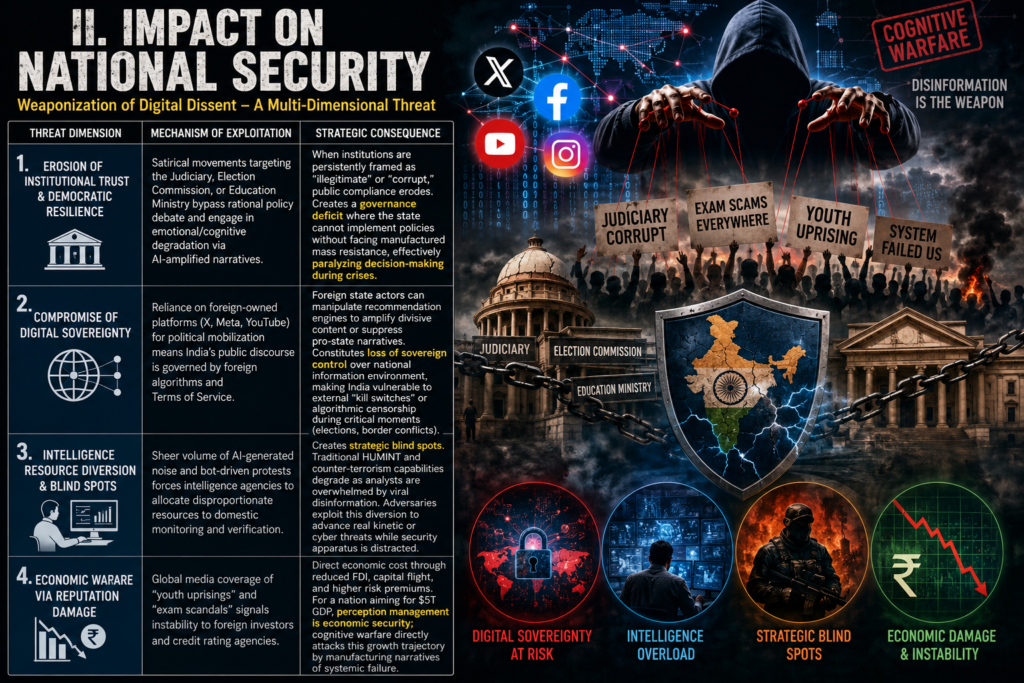
The weaponization of digital dissent poses severe, multi-dimensional threats to India’s security architecture:
| Threat Dimension | Mechanism of Exploitation | Strategic Consequence |
|---|---|---|
| 1. Erosion of Institutional Trust & Democratic Resilience | Satirical movements targeting the Judiciary, Election Commission, or Education Ministry bypass rational policy debate and engage in emotional/cognitive degradation via AI-amplified narratives. | When institutions are persistently framed as “illegitimate” or “corrupt,” public compliance erodes. Creates a governance deficit where the state cannot implement policies without facing manufactured mass resistance, effectively paralyzing decision-making during crises. |
| 2. Compromise of Digital Sovereignty | Reliance on foreign-owned platforms (X, Meta, YouTube) for political mobilization means India’s public discourse is governed by foreign algorithms and Terms of Service. | Foreign state actors can manipulate recommendation engines to amplify divisive content or suppress pro-state narratives. Constitutes loss of sovereign control over national information environment, making India vulnerable to external “kill switches” or algorithmic censorship during critical moments (elections, border conflicts). |
| 3. Intelligence Resource Diversion & Blind Spots | Sheer volume of AI-generated noise and bot-driven protests forces intelligence agencies to allocate disproportionate resources to domestic monitoring and verification. | Creates strategic blind spots. Traditional HUMINT and counter-terrorism capabilities degrade as analysts are overwhelmed by viral disinformation. Adversaries exploit this diversion to advance real kinetic or cyber threats while security apparatus is distracted. |
| 4. Economic Warfare via Reputation Damage | Global media coverage of “youth uprisings” and “exam scandals” signals instability to foreign investors and credit rating agencies. | Direct economic cost through reduced FDI, capital flight, and higher risk premiums. For a nation aiming for $5T GDP, perception management is economic security; cognitive warfare directly attacks this growth trajectory by manufacturing narratives of systemic failure. |
III. IMPACT ON YOUTH FUTURE
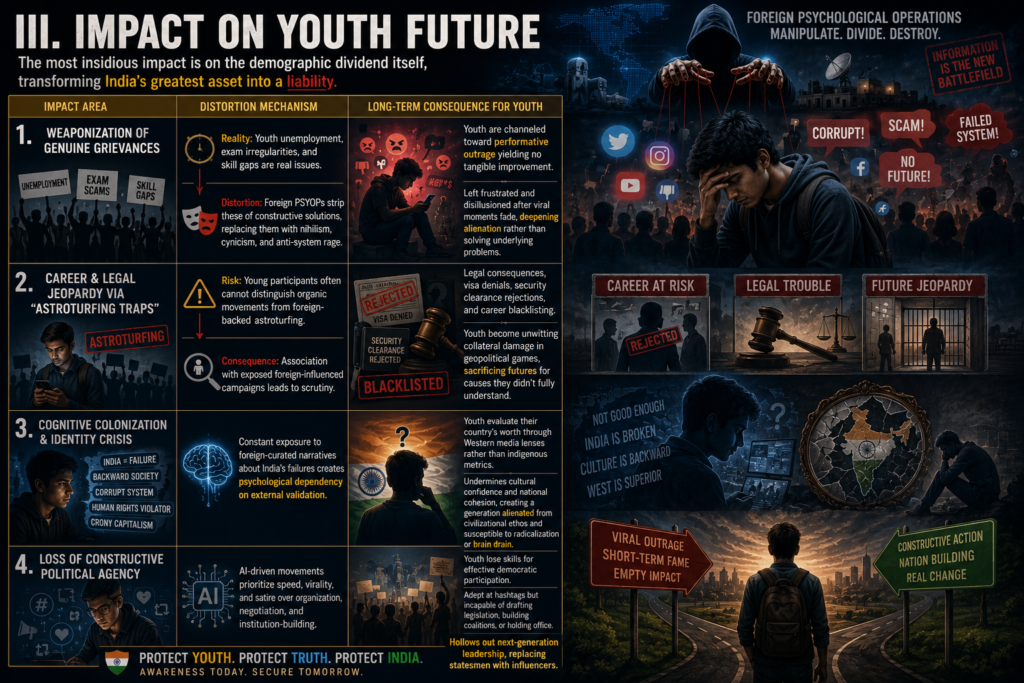
The most insidious impact is on the demographic dividend itself, transforming India’s greatest asset into a liability:
| Impact Area | Distortion Mechanism | Long-Term Consequence for Youth |
|---|---|---|
| 1. Weaponization of Genuine Grievances | Reality: Youth unemployment, exam irregularities, and skill gaps are real issues. Distortion: Foreign PSYOPs strip these of constructive solutions, replacing them with nihilism, cynicism, and anti-system rage. | Youth are channeled toward performative outrage yielding no tangible improvement. Left frustrated and disillusioned after viral moments fade, deepening alienation rather than solving underlying problems. |
| 2. Career & Legal Jeopardy via “Astroturfing Traps” | Risk: Young participants often cannot distinguish organic movements from foreign-backed astroturfing. Consequence: Association with exposed foreign-influenced campaigns leads to scrutiny. | Legal consequences, visa denials, security clearance rejections, and career blacklisting. Youth become unwitting collateral damage in geopolitical games, sacrificing futures for causes they didn’t fully understand. |
| 3. Cognitive Colonization & Identity Crisis | Constant exposure to foreign-curated narratives about India’s failures creates psychological dependency on external validation. | Youth evaluate their country’s worth through Western media lenses rather than indigenous metrics. Undermines cultural confidence and national cohesion, creating a generation alienated from civilizational ethos and susceptible to radicalization or brain drain. |
| 4. Loss of Constructive Political Agency | AI-driven movements prioritize speed, virality, and satire over organization, negotiation, and institution-building. | Youth lose skills for effective democratic participation. Adept at hashtags but incapable of drafting legislation, building coalitions, or holding office. Hollows out next-generation leadership, replacing statesmen with influencers. |
IV. STRATEGIC RECOMMENDATIONS FOR MITIGATION
| Recommendation | Strategic Rationale & Implementation Framework | Expected National Security & Youth Outcome |
|---|---|---|
| 1. Establish a National Cognitive Security Doctrine | Rationale: Information space is now a sovereign domain equivalent to land, sea, air, and cyber. Current defenses are reactive; India needs a proactive doctrine treating narrative integrity as critical infrastructure. Implementation: Create an inter-agency Cognitive Security Command under NSA oversight. Mandate indigenous platform development with algorithmic sovereignty. Require AI watermarking and bot-origin disclosure for all political content. Establish “digital border” protocols to detect foreign-seeded narrative surges in real-time. | Restores sovereign control over national discourse. Reduces vulnerability to foreign “kill switches” or algorithmic manipulation during elections/crises. Creates secure digital ecosystem where organic dissent can flourish without external hijacking. |
| 2. Youth Digital Literacy & Critical Thinking Curriculum | Rationale: Youth are the primary target of cognitive warfare but lack defensive skills. Media literacy must evolve beyond fact-checking to include tradecraft awareness. Implementation: Integrate OSINT verification, source tracing, “Active Measures” history (including Soviet/U.S. precedents), and AI-detection tools into NCERT/UGC curricula. Partner with domestic universities (not foreign-linked institutions) to develop indigenous counter-disinformation modules. Make digital forensics a mandatory elective in journalism, law, and political science programs. | Empowers youth to detect manipulation before becoming unwitting assets. Builds societal immunity against bounce-back disinformation and astroturfing. Cultivates a generation of critical thinkers rather than reactive consumers of viral content. |
| 3. Transparent Grievance Redressal Mechanisms | Rationale: Foreign PSYOPs exploit genuine societal fractures. Denying them this fuel requires addressing root causes with radical transparency, not suppression. Implementation: Establish independent, time-bound inquiry commissions for high-stakes issues (NEET, unemployment). Publish real-time dashboards tracking grievance resolution. Create statutory whistleblower protections for exam/administrative irregularities. Ensure judicial/executive responses are communicated directly to youth via trusted domestic channels, bypassing foreign media validation loops. | Removes the “organic fracture” that foreign actors weaponize. Restores trust in institutions through demonstrable accountability. Transforms youth energy from destructive outrage to constructive engagement with responsive governance. |
| 4. Legal Framework for Foreign Academic/NGO Ties | Rationale: The BU-CIA nexus demonstrates how academic exchanges can serve as intelligence pipelines. Current FCRA/regulatory frameworks don’t address dual-use training in strategic communication/covert action theory. Implementation: Amend FCRA to require disclosure of foreign intelligence-linked training, recruitment events, or curriculum ties for individuals/organizations influencing domestic politics. Mandate registration for “strategic communication” consultants working on political campaigns. Create a vetting protocol for international students/fellows in sensitive fields at foreign institutions with documented intelligence ties. Apply UAPA only to proven coordination with hostile state actors, never to ideological dissent. | Closes the academic-intelligence pipeline used for elite capture and tradecraft transfer. Ensures transparency in foreign influence while protecting legitimate academic exchange. Prevents witting/unwitting agents of influence from operating under guise of civil society or education. |
| 5. Constructive Youth Engagement Channels | Rationale: AI-driven movements prioritize virality over institution-building, hollowing out democratic agency. Youth need formal pathways to convert grievances into policy, not just hashtags. Implementation: Establish statutory Youth Policy Councils at district/state/national levels with binding consultation rights. Create funded fellowships for youth-led policy research and legislative drafting. Institutionalize participatory budgeting for youth-focused programs. Recognize and reward constructive civic engagement (not just protest) through national awards and career incentives. | Rebuilds democratic muscle memory among youth. Converts performative outrage into tangible policy outcomes. Cultivates next-generation leaders skilled in negotiation, coalition-building, and governance—replacing influencers with statesmen. |
CIA Organizational Structure & Strategic Relevance
| CIA Unit / Directorate | Core Function & Key Personnel Links to BU | Relevance to Cognitive Warfare & National Security Assessment |
|---|---|---|
| 1. Directorate of Operations (DO) / National Clandestine Service | Covert arm responsible for HUMINT collection and covert action abroad. Manages case officers, assets, and clandestine communications. • Near East & South Asia Division: Former BU Prof. James R. Hughes served as Chief. • Europe Division: Former BU Prof. Joseph Wippl served as Chief. • Special Projects Element: Richard Bissell Jr. brought in BUPRL personnel during CORONA era. | Validates that BU faculty have led regional operations directly relevant to India (South Asia Division). Confirms graduates are trained by practitioners who executed covert influence campaigns at the highest levels, lending operational credibility to curricula on “Covert Action.” |
| 2. Directorate of Science and Technology (DS&T) | Develops technical collection systems, surveillance tech, satellite reconnaissance, and forensic analysis. • CORONA Program: BU’s BUPRL developed HYAC camera tech spun off to Itek Corp. • Biometrics: Former BU Prof. John D. Woodward Jr. served as technical intel officer and later directed DoD Biometrics Management Office. • Document Forensics: Exposed Soviet forgeries (e.g., 1975 Westmoreland manual). | Links BU’s historical R&D to modern technical intelligence. Woodward’s biometrics expertise informs digital identity verification and bot detection. Document forensics legacy underpins OSINT protocols for detecting AI-generated manifestos and forged protest materials. |
| 3. Office of Communications (OC) | Manages classified comms networks, supports covert broadcasting, and provides infrastructure for information operations. • Supports “foreign media placements” and clandestine radio (e.g., RFE/RL funding/content guidance). | Provides technical backbone for “bounce-back” disinformation campaigns. Modern equivalents include encrypted messaging apps and proxy websites used to seed narratives in target countries while maintaining plausible deniability. |
| 4. Center for the Study of Intelligence (CSI) | Preserves institutional memory; conducts classified/unclassified research on intel history, methodology, and lessons learned. Publishes Studies in Intelligence. • Cited works: Dujmovic on Fecteau/Downey; CORONA histories; Active Measures analyses. | Serves as doctrinal repository for tradecraft taught at BU. Ensures that courses on intelligence history and covert action are grounded in verified operational experience rather than theoretical speculation. |
| 5. Counterintelligence Staff / Division | Protects Agency from penetration; identifies foreign intel threats; vets employees; investigates leaks/moles. • Ames Damage Assessment: Former BU Prof. Joseph Wippl assigned to assess betrayal impacts. • Soviet Active Measures Analysis: CI analysts study KGB/GRU tactics to develop detection protocols (McMahon testimony, 1982). | Directly informs counter-disinformation methodologies taught at BU. Wippl’s Ames experience underscores insider threat risks; CI analysis of Soviet tactics provides forensic templates for detecting modern foreign PSYOPs targeting India. |
| 6. Public Affairs Office / Office of Public Affairs | Manages CIA-media-academia relations; handles press inquiries; facilitates academic outreach; manages declassification. • Arthur S. Hulnick: Chief of PR Unit & Coordinator for Academic Affairs (1987–89); advised DCI; briefed hundreds of groups; became BU’s first CIA Officer-in-Residence. • Presentations Officers: Brief academic/media audiences on intel matters. | Establishes formal pipeline between CIA and academia. Hulnick’s role confirms BU was an active recruitment and curriculum development site, not merely a passive observer. Validates concern that strategic communication training occurs within intelligence-aligned ecosystem. |
| 7. Congressional Affairs Office | Manages CIA-legislative oversight interface; coordinates briefings; ensures compliance with covert action reporting; liaises with members/staff. • Joseph Wippl: Served as Director of Congressional Affairs. | Critical nexus for understanding how covert actions are authorized, funded, and exposed. Wippl’s dual expertise in covert ops and oversight informs BU courses on intelligence accountability and democratic governance—relevant for assessing legal boundaries of foreign influence operations. |
| 8. Foreign Broadcast Information Service (FBIS) (Under CIA until 1996) | Monitors/translates foreign open-source media; disseminates to policymakers/intel consumers. • Essential for tracing disinformation trails (Romerstein/USIA cited FBIS for linking obscure outlets to TASS/Pravda). | Historical precursor to modern OSINT. Provides methodological foundation for tracking “bounce-back” effects: identifying when narratives seeded in foreign/proxy outlets re-enter domestic media as validated global consensus. |
| 9. Covert Action Staff / Special Activities Division | Plans/executes covert action programs (propaganda, political influence, economic disruption, paramilitary). Requires Presidential Finding. • Libyan Campaign (1986): Executed “foreign media placements” authorized via NSDD after NSPG approval. | Demonstrates execution mechanism for state-directed disinformation. Mirrors modern concerns about AI-driven astroturfing campaigns being authorized/coordinated by foreign intelligence services to destabilize target nations like India. |
| 10. Disinformation / Counter-Disinformation Elements | Interagency coordination to counter adversary disinformation. • Project Truth (1981): Fast-reply service (USIA/CIA/State coordination). • Active Measures Working Group: State/CIA/FBI/USIA/DoD body producing reports, alerting media, developing counter-narratives. • Blowback Monitoring: Internal tracking of CIA-planted stories re-entering U.S. media (Woodward noted this contamination risk). | Provides institutional model for India’s proposed Cognitive Security Command. Demonstrates that effective counter-disinformation requires interagency coordination, real-time monitoring, and proactive narrative defense—not just reactive fact-che |
Key Personnel Linking CIA Units to Boston University
These individuals provide direct institutional knowledge of CIA unit structures and tradecraft within BU’s academic environment:
| Name | CIA Unit/Role | BU Role | Relevance |
|---|---|---|---|
Joseph Wippl | DO (Europe Div. Chief, Dir. Congressional Affairs); Ames Damage Team | Prof. of Practice, IR | Teaches covert action, congressional oversight, counterintelligence |
John D. Woodward Jr. | DO (Clandestine Ops); DS&T (Tech Intel); DoD Biometrics | Prof. of Practice, IR; Dir. Military Ed | Teaches biometrics, tech intel, clandestine tradecraft |
Arthur S. Hulnick | DO (Ops/Analysis/Mgmt); Public Affairs Chief; Academic Affairs Coord. | Prof. Emeritus; CIA Officer-in-Residence | Pioneer in academic intel education; public affairs/media liaison |
James R. Hughes | DO (Near East/South Asia Div. Chief); Station Chief | MA Alum; AFIO President | Regional ops expertise; post-career intel community leadership |
Lawrence Martin-Bittman | Czechoslovak Intel (Defector); Active Measures Expert | Prof. Journalism; Dir. Disinfo Doc Ctr | Taught disinformation detection; founded BU’s counter-disinfo center |
Richard Fecteau | DO (Paramilitary Ops) | Alum ’51; Asst. AD Athletics | Distinguished Intelligence Cross recipient; 19 yrs China prison |
William F. Buckley | DO (Station Chief, Beirut) | CAS Alum ’55 | Killed in captivity; CIA Memorial Wall |
Darren James LaBonte | DO (Ops Officer) | Metro College Alum ’06 | Killed Camp Chapman; CIA Memorial Wall |
Keith Alexander/ KeItH B. Alexander | NSA Director; USCYBERCOM Commander | MBA Alum ’78 | Signals intelligence, cyber command leadership |
Operational Relevance of CIA Units to CJP/NEET Assessment
| CIA Unit / Capability | Historical Precedent & BU Nexus | Application to CJP/NEET Investigation & Threat Analysis |
|---|---|---|
| Covert Action Staff / DO | Libyan Case Study (1986): Proves CIA historically used “foreign media placements” and NSDD-authorized “illusionary events” to psychologically destabilize foreign leaders via international press. BU Link: Faculty like Joseph Wippl (former Director of Congressional Affairs) and curriculum on “Covert Action” teach this exact tradecraft. | Modern Media Seeding: Validates that CJP’s rapid global validation (NYT, BBC, CNN) may not be organic but the result of deliberate “foreign media placements” via proxy outlets or influencers. OSINT audits should trace if initial coverage originated from known intelligence-linked nodes before bouncing back to Indian domestic media. |
| Congressional Affairs Office | Oversight Leakage: Wippl’s background demonstrates how sensitive operations can leak through oversight channels or be deliberately amplified via diplomatic/media backchannels to create plausible deniability. BU Link: Wippl taught courses integrating covert ops with democratic accountability. | Diplomatic Backchannel Amplification: Suggests CJP’s sudden legitimacy may reflect leakage or deliberate signaling through diplomatic cables, think tank reports, or academic exchanges rather than grassroots momentum. Intelligence agencies should monitor foreign embassy communications and NGO reports coinciding with viral surges. |
| Directorate of Science & Technology (DS&T) | Technical Evolution: DS&T’s shift from CORONA satellite recon to biometrics/cyber mirrors modern AI-driven astroturfing. Former BU Prof. Woodward (DS&T/Biometrics) links technical intel to identity verification. BU Link: BUPRL’s historical R&D and current cyber/OSINT curricula. | AI-Scale Algorithmic Manipulation: Confirms that tools once used for physical reconnaissance now enable digital influence at scale. CJP’s AI-generated manifestos and bot-driven engagement patterns should be forensically analyzed using DS&T-derived methodologies to distinguish organic virality from state-sponsored technical amplification. |
| Counter-Disinformation Elements | Institutional Capacity: Project Truth and Active Measures Working Groups show U.S. has dual capacity to detect and deploy disinformation. BU Link: Martin-Bittman’s Disinformation Documentation Center explicitly taught journalists to spot these tactics; knowledge embedded in COM/Pardee curricula. | Dual-Use Tradecraft Transfer: Graduates trained at BU possess both offensive (creating illusionary events) and defensive (detecting them) skills. When applied domestically in India, this creates operatives capable of executing sophisticated PSYOPs while evading detection by leveraging counter-disinformation training to mask their own operations. |
| Public Affairs / Academic Liaison | Recruitment Pipeline: Hulnick’s role as CIA Officer-in-Residence and Coordinator for Academic Affairs confirms BU was an active recruitment site, not passive observer. BU Link: Formalized networking (Pardee Works), federal funding alignment, and intelligence faculty mentorship. | Elite Capture & Talent Identification: Students in PR/comms programs were exposed to intelligence professionals identifying talent for influence operations. Abhijeet Dipke’s trajectory (AAP digital campaigns → BU PR Master’s → viral satirical movement) fits this recruitment profile, warranting investigation into whether his methodologies align with taught covert action doctrines. |
This report has been researched, analysed, and prepared by our strategic research partner, the Security Advisor and Research Organisation (SARO).
The Security Advisor and Research Organisation (SARO) is an independent intelligence, strategic research, and advisory organisation dedicated to advancing national security, resilience, and informed decision-making in an increasingly complex global security environment. Through evidence-based research, intelligence analysis, and strategic assessments, SARO supports governments, organisations, businesses, and stakeholders in understanding emerging risks, geopolitical developments, and security challenges.
Strategic Research Partner
Independent Intelligence • Strategic Research • Advisory Excellence