
THE DIGITAL PERIMETER: Assessing the National Security Risks of Commercial Messaging Platforms (WhatsApp) within the Indian Armed Forces and Paramilitary Organizations
1. EXECUTIVE SUMMARY
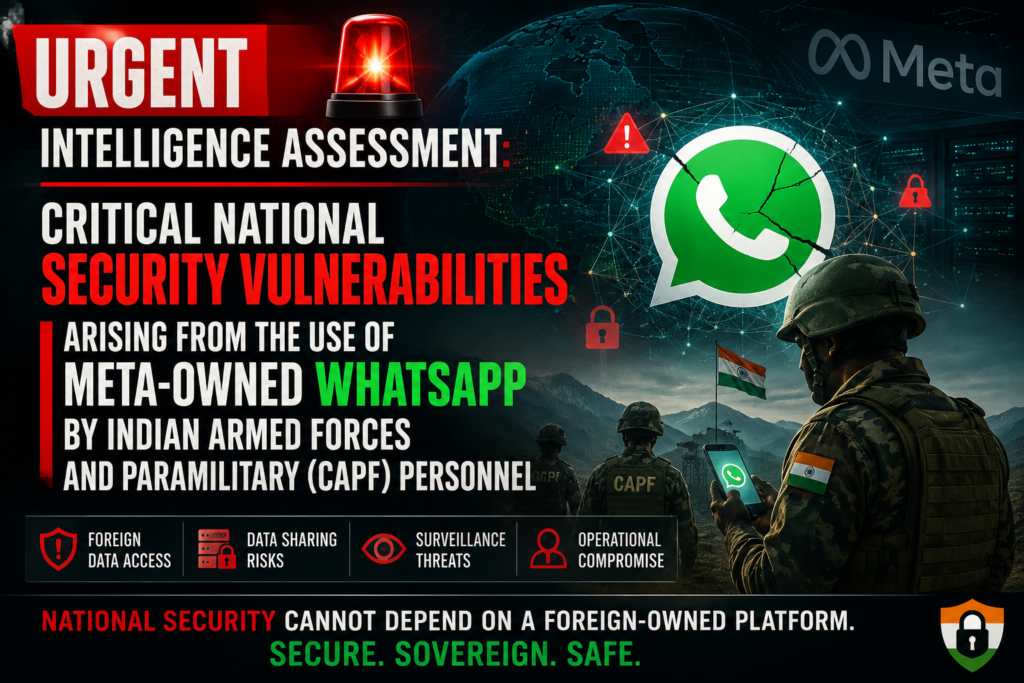
The digital communication habits of the Indian Armed Forces (Army, Navy, Air Force) and Paramilitary organizations (Central Armed Police Forces – CAPF, including BSF, ITBP, CRPF, CISF, and SSB) represent a critical, often overlooked domain of national security. While the use of commercial, foreign-owned messaging applications like WhatsApp (Meta Platforms, Inc.) offers convenience, it introduces severe, systemic vulnerabilities.
This intelligence assessment concludes that the primary threat to Indian defence personnel is not the mathematical breaking of End-to-End Encryption (E2EE), but rather endpoint compromise, metadata harvesting, and jurisdictional exploitation by foreign state-sponsored actors. The continued reliance on Meta-owned ecosystems by military and paramilitary personnel poses an unacceptable risk to India’s operational security, digital sovereignty, and the physical safety of its service members.
2. THREAT ASSESSMENT: TECHNICAL VECTORS OF COMPROMISE
To understand the risk, it is imperative to separate cryptographic theory from operational reality. WhatsApp’s E2EE secures the payload in transit, but it leaves the endpoint and the surrounding metadata ecosystem highly vulnerable.
Vector A: Endpoint Compromise (Bypassing E2EE)
Advanced foreign intelligence agencies (such as the U.S. Intelligence Community and China’s Ministry of State Security) do not need to break WhatsApp’s encryption algorithms. Instead, they target the endpoint—the physical smartphone.
- Zero-Day Exploits & Spyware: State-sponsored actors deploy military-grade commercial spyware (e.g., Pegasus) or custom zero-day exploits to gain kernel-level access to iOS and Android devices.
- Pre-Encryption/Post-Decryption Capture: Once the device is compromised, the malware captures keystrokes, records screen activity, and extracts messages directly from the device’s RAM before WhatsApp encrypts the data for transmission, or after it is decrypted for the user to read. The transit encryption is rendered entirely irrelevant.
Vector B: Metadata Harvesting & Jurisdictional Subpoena
E2EE does not encrypt metadata. Meta’s servers process and store vast amounts of unencrypted metadata, including IP addresses, device identifiers, precise timestamps, and contact graphs.
- The U.S. CLOUD Act & FISA 702: As a U.S.-domiciled corporation, Meta is subject to the U.S. CLOUD Act and the Foreign Intelligence Surveillance Act (FISA). U.S. intelligence agencies can legally compel Meta to hand over this metadata via National Security Letters (NSLs), often accompanied by permanent gag orders.
- Tactical Impact: For the military and CAPFs, metadata is as lethal as message content. It allows hostile actors to map the entire chain of command, track the geolocation of border-guarding forces (like ITBP in the Himalayas), and identify key nodes in military communication networks without ever reading a single message.
Vector C: The AI & Cloud Infrastructure Nexus
A common misconception is that the U.S. Intelligence Community uses Meta’s commercial cloud servers. This is factually incorrect. The CIA and NSA rely on heavily vetted, federal-grade infrastructure like the Commercial Cloud Enterprise (C2E) consortium (AWS, Microsoft, etc.).
- The Real Threat (Meta AI Integration): While Meta does not host U.S. classified cloud data, Meta’s open-source AI models (such as the Llama series) have been explicitly authorized for deployment within secure, isolated U.S. government cloud environments.
- Weaponization of AI: This enables foreign intelligence agencies to leverage Meta’s advanced, state-of-the-art analytical AI tools to process, correlate, and weaponize the intercepted metadata and communications of Indian defense personnel.
3. OPERATIONAL IMPACT ON INDIAN DEFENSE & CAPF
The exploitation of the aforementioned vectors results in direct, tangible threats to India’s national security apparatus:
- Network & Command Mapping: Intelligence agencies can identify key nodes, informal communication channels, and the exact hierarchy within military units and CAPF battalions.
- Geolocation & Troop Movement Tracking: Correlation of IP addresses and timestamps allows hostile states to deduce troop movements, forward operating base locations, and the real-time whereabouts of high-value personnel in sensitive border areas.
- Social Engineering & Blackmail: Harvesting of personal contacts, family details, and behavioral patterns allows hostile actors to craft highly targeted phishing attacks or compromise personnel through blackmail.
- Lateral Movement into Secure Networks: A compromised personal smartphone can serve as a digital bridge. If a soldier uses the same device or network to access broader, secure military networks (e.g., AFNET), it provides a pathway for malware to infiltrate classified defense infrastructure.
4. STRATEGIC RECOMMENDATIONS FOR THE GOVERNMENT OF INDIA
The Helpful Foundation’s National Security Section urgently recommends the following policy and technical interventions for the Ministry of Defence (MoD), Ministry of Home Affairs (MHA), and the National Security Council Secretariat (NSCS):
Recommendation 1: Enforce Zero-Trust Architecture & Technical Blocking
Issue a strict, zero-tolerance directive prohibiting the use of WhatsApp and all Meta-owned applications on devices used for official or sensitive communication by both Armed Forces and Paramilitary (CAPF) personnel. This must be technically enforced via Mobile Device Management (MDM) solutions and network-level geofencing to block Meta’s IP addresses and domains on all military and paramilitary installations.
Recommendation 2: Accelerate Migration to Indigenous Platforms
Fast-track the mandatory, widespread deployment of certified, militarily graded secure communication platforms, such as the upgraded SANDes (Secure Application for Internet) and CGNet. Ensure all ranks across the Armed Forces and CAPF are equipped with state-owned, audited hardware and software that comply with Indian data localization and security laws.
Recommendation 3: Mandate Continuous Threat Hunting
Authorize the Defence Cyber Agency (DCyA), the National Critical Information Infrastructure Protection Centre (NCIIPC), and CERT-In to conduct periodic, random forensic audits of communication devices used by personnel in sensitive postings. This will detect and neutralize any state-sponsored spyware or endpoint compromises before data exfiltration occurs.
Recommendation 4: Institutionalize Advanced Cyber-Hygiene Training
Integrate mandatory, recurring cybersecurity awareness programs into the standard training curriculum for both military and paramilitary forces. Personnel must be specifically educated on the dangers of metadata leakage, cloud backup vulnerabilities, and social engineering tactics.
5. CONCLUSION
In modern hybrid warfare and internal security operations, the digital domain is as critical as the physical border. Relying on foreign-owned, commercially driven platforms subject to foreign legal jurisdictions for the communication of our Armed Forces and Paramilitary personnel is an unacceptable strategic risk.
The Indian Armed Forces and CAPFs secure our physical borders with unmatched valor; it is the duty of the state to secure their digital borders with equal rigor. Strengthening our digital defenses and achieving true communication sovereignty is paramount to safeguarding the Republic and the safety of our service members.
This report has been researched, analysed, and prepared by our strategic research partner, the Security Advisor and Research Organisation (SARO).
The Security Advisor and Research Organisation (SARO) is an independent intelligence, strategic research, and advisory organisation dedicated to advancing national security, resilience, and informed decision-making in an increasingly complex global security environment. Through evidence-based research, intelligence analysis, and strategic assessments, SARO supports governments, organisations, businesses, and stakeholders in understanding emerging risks, geopolitical developments, and security challenges.
Strategic Research Partner
Independent Intelligence • Strategic Research • Advisory Excellence