
India’s National Security Failure and Institutional Negligence: An Analysis of Alleged Intelligence and Security Lapses
This report examines allegations of intelligence failures, security lapses, and institutional accountability involving the PMO, NSA Ajit Doval, and the Ministry of Home Affairs, including claims relating to suspected foreign intelligence influence and national security risks.
BACKGROUND OF MSS
The Ministry of State Security (MSS) (Chinese: 中华人民共和国国家安全部; Guójiā Ānquánbù) is the primary civilian intelligence, security, and secret police agency of the People’s Republic of China (PRC).
It is one of the most powerful and secretive organs of the Chinese Communist Party (CCP) and the Chinese government.
The Ministry of State Security (MSS) is the primary civilian intelligence and security agency of the People’s Republic of China. Responsible for foreign intelligence, counterintelligence, covert operations, and political security, it is considered one of the world’s largest and most secretive intelligence services.
The MSS maintains an extensive network of semi-autonomous branches throughout China and oversees the State Security Police, the country’s secret police force. Headquartered at Yidongyuan in Beijing’s Haidian District, the ministry plays a central role in protecting China’s national security and advancing the strategic interests of the Chinese state.
Here is a comprehensive overview of the MSS, its history, functions, and structure:
1. Core Mandate and Functions
The MSS operates at the intersection of foreign intelligence gathering and domestic political security. Its primary responsibilities include:
| Core Function | Description / Key Activities |
|---|---|
| Foreign Intelligence | Gathering political, economic, military, scientific, and technological intelligence outside of China to inform the CCP’s decision-making. |
| Counterintelligence | Identifying, monitoring, and neutralizing foreign intelligence operations and spies within China. |
| Domestic Political Security (Secret Police) | Suppressing dissent and maintaining the political supremacy of the CCP. The MSS monitors and targets human rights activists, political dissidents, religious groups (such as Falun Gong or underground Christians), and ethnic separatist movements (in Tibet, Xinjiang, and Inner Mongolia). |
| Cyber and Economic Espionage | Conducting and overseeing cyber espionage operations to steal foreign trade secrets, intellectual property, and advanced technology to support China’s economic and military modernization. |
| Protection of Leadership | Providing intelligence and security assessments to protect the top leadership of the CCP. |
2. History and Formation
The MSS was established in the summer of 1983 during a government reorganisation. It was created by merging several existing intelligence and security agencies to consolidate the CCP’s intelligence apparatus.
| Aspect | Details |
|---|---|
| Establishment | Formed in the summer of 1983 during a government reorganization. |
| Purpose of Merger | To consolidate the CCP’s intelligence apparatus and create a single, unified “KGB-style” agency capable of handling both foreign espionage and domestic political threats. |
| Agencies Absorbed | • Central Investigation Department (CID) of the CCP: Handled foreign intelligence and clandestine operations. • Ministry of Public Security (MPS): Contributed its counterintelligence and political security departments. • People’s Liberation Army (PLA): Contributed its central intelligence department. • United Front Work Department: Contributed its intelligence sections (in some capacities). |
3. Organisational Structure
The MSS is formally a ministry under the State Council (China’s cabinet), but in reality, it takes its direct orders from the CCP Central Committee and the Central Politburo.
| Aspect | Details |
|---|---|
| Formal Status | Formally a ministry under the State Council (China’s cabinet), but in reality, takes direct orders from the CCP Central Committee and the Central Politburo. |
| Leadership | Headed by a Minister. As of 2023, the Minister of State Security is Chen Yixin. The Minister is typically a member of the CCP’s Central Committee and often holds a seat on the Central Political and Legal Affairs Commission (CPLAC), which oversees all of China’s security and legal organs. |
| Headquarters | Located in a highly secure compound at No. 1 Dongsi Qiantiao, Dongcheng District, Beijing. |
| The Bureau System | The headquarters in Beijing is divided into specialized “Bureaus” (numbered 1 through 18+). • Internal Administration: Some bureaus handle personnel, training, and logistics. • Geographic Regions: Some handle specific regions (e.g., 18th Bureau for the US, 15th for Taiwan, 3rd for Hong Kong/Macao). • Specific Functions: Some handle specific functions (e.g., 1st Bureau for domestic security, 2nd for foreign intelligence, 13th for cyber/tech). |
| Cover Identities | Many MSS bureaus operate under public-facing “cover” organizations, such as think tanks, academic institutes, or technology centers. • Example 1: The 11th Bureau operates under the cover of the China Institutes of Contemporary International Relations (CICIR). • Example 2: The 13th Bureau uses the China Information Technology Security Evaluation Center (CNITSEC). |
| Provincial Branches | Below the national headquarters, the MSS has a State Security Department (or Bureau) in every province, autonomous region, and major municipality. These local branches execute national directives while managing regional assets and domestic dissidents. |
4. Operational Tactics and Global Reach
The MSS is known for its highly sophisticated, long-term, and patient approach to intelligence gathering.
| Operational Tactic | Description / Key Activities |
|---|---|
| Human Intelligence (HUMINT) | The MSS heavily recruits human sources, including foreign diplomats, business people, academics, and students studying in China. |
| Diaspora and United Front | The MSS works closely with the United Front Work Department (UFWD) to leverage overseas Chinese communities, student associations, and business groups to gather intelligence and influence foreign policies. |
| Cyber Operations | While the PLA handles military cyber warfare, the MSS is heavily involved in civilian cyber espionage, often targeting foreign corporations, government contractors, and critical infrastructure. |
| “Thousand Grains of Sand” Approach | Rather than relying solely on stealing massive, highly classified documents, the MSS often collects vast amounts of unclassified or “open-source” data (academic papers, business registrations, local news) and uses big data analytics to piece together a comprehensive intelligence picture. |
5. Relationship with Other Agencies
The MSS does not operate in a vacuum; it is part of a broader, overlapping Chinese security apparatus:
| Agency / Legal Framework | Role and Relationship with MSS |
|---|---|
| Ministry of Public Security (MPS) | The national police force handling ordinary criminal law enforcement, traffic, and fire safety. While the MSS handles “political security” and espionage, the line between the two can blur as both possess domestic surveillance and secret police powers. |
| People’s Liberation Army (PLA) | The PLA’s intelligence branches (such as the Intelligence Bureau of the Joint Staff Department) focus on military intelligence, whereas the MSS focuses on state, political, and economic intelligence. The two agencies cooperate but also compete for resources and influence. |
| National Intelligence Law (2017) | The MSS is the primary civilian executor of this law, which legally mandates that all Chinese citizens and organisations must “support, assist, and cooperate with the state intelligence work.” |
6. Core Intelligence and Operational Bureaus
The Chinese Ministry of State Security (MSS) is organised into over 18 specialised central bureaus at its Beijing headquarters, each handling distinct functional domains. Additionally, the MSS operates a decentralised network of state security departments in each of China’s 31 provincial-level administrative divisions.
| Bureau Number & Name | Focus Area and Responsibilities |
|---|---|
| 1st Bureau (Domestic) | Manages internal affairs and domestic security in each Chinese province. It resembles the First General Bureau of the KGB and operates mainly within China. |
| 2nd Bureau (Foreign Intelligence) | Responsible for collecting foreign intelligence. |
| 3rd Bureau | Focuses on intelligence and operations regarding Hong Kong, Macao, and Taiwan. |
| 4th Bureau (Technology) | Handles technological intelligence and operations. |
| 5th Bureau (Local Intelligence) | Manages local-level intelligence gathering. |
| 6th Bureau | Dedicated to counterintelligence and economic security. |
| 7th Bureau | Responsible for circulation, surveillance, and counterespionage. |
| 8th Bureau (Research) | Historically, the 8th Bureau of the former Central Investigation Department (CID), it was absorbed into the MSS and is associated with the Institute of Contemporary International Relations (CICIR). |
| 9th Bureau (Anti-Defection and Counter-Surveillance) | Monitors foreign activity within China and prevents defections among MSS cadres and Chinese institutions abroad. |
| 10th Bureau (Overseas Operations) | Part of China’s broader overseas intelligence network, managing an estimated 40,000 operatives embedded globally. |
| 11th Bureau (CICIR) | The China Institutes of Contemporary International Relations (CICIR) serves as the cover identity for this bureau, which focuses on foreign intelligence analysis and open-source research. (Note: CICIR is sometimes referred to as the 8th Bureau due to its CID origins, but is officially designated as the 11th Bureau within the MSS structure. |
| 12th Bureau (Scientific and Technological Intelligence) | Focuses on science and technology intelligence gathering and acts as a liaison under the Office of Foreign Affairs. |
| 13th Bureau (Information Technology) | Handles information technology and cyber operations; its cover identity is the China Information Technology Security Evaluation Center. |
| 14th Bureau (Technical Reconnaissance) | The primary designated unit for technical reconnaissance operations. |
| 15th Bureau (Taiwan Operations) | Responsible for intelligence operations targeting Taiwan; its cover identity is the Institute of Taiwan Studies. |
| 16th Bureau (Image Intelligence) | Dedicated to image and geospatial intelligence analysis. |
| 17th Bureau (Business Bureau) | Handles business-related intelligence and front operations. |
| 18th Bureau (U.S. Operations / Legal Affairs) | Conducts clandestine operations targeting the United States and also functions as the Legal Affairs Bureau. |
7. MSS Headquarters (Core Bureaus)
The central headquarters houses the leadership and the majority of the core operational bureaus (including the 1st, 2nd, 3rd, 4th, 5th, 6th, 7th, 9th, and administrative bureaus).
| Aspect | Details |
|---|---|
| Function / Housed Units | Houses the leadership and the majority of the core operational bureaus (including the 1st, 2nd, 3rd, 4th, 5th, 6th, 7th, 9th, and administrative bureaus). |
| Official Address | No. 1 Dongsi Qiantiao Alley, Dongcheng District, Beijing, China (北京市东城区东四前头条1号). |
| Additional Facilities | The MSS also utilizes several other large, secure government compounds in the Dongcheng and Xicheng districts of Beijing to house overflow and highly sensitive operational units. |
8. Public-Facing / Cover Identity Bureaus
Several MSS bureaus operate under the guise of academic, scientific, or policy research institutes. These entities have public-facing addresses where they conduct open-source research, host conferences, and interact with foreign entities.
| Bureau / Cover Identity | Address | Function / Notes |
|---|---|---|
| 11th Bureau (CICIR) (China Institutes of Contemporary International Relations) | No. 3 Xiaoguancun Nanlu, Haidian District, Beijing, China. | Acts as the MSS’s primary foreign intelligence analysis think tank and open-source research centre. |
| 13th Bureau (CNITSEC) (China Information Technology Security Evaluation Center) | No. 7 Chegongzhuang West Road, Haidian District, Beijing, China. | Handles information technology, cybersecurity operations, and technical evaluations. |
| 15th Bureau (Institute of Taiwan Studies) | Generally operates out of secure academic or government facilities in Beijing (often associated with the Haidian University District or secure MSS compounds). Specific street addresses for the operational bureau are not publicly listed. | Focuses on intelligence gathering and analysis regarding Taiwan. |
| 8th Bureau / CICIR (Historical Context) | Same as the 11th Bureau (No. 3 Xiaoguancun Nanlu, Haidian District, Beijing, China). | Predecessor to the 11th Bureau. Originally, the 8th Bureau of the Central Investigation Department (CID) before being reorganized into the MSS structure. |
9. Provincial and Municipal Bureaus
Below the central headquarters in Beijing, the MSS maintains a decentralised network of local branches across the country.
| Aspect | Details |
|---|---|
| Structure and Presence | Maintains a State Security Department (or Bureau) in every one of China’s 31 provincial-level administrative divisions, as well as in major municipalities. |
| Addresses and Locations | Do not use public street addresses for their operational headquarters. Instead, they are housed in secure, heavily guarded government compounds in their respective provincial capitals (e.g., the Beijing State Security Bureau operates out of a secure compound in Beijing, the Shanghai State Security Bureau in Shanghai, etc.). |
| Public Interaction | If a provincial bureau needs to interact with the public (e.g., for administrative tasks or counter-espionage reporting), they typically use standard municipal government service centres or designated public security buildings. |
10. How Has the Government of India Allegedly Neglected National Security Threats Posed by the 11th Bureau (CICIR – China Institutes of Contemporary International Relations)?
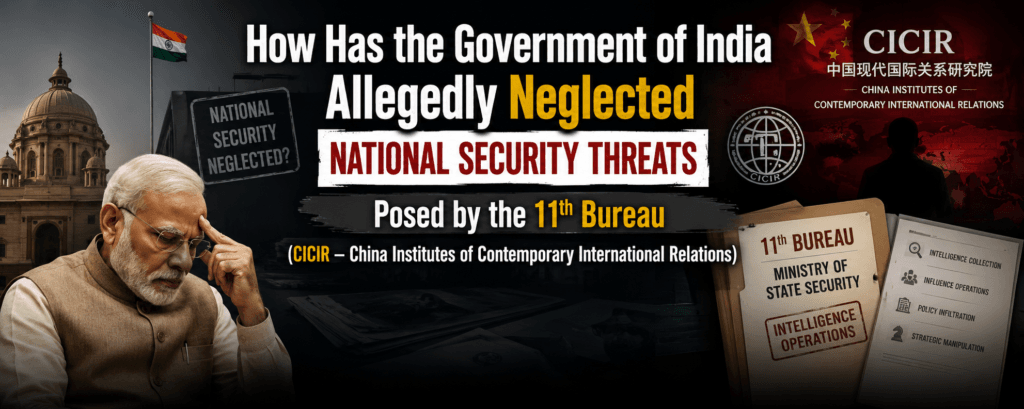
Summary: The Threat of the 11th Bureau (CICIR) to India
| Aspect | Details / Description |
|---|---|
| Nature of the Threat | The threat is primarily asymmetric, cognitive, and strategic. The bureau operates in the “gray zone” of warfare and does not conduct kinetic operations (such as sabotage or assassinations). |
| Operational Methods | Instead of relying on traditional spies or cyber hacks, the 11th Bureau exploits India’s open, democratic, and academic environments. It uses intelligence gathering, academic exchanges (e.g., hosting Indian scholars in Beijing or sending delegations to New Delhi), and open-source research to map vulnerabilities and shape global narratives. |
| Strategic Objective | Acts as the architect of China’s long-term intellectual and strategic campaign against New Delhi. Every interaction is used to actively refine strategies designed to contain, pressure, and outmaneuver India. |
| Role within the MSS | Functions as the “analytical brain” of China’s intelligence apparatus. Its primary value lies in its ability to gather deep intelligence, predict Indian actions, and formulate the CCP’s overall strategic playbook against India. |
Here is a detailed breakdown of how the 11th Bureau (CICIR) specifically threatens India:
10.1 Intelligence Gathering via “Track II” Diplomacy (HUMINT)
The most direct threat CICIR poses to India is its use of academic and diplomatic engagements as a cover for Human Intelligence (HUMINT) gathering.
| Aspect | Details / Description |
|---|---|
| Core Threat Overview | Utilizing academic and diplomatic engagements as a cover for Human Intelligence (HUMINT) gathering against India. |
| Access to the Elite | Because CICIR is globally recognized as a top-tier Chinese think tank, its “researchers” (who are actually MSS intelligence officers) are granted high-level access to India’s strategic establishment. They regularly interact with retired Indian military generals, former NSA officials, top bureaucrats, and influential journalists. |
| Eliciting Information | In closed-door “Track II” dialogues, CICIR officers use sophisticated elicitation techniques to extract information about India’s internal debates, military readiness, and political red lines regarding the Line of Actual Control (LAC). |
| The Threat to Participants | Indian participants often believe they are engaging in frank academic exchanges, unaware that they are being systematically debriefed by the MSS to understand the Indian state’s psychological and strategic thresholds. |
10.2. Strategic Profiling and “Red Teaming” for the CCP
The 11th Bureau is responsible for creating deep-dive psychological and strategic profiles of India’s decision-makers.
| Aspect | Details / Description |
|---|---|
| Mapping the Leadership | CICIR maintains extensive dossiers on current and future Indian leaders. They analyze the ideological leanings, decision-making styles, and political vulnerabilities of Indian Prime Ministers, Defense Ministers, and Army Commanders. |
| Predictive Analysis | By understanding how specific Indian leaders react to pressure, the 11th Bureau can predict New Delhi’s response to Chinese actions (such as a border incursion or a blockade). This allows the MSS to advise the CCP on exactly how much pressure to apply without triggering a full-scale war. |
| Red Teaming | When the Indian military conducts a major exercise or the government passes a new policy, CICIR acts as the “Red Team,” analysing the move from Beijing’s perspective. This helps the MSS determine India’s actual strategic intentions, stripping away public diplomatic posturing. |
10.3. Weaponising Academia for Territorial Claims
CICIR scholars are frequently utilised by the Chinese state to legitimise its territorial claims against India in the court of global public opinion and international law.
| Aspect | Details / Description |
|---|---|
| Core Strategy | Utilizing scholars to legitimize China’s territorial claims against India in the court of global public opinion and international law. |
| Targeted Territories & Methods | Arunachal Pradesh (Zangnan) and Aksai Chin: CICIR researchers regularly publish papers, host conferences, and release “historical evidence” asserting that Arunachal Pradesh belongs to China. |
| The Threat | By publishing these claims under the guise of objective academic research, CICIR attempts to normalise China’s maximalist territorial claims globally, making it harder for India to defend its sovereignty in international forums. |
10.4. Exploiting India’s Internal Fault Lines
A core mandate of the 11th Bureau’s South Asian division is to map India’s domestic vulnerabilities to advise Beijing on how to exploit them.
| Aspect | Details / Description |
|---|---|
| Identifying Pressure Points | CICIR conducts rigorous analysis of India’s internal dynamics, including ethnic tensions in the Northeast, the situation in Jammu & Kashmir, religious polarization, agrarian distress, and political opposition movements. |
| Asymmetric Pressure | If the MSS wants to pressure India during a border standoff without firing a shot, the 11th Bureau provides the analytical blueprint on how to do so. This could involve advising Beijing to amplify separatist narratives, leak sensitive information to Indian media to cause political embarrassment, or use economic leverage to exacerbate domestic economic pain. |
10.5. Formulating the Anti-Quad and Containment Playbook
As India aligns more closely with the West through the Quad (India, US, Japan, Australia), the 11th Bureau has pivoted significant resources to studying and countering this alliance.
| Aspect | Details / Description |
|---|---|
| Driving Wedges | CICIR produces extensive research on the friction points within the Quad and India’s relationships with the Global South. They analyze where India’s interests diverge from the US (e.g., on Russia, trade, or climate) and advise the Chinese Foreign Ministry on how to exploit these differences to isolate New Delhi. |
| Indian Ocean Region (IOR) | CICIR closely monitors India’s naval modernization and its “Act East” policy. They provide the MSS with strategic assessments on how China can counter India’s influence in the IOR, often recommending increased Chinese naval presence or deeper ties with India’s neighbors (like Pakistan, Sri Lanka, and the Maldives). |
10.6. Water Hegemony and Infrastructure Analysis
CICIR also plays a role in analysing the strategic implications of transboundary rivers, specifically the Brahmaputra (Yarlung Tsangpo).
| Aspect | Details / Description |
|---|---|
| Strategic Focus | Analyzing the strategic implications of trans-border rivers, specifically the Brahmaputra (Yarlung Tsangpo), which flows from China into India. |
| Research Scope | CICIR researchers study the impact of China’s upstream dam-building and diversion projects. They assess how India’s downstream infrastructure and agriculture are vulnerable to Chinese manipulation of water flow. |
| Strategic Leverage | This analysis provides the MSS with options to use water as a strategic lever against India during times of heightened tension—potentially threatening water security, agricultural output, and regional stability. |
11. Analysis of Recent CICIR Delegations and Engagements in India
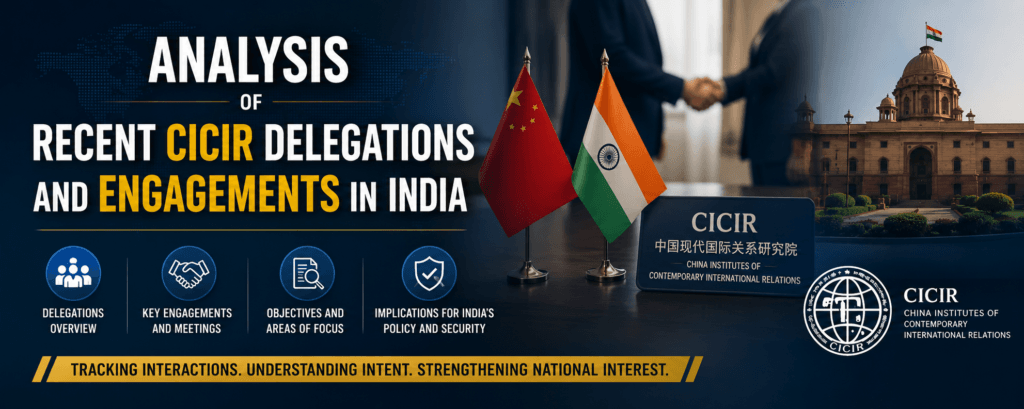
CICIR Delegation Visit to Vivekananda International Foundation (VIF)
This event marked the resumption of dialogues between the two think tanks after a long gap since 2019.
| Aspect | Details |
|---|---|
| Event Overview | A high-level CICIR delegation visited the Vivekananda International Foundation (VIF) in New Delhi, led by Dr. Hu Shisheng (Special Assistant to the President of CICIR). |
| Delegation Members | • Dr. Fu Mengzi: Vice President, CICIR • Dr. Hu Shisheng: Special Assistant to the President of CICIR & Director, Institute of South Asian Studies • Mr. Xu Xiaotian: Director, Institute of Maritime Studies • Dr. Guo Chunmei: Senior Researcher, Institute of Southeast Asian Studies • Mr. Zhang Xinbo: Assistant Researcher, Institute of Maritime Studies • Mr. Wang Se: Assistant Researcher, Institute of South Asian Studies |
| Topics Discussed | • India-China bilateral relations • India’s economic growth and governance • Indo-Pacific concept and China’s concerns • Quadrilateral Security Dialogue (Quad) • Belt and Road Initiative (BRI) • Cultural exchanges between India and China |
PART A – Security Failure & Negligence Report: NSA AJIT DOVAL
12. The Founder of the Vivekananda International Foundation (VIF): Background and Vision
(Excerpt from: PART A – Security Failure & Negligence Report: NSA AJIT DOVAL)
| Aspect / Section | Details |
|---|---|
Primary Founder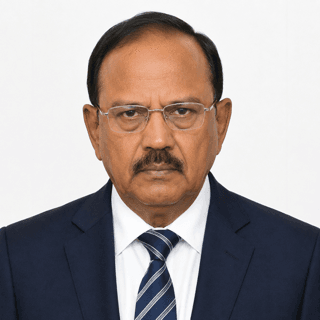 | Ajit Doval (National Security Advisor to the Prime Minister of India) • Role in VIF: Founder Director of the Vivekananda International Foundation, which was established in 2009. • Background: A highly decorated former Indian police officer who previously served as the Director of the Intelligence Bureau (IB). |
| Parent Organization & Ideological Backing | • Umbrella Organization: The VIF was established under the umbrella of Vivekananda Kendra. • Vivekananda Kendra: A spiritually-based service organization inspired by the philosophy of Swami Vivekananda, founded in the 1970s by prominent RSS leader Eknath Ranade. • Affiliations: It is affiliated with the Rashtriya Swayamsevak Sangh (RSS) and the broader Sangh Parivar. |
| Composition and Purpose | • Composition: The foundation was established through the collaborative efforts of India’s leading security, military, and diplomatic experts. • Purpose: It operates as a New Delhi-based public policy think tank with a primary focus on national security, international relations, and Indian history. |
13. Interaction with China Institutes of Contemporary International Relations (CICIR)
| Aspect | Details |
|---|---|
| Event Overview | The Vivekananda International Foundation (VIF) hosted a delegation from the China Institutes of Contemporary International Relations (CICIR), Beijing, on April 25, 2019. The delegation consisted of researchers from various institutes within CICIR. |
| Context of CICIR | CICIR operates as the 11th Bureau of China’s Ministry of State Security (MSS), making it an intelligence-linked entity rather than a purely academic institution. |
| Redefining “Security Breach” | In the context of Track II diplomacy with organizations like CICIR, a “security breach” does not refer to hacking into a computer network. Instead, it refers to Strategic Intelligence Leakage or Human Intelligence (HUMINT) Elicitation. |
| Objective of the Visit | When an intelligence-linked think tank visits a strategic think tank like VIF, the primary goal is to extract sensitive strategic information through sophisticated elicitation techniques without the host realizing they are being systematically interrogated. |
Analysis of Intelligence Leakage in Track II Diplomacy
(Using the VIF-CICIR interaction as a case study)
| Aspect | Details |
|---|---|
| Context of Track II Diplomacy | In the realm of Track II diplomacy involving organizations like CICIR (which operates as the 11th Bureau of China’s Ministry of State Security), traditional definitions of security threats do not always apply. |
| Definition of a “Security Breach” | In this context, a security breach does not mean hacking into a computer network. Instead, it refers to Strategic Intelligence Leakage or Human Intelligence (HUMINT) Elicitation. |
| Objective of the Visit | When an intelligence-linked think tank visits a strategic think tank like the Vivekananda International Foundation (VIF), the primary goal is to extract sensitive strategic information without the host realizing they are being interrogated. |
| Analytical Focus | This section provides an analysis of how a “security breach” (intelligence leakage) actually occurs in these diplomatic settings, using the provided VIF-CICIR interaction as the specific case study. |
13.1. How the “Breach” Occurs: Intelligence Gathering Techniques
Intelligence officers disguised as researchers use sophisticated psychological and conversational techniques to extract information. In the provided text, several of these techniques are visible:
| Intelligence Gathering Technique | Details / Application in the Interaction |
|---|---|
| Targeted Elicitation | The text notes that “The questions from the Chinese delegation were focused on India’s economic growth and Indo-Pacific.” By asking seemingly academic questions about India’s economy or maritime strategy, CICIR delegates are trying to gauge India’s internal confidence, economic vulnerabilities, and future strategic calculations. |
| Probing for Red Lines (The “Bait”) | The Chinese delegates explicitly stated their belief that the “Indo-Pacific strategy appears to be aimed at China.” This is a classic elicitation tactic. By making a provocative statement, they force the Indian hosts to react. The way the Indian hosts respond (e.g., Lt. Gen. Sawhney clarifying that the Quad is “informal” and “not a military alliance”) tells CICIR exactly where India’s strategic red lines are and how far India is willing to go to antagonize China. |
| Profiling the Adversary’s Mindset | VIF is deeply connected to India’s national security establishment (founded by NSA Ajit Doval). By interacting with VIF fellows, CICIR is profiling the thought processes of India’s strategic community. They are looking for internal disagreements, unannounced policy shifts, or the personal biases of key decision-makers. |
13.2. What Crosses the Line into an Actual “Security Breach”?
In a Track II setting, a “breach” happens when a host inadvertently crosses the line from discussing public policy to revealing classified or highly sensitive information.
| Type of Breach | Description / How it Occurs |
|---|---|
| Revealing Unannounced Policy | An expert accidentally reveals that the Indian government is secretly planning a specific military deployment or a new diplomatic initiative that hasn’t been made public yet. |
| Disclosing Vulnerabilities | An expert gets too comfortable and discusses specific technical weaknesses in India’s border infrastructure, cyber defenses, or naval capabilities under the guise of “academic analysis.” |
| Confirming Suspicions | Sometimes, the intelligence agency already has a hypothesis. If an Indian expert casually confirms a detail that China was unsure about, it validates their intelligence and constitutes a breach of operational security. |
Summary
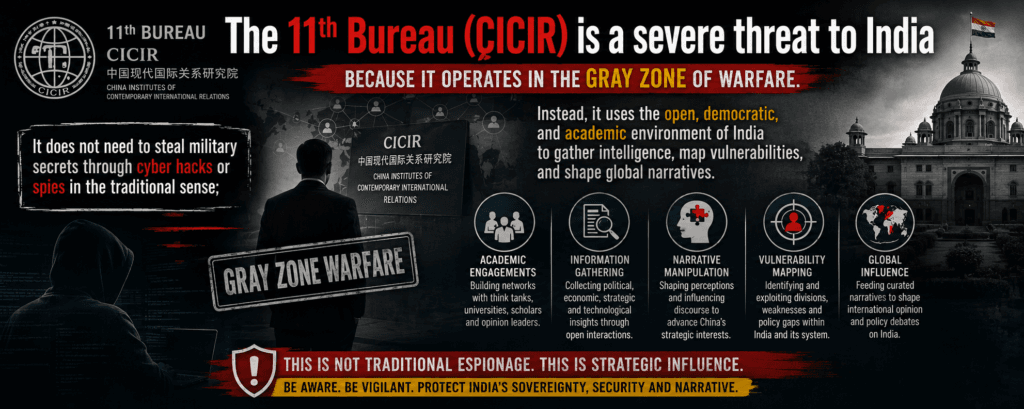
The 11th Bureau (CICIR) is a severe threat to India because it operates in the gray zone of warfare. It does not need to steal military secrets through cyber hacks or spies in the traditional sense; instead, it uses the open, democratic, and academic environment of India to gather intelligence, map vulnerabilities, and shape global narratives.
Every time a CICIR delegation visits New Delhi or hosts an Indian scholar in Beijing, the MSS is actively refining its strategy to contain, pressure, and outmanoeuvre India. They are the architects of China’s long-term intellectual and strategic campaign against New Delhi.
14. Welcome Remarks by the Director on the visit of the CICIR delegation to the VIF on 30 Nov 2023
Context: NSA Ajit Doval met his Chinese counterpart on the sidelines of the BRICS NSA meetings in July 2023. Earlier, EAM Sh Jaishankar met Mr. Wang Yi in Jakarta.
Core Premise: Because the Vivekananda International Foundation (VIF) was founded by India’s current National Security Advisor (NSA) Ajit Doval and maintains deep ties to the Indian security establishment, Chinese intelligence (the MSS, operating via CICIR) treats VIF’s public statements not merely as academic opinions, but as sanctioned signals from the Indian government’s strategic mind. The primary threats here are Strategic Intelligence Leakage, Diplomatic Exploitation, and Psychological Signalling.
Below is an analysis of how an adversary intelligence service reads these specific welcome remarks to exploit vulnerabilities:
| Analysis Point | The Quote / Context | The Threat to Security | How it is Exploited by MSS/CICIR |
|---|---|---|---|
| 14.1. Revealing Strategic Frustration and Impatience | “The policy of putting the border issue on the back burners while normalising relations in other fields has its limitations… India-China relations require a course correction.” | Signals to Chinese intelligence that India is deeply frustrated with the status quo and feels the current diplomatic strategy is failing. | China now knows the Indian strategic establishment is under immense internal pressure. In negotiations, they can afford to stall, make minimal concessions, or demand that India make the first major compromise to restore ties. |
| 14.2. Validating the Adversary’s “Salami Slicing” Strategy | “Large number of troops have been deployed from both sides… This is an unusual situation fraught with risk.” | Confirms to Chinese intelligence that their strategy of keeping the border “hot” is successfully draining Indian military resources and causing high-level anxiety in New Delhi. | MSS analysts will report that the financial and logistical strain of high-altitude winter deployments weighs heavily on India. China may maintain the standoff to exhaust India economically without firing a single shot. |
| 14.3. Exposing Domestic and Economic Vulnerabilities | “Covid 19 was a watershed event… disruption in global supply chains, downturn in global and national economies, rise in inflation and deepening of poverty.” | Highlighting economic pain points (inflation, poverty) in a bilateral security dialogue inadvertently signals India’s pressing domestic vulnerabilities. | China calculates that India’s appetite for a prolonged, expensive military standoff is limited by its urgent need to focus on domestic economic recovery and poverty alleviation. |
| 14.4. The “Proxy” Problem: Track II as a Backchannel | Context: Mentions recent high-level meetings: “NSA, Mr Ajit Doval met the Chinese counterpart… EAM Sh Jaishankar has met Mr Wang Yi.” | Reinforces the perception that VIF is acting as a Track II proxy for Track I (official government) policy, especially since its founder is the NSA. | When official channels are frozen, China uses Track II to test the waters. They analyze if VIF is floating a “trial balloon” and may use the CICIR delegation to deliver threats or false concessions directly to the Indian NSA off the official record. |
| 14.5. Ceding the Narrative Floor | “In today’s discussion, we look forward to understanding the Chinese perspective on bilateral, regional and global issues.” | Acts as an open invitation for calibrated strategic messaging or psychological operations from an MSS-linked entity. | CICIR uses this floor to test Indian red lines by injecting curated deterrence narratives (e.g., warning against joining US-led maritime initiatives). They observe Indian rebuttals and micro-expressions to gauge the effectiveness of their deterrence. |
Summary of the Security Risk
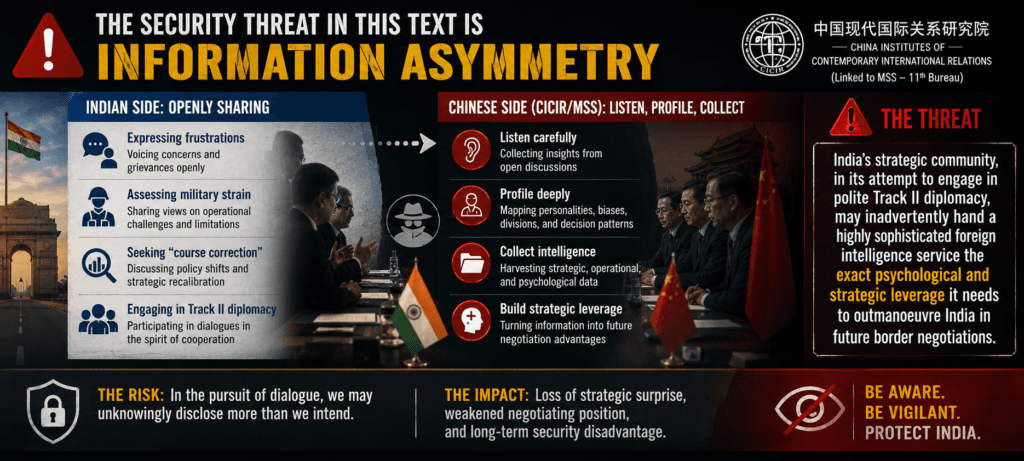
The security threat in this text is Information Asymmetry. The Indian side is openly sharing its frustrations, its assessment of the military strain, and its desire for a “course correction.” The Chinese side (CICIR/MSS), however, is there to listen, profile, and collect intelligence. The threat is that India’s strategic community, in its attempt to engage in polite Track II diplomacy, may inadvertently hand a highly sophisticated foreign intelligence service the exact psychological and strategic leverage it needs to outmanoeuvre India in future border negotiations.
PART 2:
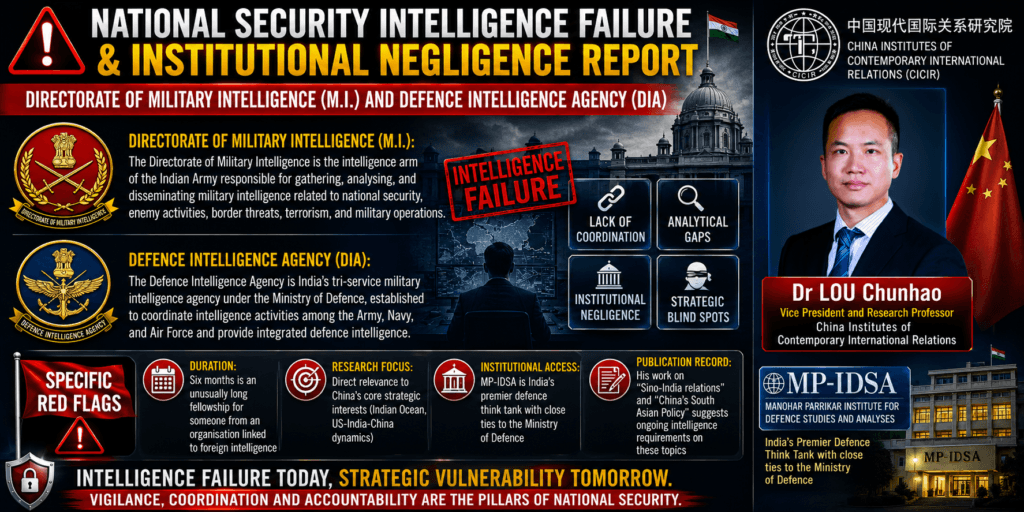
15. National Security Intelligence Failure & Institutional Negligence Report: Directorate of Military Intelligence (M.I.) and Defence Intelligence Agency (DIA)
Indian Military Intelligence Agencies
| Intelligence Agency | Role and Core Responsibilities |
|---|---|
| Directorate of Military Intelligence (M.I.) | • Role: The primary intelligence arm of the Indian Army. • Responsibilities: Responsible for gathering, analysing, and disseminating military intelligence related to national security, enemy activities, border threats, terrorism, and military operations. |
| Defence Intelligence Agency (DIA) | • Role: India’s tri-service military intelligence agency operating under the Ministry of Defence. • Responsibilities: Established to coordinate intelligence activities among the Army, Navy, and Air Force, and to provide integrated, joint-service defence intelligence. |
Profile and Strategic Engagements of Dr. Lou Chunhao (CICIR)
| Aspect | Details |
|---|---|
Professional Profile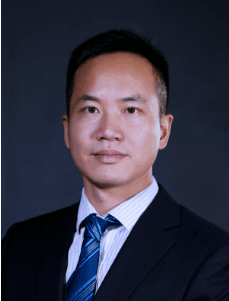 Dr Lou Chunhao | Dr. Lou Chunhao serves as the Vice President and Research Professor at the China Institutes of Contemporary International Relations (CICIR). |
| Affiliation & Intelligence Context | CICIR operates as the public cover for the 11th Bureau of China’s Ministry of State Security (MSS). Consequently, Dr. Lou’s academic positions and engagements at Indian strategic institutions (such as MP-IDSA) could serve as sophisticated intelligence-gathering opportunities under the guise of Track II diplomacy. |
| Engagements in India | • July 2012: Engaged at IDSA (now MP-IDSA) on the topic: “US–India–China Relations in the Indian Ocean: A Chinese Perspective.” • August 28, 2019: Visited and held discussions at The Vivekananda International Foundation (VIF) in New Delhi. |
| Engagements in Pakistan | • May 7, 2021 (Islamabad): Participated in a webinar titled “Future leaders in shaping Pakistan-China relations,” organized by the Pakistan-China Institute. • Context: The conference was arranged under the “Friends of Silk Road” initiative to commemorate 70 years of Pakistan-China diplomatic relations. |
Profile and Strategic Engagements of Zhang Shujian (CICIR)
| Aspect | Details |
|---|---|
Professional Profile Zhang Shujian | Zhang Shujian serves as an Assistant Research Professor at the Institute of South and Southeast Asian and Oceanian Studies within the China Institutes of Contemporary International Relations (CICIR). |
| Research Focus | Specializes in South Asian studies, with a primary focus on India’s domestic politics and foreign relations. |
| Engagements in India | • August 19, 2019 (IDSA): Visited the Manohar Parrikar Institute for Defence Studies and Analyses (IDSA) and met with Director General Amb. Sujan R. Chinoy for an exchange of views on India-China relations. • June 13, 2018 (ICS): Visited The Institute of Chinese Studies (ICS) in Delhi. • VIF Engagement: Visited the Vivekananda International Foundation (VIF), where the opening remarks for his session were delivered by Lt. Gen. Ravi Sawhney. |
| Engagements in Pakistan | • November 11, 2025 (CISS): Engaged with the Centre for International Strategic Studies (CISS) in Islamabad, Pakistan. |
VIF Hosted CICIR Delegation: Dr. Lou Chunhao & Dr. Zhang Shujian
| Aspect | Details |
|---|---|
| Host Organization | The Vivekananda International Foundation (VIF), New Delhi, India. |
| Visiting Delegation (CICIR) | • Dr. Lou Chunhao: Deputy Director of the Institute of South Asian Studies, CICIR. • Dr. Zhang Shujian: Assistant Research Professor, Institute of South and Southeast Asian and Oceanian Studies, CICIR. 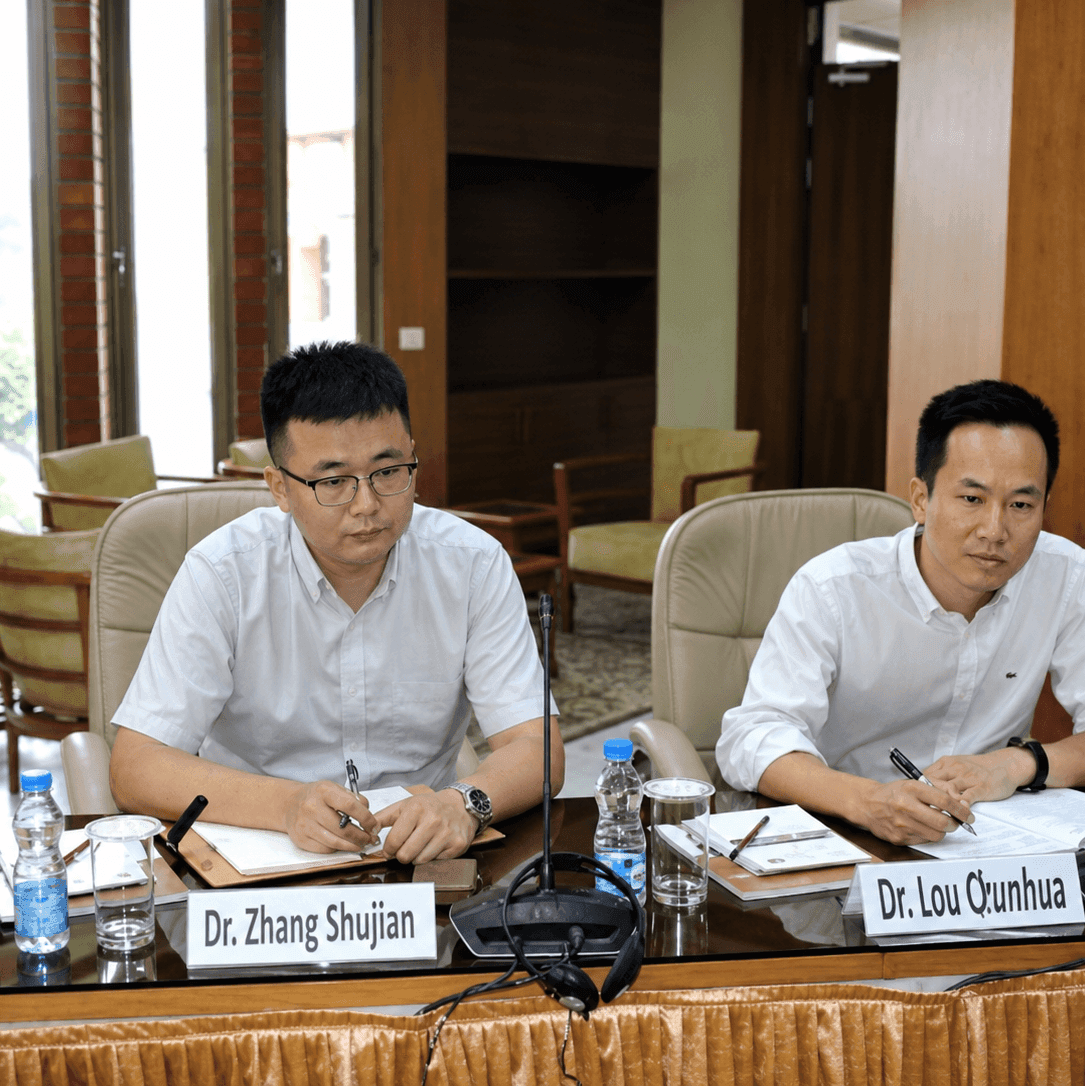 |
| Affiliation Context | Both delegates represent the China Institutes of Contemporary International Relations (CICIR), which operates as the public-facing cover for the 11th Bureau of China’s Ministry of State Security (MSS).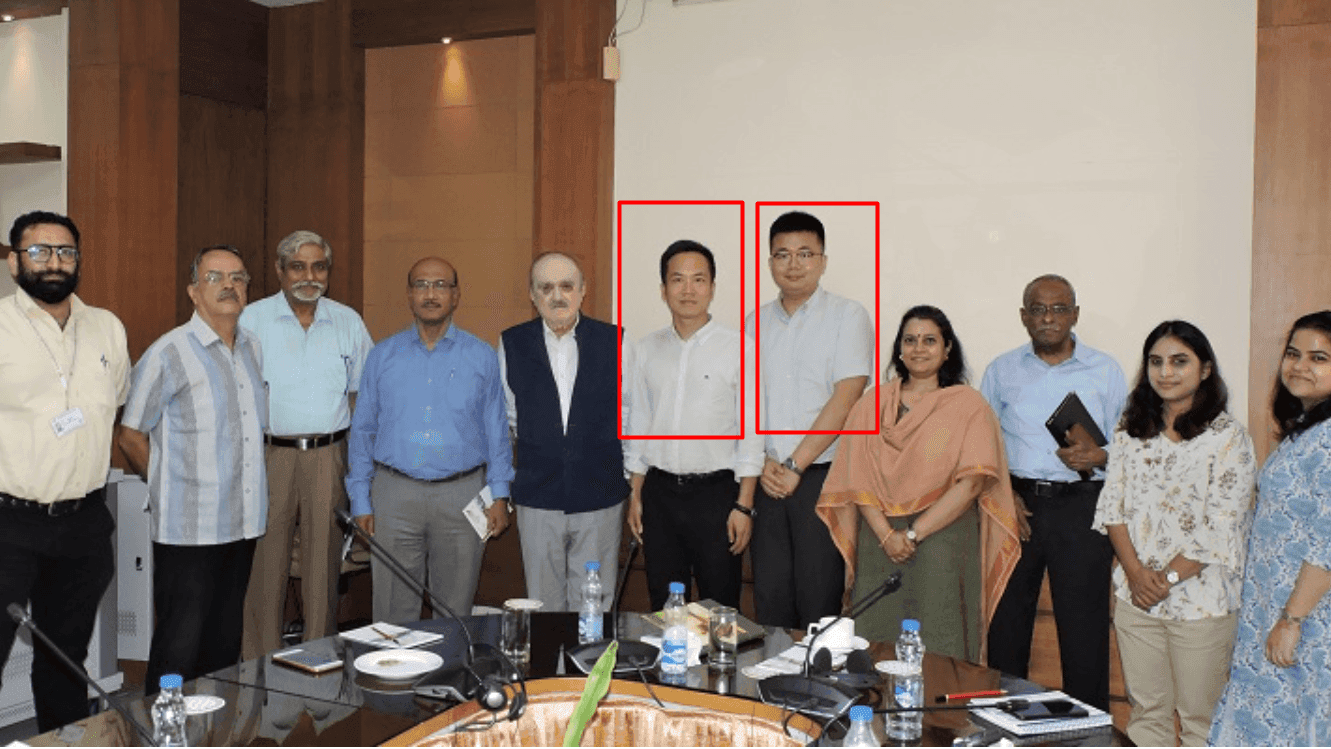 |
| Purpose of Visit | Engagement with VIF for Track II diplomatic dialogue, exchange of views on India-China relations, regional security, and strategic perspectives. |
| Related Engagement (Pakistan) | • Date: November 11, 2025 • Location: Centre for International Strategic Studies (CISS), Islamabad, Pakistan. • Context: Part of a broader regional engagement pattern by CICIR-affiliated researchers in South Asia. 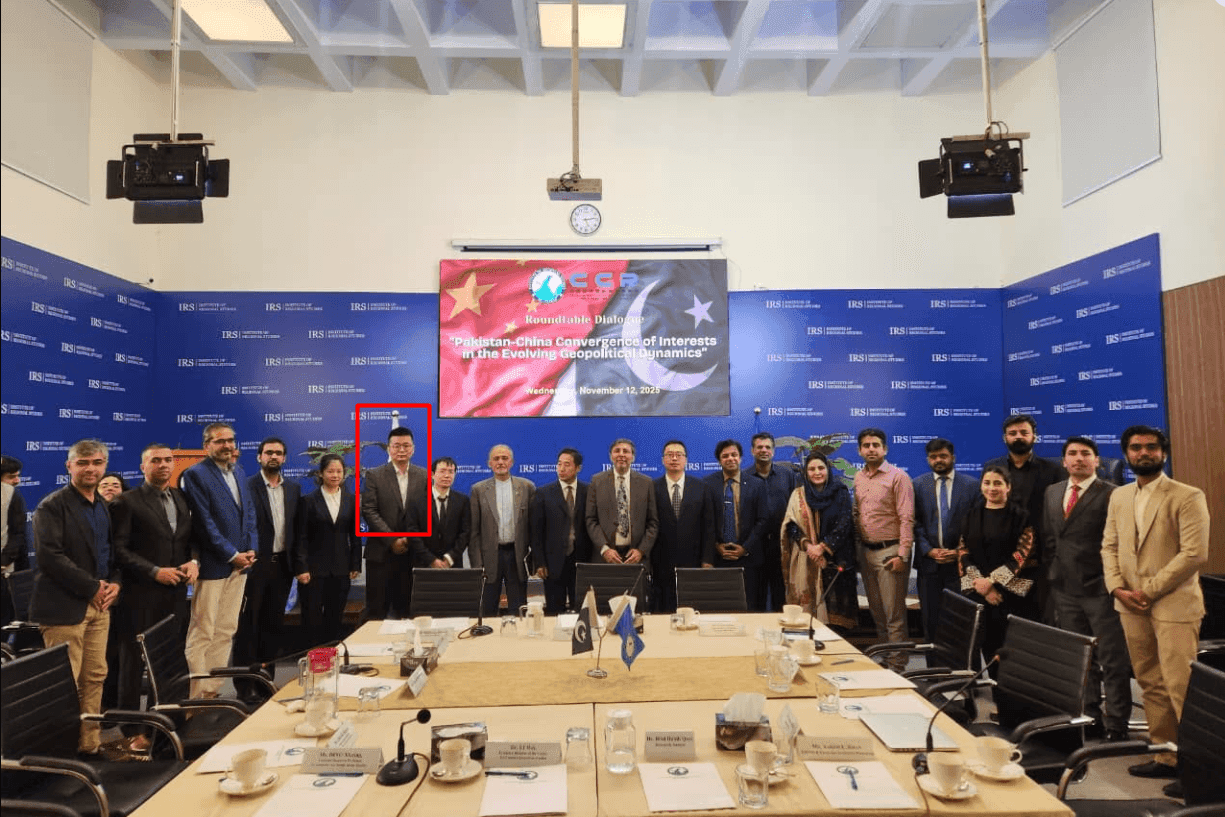 |
CICIR Delegation Visit to IDSA
| Aspect | Details |
|---|---|
| Event Title | CICIR Delegation Discusses India-China Relations with Director General |
| Date | August 19, 2019 |
| Host Institution | Manohar Parrikar Institute for Defence Studies and Analyses (IDSA) |
| Visiting Delegation (CICIR) | • Dr. Lou Chunhao (CICIR, Beijing) • Mr. Zhang Shujian (CICIR, Beijing) |
| Indian Participants (IDSA) | • Amb. Sujan R. Chinoy: Director General, IDSA • Maj. Gen. Alok Deb: Deputy Director General, IDSA • Dr. Jagannath Panda: Research Fellow, IDSA |
| Purpose of the Meeting | To hold an exchange of views on India-China bilateral relations. |
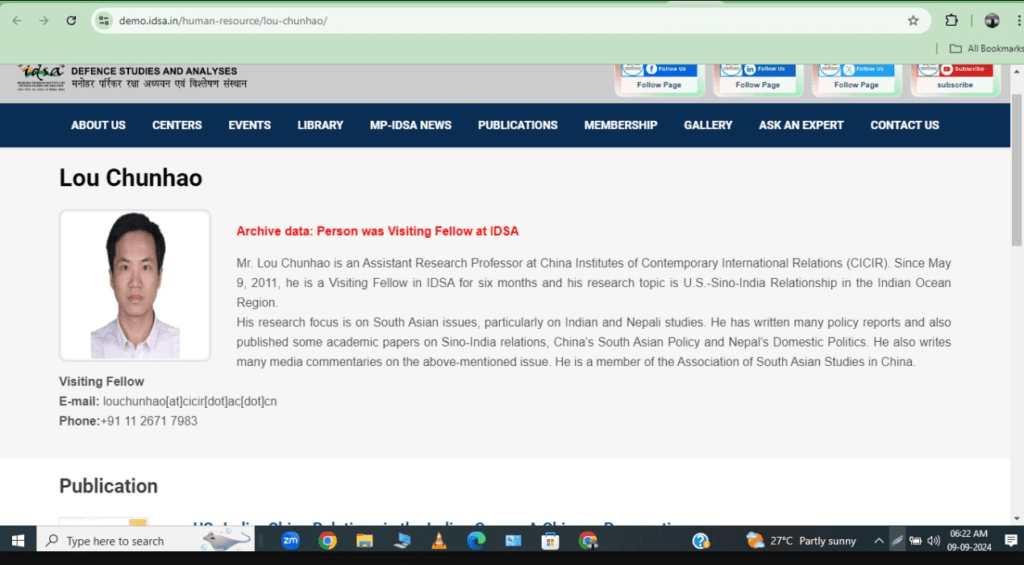
Part 1: MP-IDSA Profile and Primary Security Concerns Regarding CICIR Access
| Aspect | Details / Security Assessment |
|---|---|
| MP-IDSA Mission & Profile | An autonomous institute leveraging multi-disciplinary expertise to promote national and international security through objective, policy-relevant research on defence, security, and international relations. It is India’s premier defence think tank with close ties to the Ministry of Defence. |
| 1. Intelligence Collection Under Academic Cover | • CICIR Affiliation: As an MSS 11th Bureau cover, a CICIR researcher’s position at MP-IDSA serves as a sophisticated intelligence-gathering opportunity. • Network Access: Extended fellowships provide deep access to Indian defense analysts, former military officers, and policymakers. • Topic Sensitivity: Research on the “U.S.-Sino-India Relationship in the Indian Ocean Region” directly targets China’s strategic competition with India and the Quad. |
| 2. Strategic Intelligence Leakage | During their tenure, researchers potentially gain access to: • Indian perspectives on naval strategy in the Indian Ocean. • Internal views on the emerging Quad alliance and US-India military convergence. • Unpublished research, internal MP-IDSA discussions, and Indian defense policy formulations. • Personal relationships and networks within India’s strategic community. |
| 3. Lack of Transparency and Vetting | • Public Disclosure: While fellowship details are archived, the actual extent of activities, publications, and interactions is rarely detailed publicly. • Vetting Process: Raises questions regarding the level of security clearance or background checks conducted before granting extended access to foreign intelligence-affiliated personnel. • Oversight: Limited public information exists regarding the monitoring or restrictions placed on their access to sensitive discussions. |
| 4. Reciprocity and Influence Operations | • Asymmetric Access: Chinese researchers easily access Indian think tanks, but Indian researchers rarely receive equivalent access to Chinese strategic institutions. • Long-term Relationship Building: Fellowships cultivate personal relationships leveraged for future influence operations. • Narrative Shaping: Provides opportunities to understand, map, and potentially influence Indian strategic thinking regarding China. |
| Specific Red Flags | • Duration: A six-month fellowship is unusually long for someone linked to a foreign intelligence apparatus. • Research Focus: Directly aligns with China’s core strategic anxieties (Indian Ocean, US-India dynamics). • Institutional Access: Unfettered access to an MoD-linked premier institute. • Publication Record: Ongoing intelligence requirements evident in their work on Sino-India relations and South Asian policy. |
Part 2: National Security and Intelligence Analysis of the IDSA Engagement (August 19, 2019)
| Analytical Dimension | Detailed Intelligence & Strategic Assessment |
|---|---|
| 1. The Caliber of the Indian Hosts (A Calculated Engagement) | This was not a naive academic exchange, but a serious strategic dialogue with heavyweights who understood the stakes: • Amb. Sujan R. Chinoy (DG, IDSA): A former Ambassador to China (2006–2009), intimately familiar with the MSS and CICIR. His presence confirms the Indian side knew exactly who they were dealing with. • Maj. Gen. Alok Deb (Deputy DG): Represented the military perspective, signalling that the military dimension of the relationship was a key focus. • Dr. Jagannath Panda: Provided granular, academic expertise on East Asian geopolitics. |
| 2. The Core Intelligence Target: The Indian Ocean Region (IOR) | The topic “US–India–China Relations in the Indian Ocean” targets China’s most sensitive strategic vulnerabilities: • The “Malacca Dilemma”: Chinese anxiety over energy supply lines passing through the Indian Navy-dominated IOR. • US-India Military Convergence: Fear of US-Indian naval integration (e.g., COMCASA, BECA). • The Intelligence Goal: Elicitation (probing the depth of US-India interoperability and if India would host US strategic assets) and Signaling (using the “Chinese Perspective” to deliver strategic warnings about Beijing’s red lines). |
| 3. Dynamics of the “Chinese Perspective” Presentation | Presenting a “Chinese Perspective” is a tool for cognitive mapping and strategic signaling: • Testing Reactions: Dr. Lou would present China’s official anxieties (e.g., feeling encircled) and closely observe the micro-expressions, verbal rebuttals, and concessions of the Indian hosts. • Gauging Indian Resolve: If Indian hosts softened their stance on the Quad to “reassure” the delegation, CICIR would report that India’s US commitment is malleable. If they stood firm, Beijing would know to adjust its own military posture. |
| 4. Track 1.5 Diplomacy as a Backchannel | With formal diplomatic channels strained in 2019, this meeting served as a vital backchannel: • Message Delivery: The MSS used CICIR to convey warnings about India’s maritime closeness to the US that the Chinese Foreign Ministry could not officially state via formal demarche. • Message Receipt: Amb. Chinoy used the forum to clearly articulate India’s strategic red lines regarding the border and Pakistan, knowing CICIR would faithfully transmit his calibrated views to the highest levels of the CCP. |
Summary of Risk
Dr Lou Chunhao, acting under the cover of a researcher but backed by the MSS, was in that room to map the exact contours of India’s maritime strategy, gauge the depth of the India-US alliance, and deliver calibrated strategic warnings on behalf of Beijing.
The Indian side, led by a former Ambassador to China, was fully aware of this dynamic and engaged in the same reciprocal intelligence-gathering and signalling. It is a high-stakes game of strategic chess played under the polite guise of academic dialogue.
FACT
Critical National Security Failure: Analysis of MP-IDSA’s RTI Response
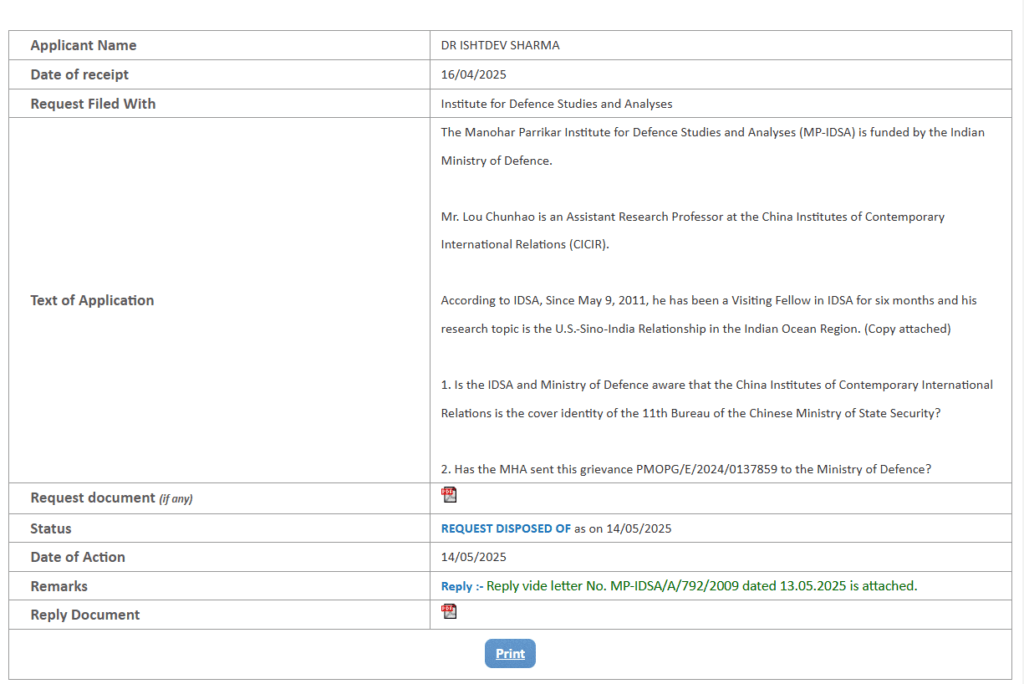
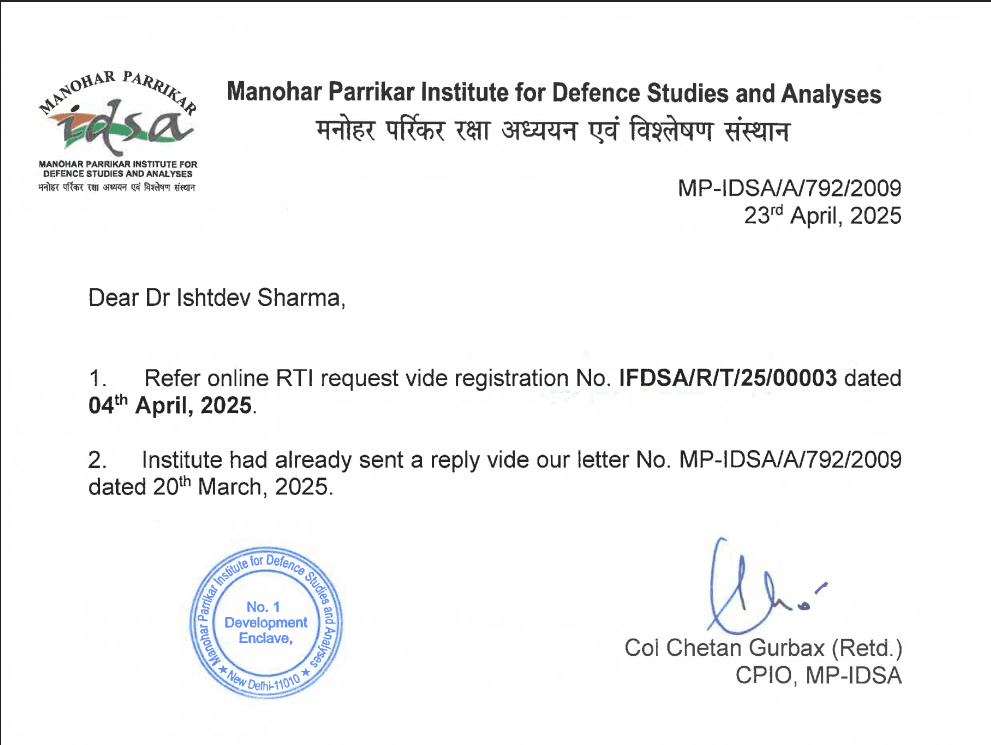
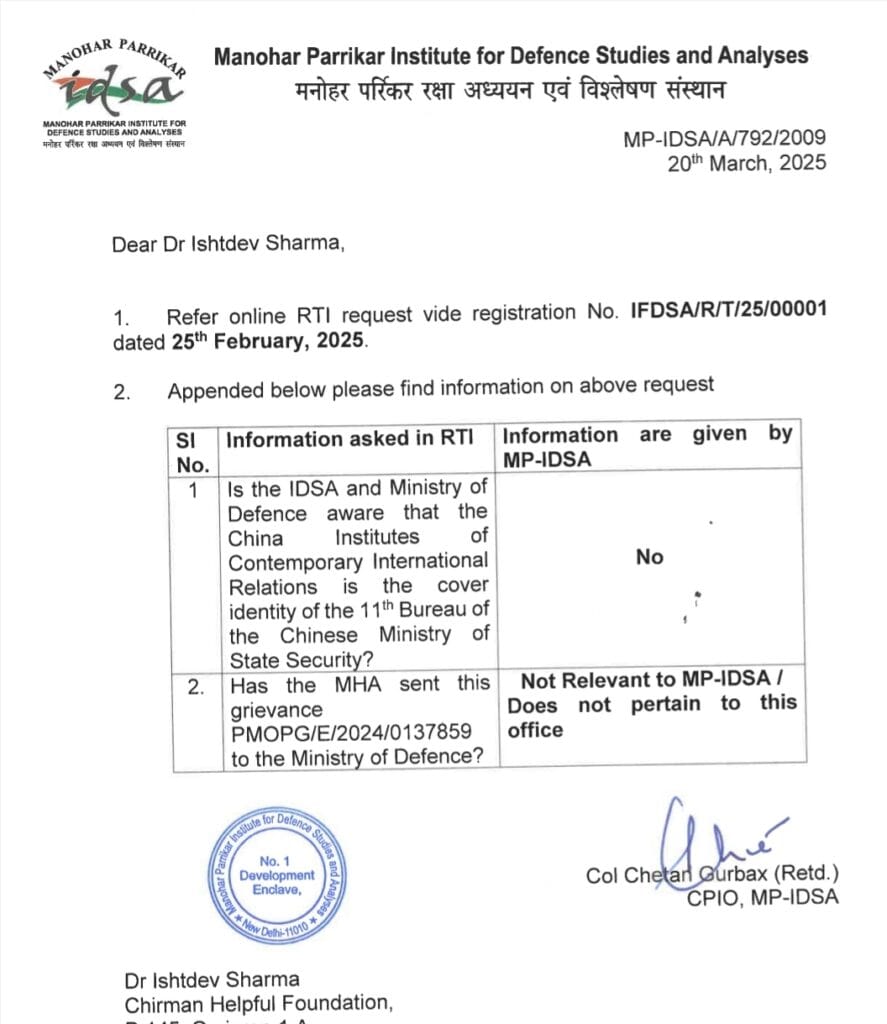
| Aspect / Category | Details and Analysis |
|---|---|
| The Explosive Admission (RTI Response) | • Date of Response: 20th March 2025 • The Admission: MP-IDSA and the Ministry of Defence officially claimed they are NOT AWARE (“No”) that CICIR is the cover identity of the 11th Bureau of China’s Ministry of State Security (MSS). • Significance: This is not merely bureaucratic ignorance; it represents a catastrophic, systemic failure of India’s military intelligence architecture. |
| 1. The Intelligence Community’s Core Mandate | The Directorate of Military Intelligence (MI) and the Defence Intelligence Agency (DIA) are legally mandated to: • Identify, assess, and disseminate intelligence on foreign military and intelligence threats. • Provide counter-intelligence briefings to all defense establishments. • Alert Ministry of Defence institutions about hostile intelligence services. • Maintain threat databases on adversarial intelligence entities. |
| The Failure: Why This is a National Security Lapse | If India’s premier defense think tank (MP-IDSA), which operates under the Ministry of Defence, is unaware that CICIR is an MSS front, it indicates one of two critical failures: • Failure to Disseminate: MI and DIA failed to share known, critical intelligence with a key defense institution. • Failure to Act: MP-IDSA ignored or failed to act upon the counter-intelligence briefings they received. • Conclusion: Either scenario represents a severe dereliction of constitutional and national security duty by MI and DIA. |
The CICIR-MSS Connection: Public Knowledge and Institutional Negligence
| Aspect / Category | Details and Analysis |
|---|---|
| Public Availability of the CICIR-MSS Connection | The fact that CICIR operates as the 11th Bureau of China’s Ministry of State Security (MSS) is not classified information. It is widely known and accessible: • Documented: Publicly documented in international security literature. • Global Intelligence Awareness: Known to Western intelligence agencies (including the CIA, FBI, and the Five Eyes alliance). • Academic Record: Published extensively in academic journals and global think tank reports. • Historical Open Source: Available in open-source intelligence (OSINT) since at least the 1990s. |
| The Negligence: Systemic Failure | The stark contrast between global awareness and the Indian Defence Ministry’s think tank claiming ignorance highlights severe institutional negligence: • Failure of Due Diligence: If foreign academics and journalists know this connection, the Directorate of Military Intelligence (MI) and Defence Intelligence Agency (DIA) have completely failed their basic due diligence and threat-assessment functions. • Broken Pipeline: There is a demonstrable “zero” intelligence-to-policy pipeline for critical counter-intelligence information within the defence establishment. • Intelligence Vacuum: India’s defence establishment is effectively operating in an intelligence vacuum, allowing adversarial intelligence fronts to operate freely within premier strategic institutions. |
3. The Inexcusable Timeline: Institutional Negligence Regarding CICIR Engagements
| Aspect / Category | Details and Evidence |
|---|---|
| Timeline of Documented Engagements | • 2011: Dr. Lou Chunhao completed a 6-month fellowship at IDSA. • April 2019: A CICIR delegation (including Dr. Fu Mengzi and Dr. Hu Shisheng) visited the Vivekananda International Foundation (VIF). • August 2019: A CICIR delegation visited IDSA and held strategic discussions with the former Indian Ambassador to China. • November 2023: A CICIR delegation officially resumed dialogues with VIF. |
| Ongoing Institutional Actions (The Failure) | For over a decade, premier Indian think tanks like MP-IDSA have been actively: • Hosting CICIR delegations. • Granting long-term fellowships to CICIR researchers. • Discussing highly sensitive national security topics (e.g., Indian Ocean strategy, the Quad, and border policy). • Sharing strategic assessments and internal perspectives. |
| The Core Contradiction | Indian defense and strategic institutions have engaged in all of the above high-level activities while simultaneously claiming official ignorance of CICIR’s true identity as the 11th Bureau of China’s Ministry of State Security (MSS). |
| Final Assessment | This is not mere ignorance; this is institutional negligence of the highest order. The documented timeline proves that the interactions were sustained, involved top-tier officials, and covered critical strategic vulnerabilities, making the Ministry of Defence’s claim of unawareness completely inexcusable. |
Specific Failures of the Directorate of Military Intelligence (MI) and Defence Intelligence Agency (DIA)
| Failure Category | Details, Mandates, and Reality |
|---|---|
| A. Failure to Issue Counter-Intelligence Advisories | What MI/DIA should have done: • Issued mandatory CI briefings to all MoD think tanks about CICIR. • Flagged CICIR personnel in visa/entry databases. • Required pre-clearance for any engagement with CICIR. • Monitored all Track II interactions with Chinese entities.The Reality: They did none of this. |
| B. Failure to Protect Critical Defense Assets | MP-IDSA Profile: • Funded directly by the Ministry of Defence. • Staffed by retired military officers, diplomats, and defense scientists. • Tasked with advising the government on national security. • Serves as a primary repository of India’s strategic thinking.The Failure: Allowing an MSS front organization to penetrate this highly sensitive institution without any safeguards constitutes a massive counter-intelligence disaster. |
| C. Failure to Conduct Due Diligence | What MI/DIA should have done before any CICIR visit or fellowship: • Conducted thorough background checks on all CICIR personnel. • Assessed the strategic risk of the engagement. • Provided specific threat briefings to MP-IDSA leadership. • Established strict information-sharing boundaries.The Reality: There is no evidence that any of these basic due diligence steps occurred. |
Bureaucratic Deflection: Analysis of the Second RTI Response
| Aspect | Details and Strategic Implications |
|---|---|
| The RTI Query | Question Asked: “Has the Ministry of Home Affairs (MHA) forwarded grievance PMOPG/E/2024/0137859 to the Ministry of Defence (MoD)?” |
| MP-IDSA’s Official Response | Stated Position: “Not Relevant to MP-IDSA / Does not pertain to this office.” |
| The Core Issue: Bureaucratic Deflection | Rather than addressing the gravity of the intelligence lapse, the institute resorted to classic bureaucratic buck-passing, attempting to dismiss and distance itself from a critical national security inquiry. |
| Systemic Implications (The Failure) | • Zero Inter-Agency Coordination: Exposes a glaring disconnect and lack of information-sharing between the MHA, MoD, and national intelligence agencies regarding internal security threats. • Absence of Accountability: Highlights a systemic failure in defining who is ultimately responsible for counter-intelligence oversight and threat mitigation at state-funded defense think tanks. • Evasion of Institutional Ownership: Demonstrates a complete refusal by the establishment to take ownership of, or responsibility for, a catastrophic security failure. |
The Cascading Intelligence Failures: A Systemic Collapse
This single “No” response from MP-IDSA exposes a systemic collapse across India’s defense intelligence architecture. Below is a breakdown of the critical failure points:
| Failure Point | What Should Have Happened | What Actually Happened (The Reality) |
|---|---|---|
| Threat Identification | MI/DIA identifies CICIR as a front for China’s Ministry of State Security (MSS). | No action taken; the threat was not recognized or flagged. |
| Intelligence Dissemination | Ministry of Defence (MoD) think tanks are officially briefed on the CICIR threat. | MP-IDSA claims official ignorance of CICIR’s true identity. |
| Access Control | CICIR personnel are flagged in security databases and denied access to strategic institutions. | Long-term fellowships were granted, and high-level visits were allowed. |
| Information Security | Sensitive national security topics are strictly off-limits for discussion with foreign entities. | Highly sensitive topics (Indian Ocean strategy, the Quad, border policy) were openly discussed. |
| Monitoring | Track II engagements are actively monitored by Counter-Intelligence (CI) officers. | Zero oversight or monitoring of the interactions took place. |
| Accountability | Post-engagement debriefs are conducted to assess what was shared. | No tracking, reporting, or assessment of potential information leakage occurred. |
Legal & Constitutional Implications of the Intelligence Failure
The systemic collapse of counter-intelligence protocols at premier defence institutions potentially violates several foundational legal and constitutional frameworks:
| Legal / Constitutional Framework | Specific Violation / Nature of the Failure |
|---|---|
| Official Secrets Act, 1923 | Failure of Protection: Represents a fundamental failure to protect defense establishments and strategic assets from infiltration and intelligence gathering by foreign state actors. |
| Defence Services Regulations | Gross Negligence: Highlights a severe dereliction of duty and negligence in safeguarding highly sensitive strategic information, defense policies, and military assets from adversarial entities. |
| Right to Information (RTI) Act, 2005 | Lack of Transparency & Accountability: The very fact that this catastrophic security lapse had to be forcibly extracted by the public via an RTI query—rather than being internally audited, reported, and corrected—exposes a deep institutional opacity. |
| Constitutional Duty: Article 53(2) | Undermining Parliamentary Oversight: This provision grants Parliament the power to regulate military and defense matters. The executive defense apparatus’s failure in its foundational security mandates undermines the constitutional framework designed to ensure the safety and regulation of the nation’s armed forces and strategic institutions. |
PART 3 – Report on National Security Intelligence Failure and Institutional Negligence by the Ministry of External Affairs
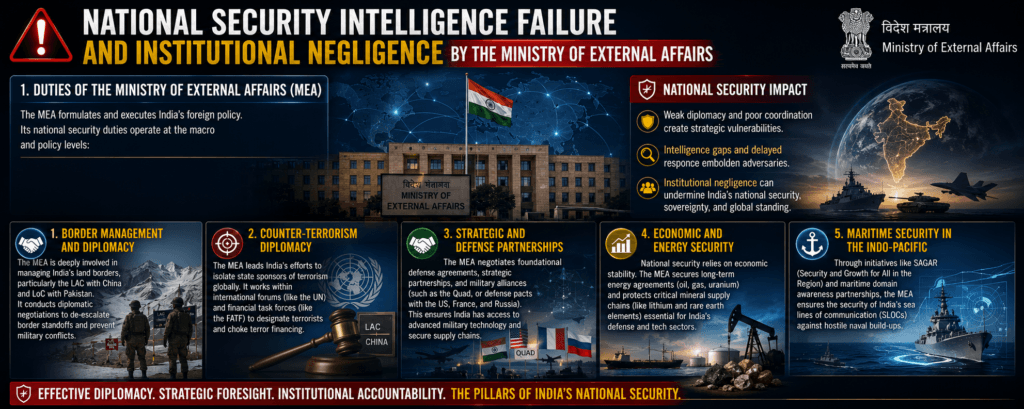
Duties of the Ministry of External Affairs (MEA)
The MEA formulates and executes India’s foreign policy. Its national security duties operate at the macro and policy levels:
| National Security Duty | Role and Key Activities of the MEA |
|---|---|
| Border Management and Diplomacy | Deeply involved in managing India’s land borders, particularly the Line of Actual Control (LAC) with China and the Line of Control (LoC) with Pakistan. It conducts diplomatic negotiations to de-escalate border standoffs and prevent military conflicts. |
| Counter-Terrorism Diplomacy | Leads India’s efforts to isolate state sponsors of terrorism globally. It works within international forums (like the UN) and financial task forces (like the FATF) to designate terrorists and choke terror financing. |
| Strategic and Defense Partnerships | Negotiates foundational defense agreements, strategic partnerships, and military alliances (such as the Quad, or defense pacts with the US, France, and Russia). This ensures India has access to advanced military technology and secure supply chains. |
| Economic and Energy Security | Recognizing that national security relies on economic stability, the MEA secures long-term energy agreements (oil, gas, uranium) and protects critical mineral supply chains (like lithium and rare earth elements) essential for India’s defense and tech sectors. |
| Maritime Security in the Indo-Pacific | Ensures the security of India’s sea lines of communication (SLOCs) against hostile naval build-ups through initiatives like SAGAR (Security and Growth for All in the Region) and maritime domain awareness partnerships. |
Duties of the Indian Foreign Service (IFS)
The IFS comprises the diplomatic officers who execute the MEA’s policies on the ground in Indian embassies, high commissions, and consulates worldwide. Their security duties include:
| Security Duty / Function | Role and Key Activities of the IFS |
|---|---|
| Strategic Political Reporting | IFS officers act as the “eyes and ears” of the government. They analyze the political, military, and economic developments of their host countries and send classified reports back to New Delhi. This strategic foresight is vital for anticipating security threats. |
| Countering Anti-India Narratives & Propaganda | IFS officers actively counter information warfare, fake news, and separatist propaganda (such as the Khalistan movement or Pakistan-sponsored narratives) in foreign media and among foreign think tanks. |
| Crisis Management and Diaspora Protection | Protecting the roughly 32 million-strong Indian diaspora is a core human security mandate. IFS officers plan and execute the evacuation of Indian nationals from war zones or disaster areas (e.g., Operations Keshav, Ajay, and Devi). |
| Negotiating Security Treaties | IFS officers draft and negotiate the legal frameworks for extradition treaties, mutual legal assistance treaties (MLATs), and defense cooperation agreements, which are crucial for bringing fugitives to justice and joint military training. |
| Liaising with Host Country Intelligence | While IFS officers are not intelligence agents, they maintain official liaison channels with the host country’s foreign ministries and security establishments to share actionable intelligence regarding terrorism and transnational crime. |
Intersection with the Broader Security Architecture
The MEA and IFS do not work in a silo; they are deeply integrated into India’s national security apparatus:
| Security Architecture / Body | Role and Integration with MEA/IFS |
|---|---|
| Cabinet Committee on Security (CCS) | The Minister of External Affairs is a senior member of the CCS, which is the apex body that makes all final decisions regarding India’s national security, defense, and intelligence. |
| National Security Council (NSC) | The MEA works closely with the National Security Advisor (NSA) and the National Security Council Secretariat (NSCS) to ensure that foreign policy is perfectly aligned with military and intelligence strategies. |
| Intelligence Coordination | The MEA coordinates closely with RAW (external intelligence) and IB (internal intelligence). While RAW gathers covert intelligence, the MEA utilizes that actionable intelligence to shape diplomatic strategies and issue demarches (formal diplomatic protests) to hostile nations. |
Profile and Strategic Engagements of Dr Yuan Peng (CICIR)
| Aspect | Details |
|---|---|
Professional Profile Dr Yuan Peng | Dr Yuan Peng currently serves as the President of the China Institutes of Contemporary International Relations (CICIR). He also holds the academic titles of Research Professor and Doctoral Advisor. |
| Engagement in India | • Date: June 11, 2018 • Host Institution: Institute for Defence Studies and Analyses (IDSA), New Delhi. • Indian Counterpart: Amb. Jayant Prasad, Director General of IDSA. • Role at the Time: Represented CICIR (Beijing) in the capacity of Vice-President. |
| Topics Discussed | • India-China Relations in the Post-Wuhan era. • New Regional Security Dimensions. • Economic Cooperation. |
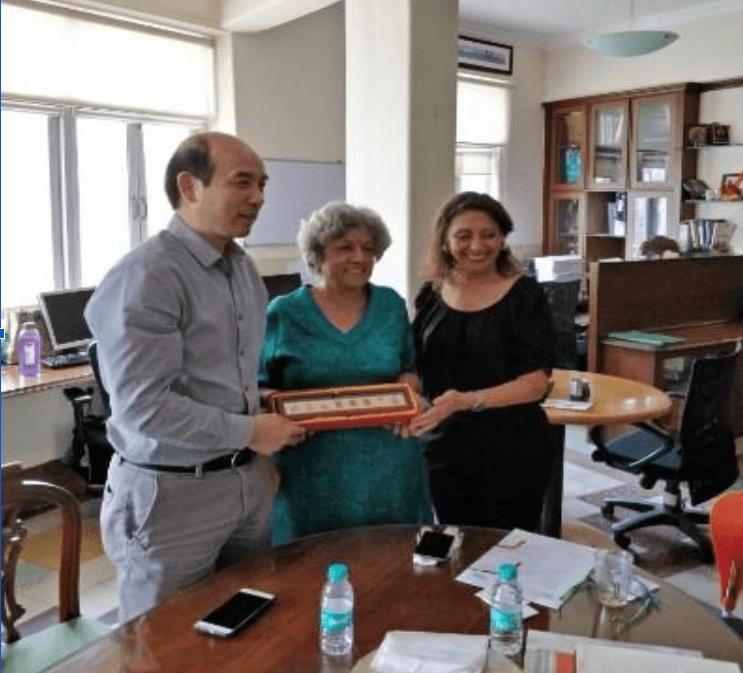
National Security Concerns: Gateway House & CICIR Engagement
| Concern Category | Details and Strategic Vulnerabilities |
|---|---|
| 1. Direct Engagement by Gateway House | Gateway House is led by former Indian Foreign Service (IFS) officers, including Neelam Deo (former Ambassador with access to sensitive diplomatic channels) and Manjeet Kripalani (Executive Director). The think tank hosted Dr. Yuan Peng (VP of CICIR) and his delegation, which included researchers from institutes covering American, South, Southeast Asian, and Oceanic Studies. |
| 2. Institutional Oversight Failures | The Ministry of External Affairs (MEA) collaborated with Gateway House on the India-China Think Tanks Forum. This raises critical security questions: • Did the MEA conduct proper security vetting of Gateway House’s engagements? • Was the MEA aware that CICIR is an MSS intelligence front when providing this collaboration? • There is a glaring lack of security protocols for think tank engagements with known foreign intelligence fronts. |
| 3. Intelligence Collection Vulnerabilities | CICIR’s mandate specifically includes: • Exploiting Engagements: Targeting foreign diplomats (e.g., leveraging Neelam Deo’s past service in Washington D.C. liaising with the U.S. Congress, State Department, and NSC). • OSINT Collection: Gathering open-source intelligence from academics and think tanks. • Influence Operations: Shaping and influencing foreign policy discourse through strategic, calibrated engagements. |
| 4. Specific Security Breaches & Risks | Former IFS officers possess deep access to U.S.-India strategic communications, sensitive bilateral negotiations, intelligence-sharing mechanisms, and border management diplomacy. Engaging with known intelligence operatives creates severe risks of: • Inadvertent disclosure of highly sensitive information. • Compromise of ongoing diplomatic strategies. • Exposure of India’s strategic thinking regarding China, the Indo-Pacific, and the Quad. • Potential compromise of U.S.-India intelligence cooperation. |
Institutional Negligence and Systemic Failures
| Institution / Entity | Nature of the Negligence / Systemic Failure |
|---|---|
| Ministry of External Affairs (MEA) | • Protocol Failure: Failed to establish mandatory security clearance protocols for think tank engagements. • Complicit Collaboration: Officially collaborated with organizations that were actively hosting known intelligence fronts. • Lack of Guardrails: Did not prevent or restrict former IFS officers from engaging with adversary intelligence services. |
| Gateway House Leadership | • Willful Blindness: Former IFS officers leading the institution should have been acutely aware of CICIR’s intelligence connections. • Due Diligence Failure: Failed to conduct basic due diligence on their Chinese counterparts. • Security Compromise: Potentially compromised sensitive diplomatic insights and strategic foresight through unvetted interactions. |
| National Security Architecture | • Zero Oversight: There is no formal oversight mechanism to monitor or regulate think tank interactions with foreign entities. • No Debriefing: Lack of mandatory debriefing requirements for former diplomats who engage with representatives of adversary nations. • Post-Service Loopholes: Complete absence of post-service engagement restrictions or “cooling-off” protocols for retired officials handling sensitive strategic dialogues. |
Profile and Strategic Engagements of CICIR Researchers (Dr. Wang Shida & Dr. Li Li)
| Aspect | Details |
|---|---|
 Professional Profile: Dr Wang Shida | Dr. Wang Shida serves as an Associate Professor and the Deputy Director of the Institute for South Asian Studies at the China Institutes of Contemporary International Relations (CICIR). |
| CICIR Delegation Visit to India (2014) | • Date: May 30, 2014 • Host Institution: Vivekananda International Foundation (VIF), New Delhi. • Activity: The delegation held strategic interactions and discussions with VIF faculty. |
| Delegation Leadership & Composition | The engagement involved a three-member delegation from CICIR, Beijing. The visit was led by Dr. Li Li, an Associate Research Fellow at CICIR. |
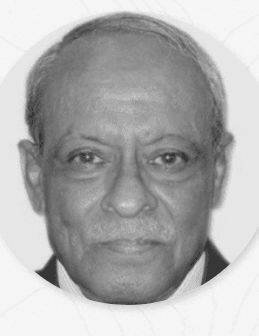
Amb R Rajagopalan Ambassador R. Rajagopalan, Former Diplomat.
The Chinese scholars were very keen to understand the Indian perspective on ‘India’s Foreign Policy- post 2014 Elections’. This was explained in some detail by Amb R Rajagoplan
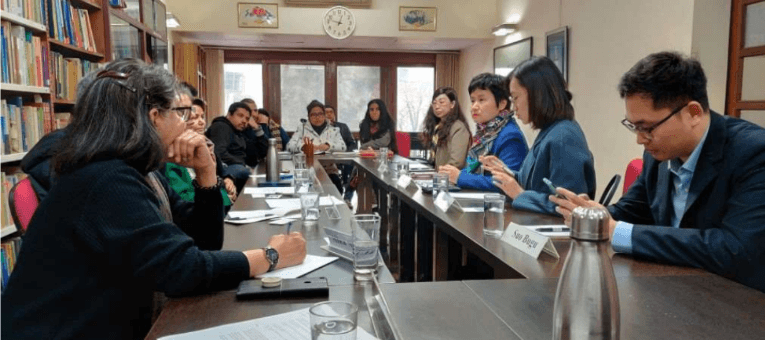
Personnel Profiles: China Council for BRICS Think Tank Cooperation (CCBTC) & IDCPC
| Personnel | Role / Title | Affiliation / Organization |
|---|---|---|
 Suo Bugu | Staff | China Council for BRICS Think Tank Cooperation (CCBTC) |
 Gao Yuanyuan | Interpreter | China Council for BRICS Think Tank Cooperation (CCBTC) |
 Dong Weihua | Deputy Director General of Research Office; Vice Secretary General | International Department of CPC (IDCPC) & China Council for BRICS Think Tank Cooperation (CCBTC) |
 Zhang Yiji | Associate Researcher | China Council for BRICS Think Tank Cooperation (CCBTC) |
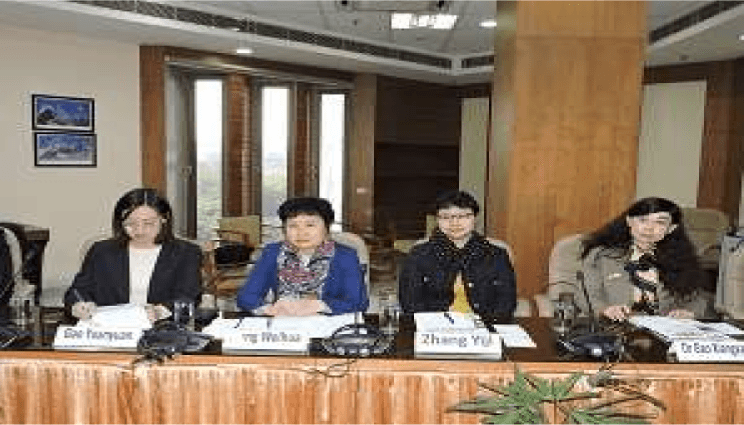
(IDCPC), February 10, 2020, Vivekananda International Foundation (VIF)
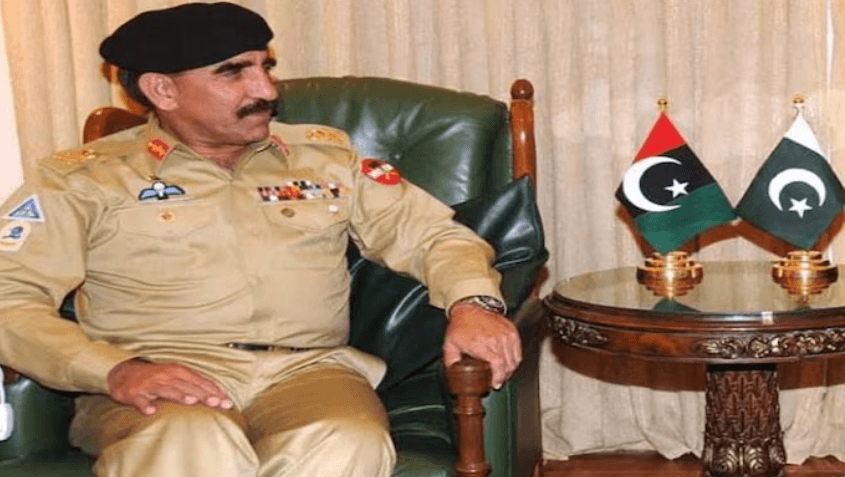
Pakistan’s ISI chief Zaheer-ul-Islam.
| 25th Director General of the ISI | |
|---|---|
| In office 19 March 2012 – 7 November 2014 |
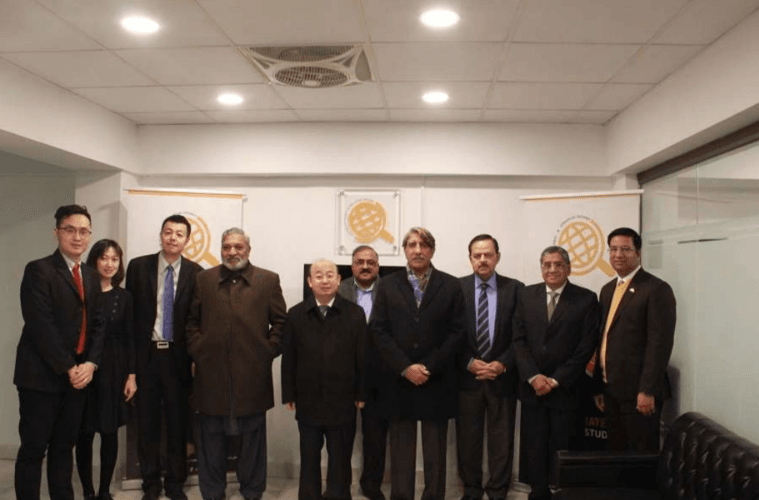
visited CGSS, Islamabad.
The participants of the meeting are as follows:
Personnel and Affiliations: CCBTC, Chinese Embassy (Islamabad), and CGSS
| Name | Title / Role | Affiliation / Organization |
|---|---|---|
| Luan Jianzhang | Secretary General | China Council for BRICS Think Tank Cooperation (CCBTC) |
| Chen Xi | Associate Researcher | China Council for BRICS Think Tank Cooperation (CCBTC) |
| Suo Bugu | Staff / Member | China Council for BRICS Think Tank Cooperation (CCBTC) |
| Gao Yuanyuan | Interpreter / Member | China Council for BRICS Think Tank Cooperation (CCBTC) |
| Mr. Chen Yongpei | Defence Attaché | Embassy of the People’s Republic of China, Islamabad, Pakistan |
| Mr. Bao Zhong | Director of Political & Press Section | Embassy of the People’s Republic of China, Islamabad, Pakistan |
| Maj. Gen. Syed Khalid Amir Jaffery HI(M), (Retd) | President | Centre for Global Strategic Studies (CGSS) |
| Maj. Gen. Hafiz Masroor Ahmed (Retd) | Vice President | Centre for Global Strategic Studies (CGSS) |
| Mr. Ashfaq Ahmed Gondal | Former Federal Secretary of Information & Broadcasting; Senior Member Advisory Board | Centre for Global Strategic Studies (CGSS) |
| Brig. Akhtar Nawaz Janjua SI(M), (Retd) | Senior Member Advisory Board | Centre for Global Strategic Studies (CGSS) |
| Lt. Col. Khalid Taimur Akram (Retd) | Executive Director | Centre for Global Strategic Studies (CGSS) |

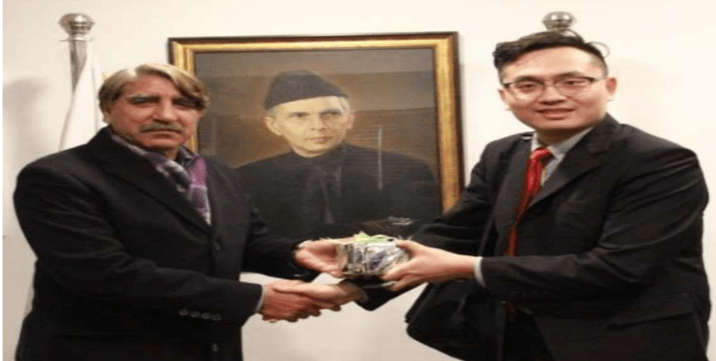
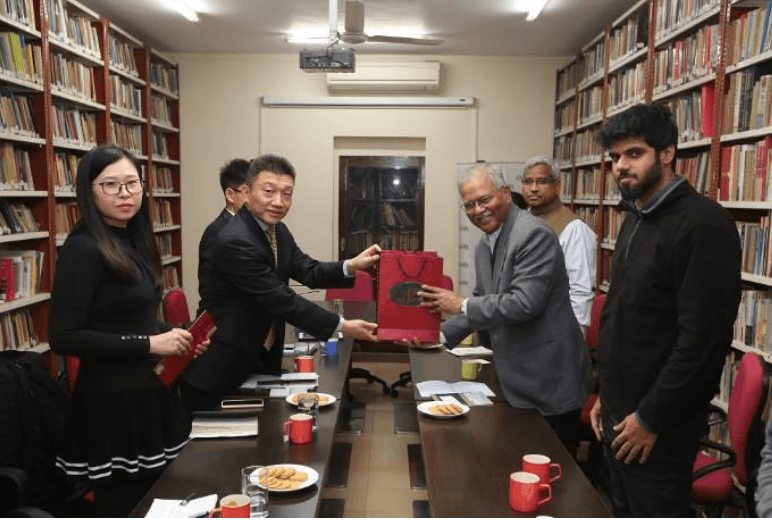
Leadership Profiles: Institute of Chinese Studies (ICS)
| Diplomat | Role at the Institute of Chinese Studies (ICS) | Diplomatic Career & Background |
|---|---|---|
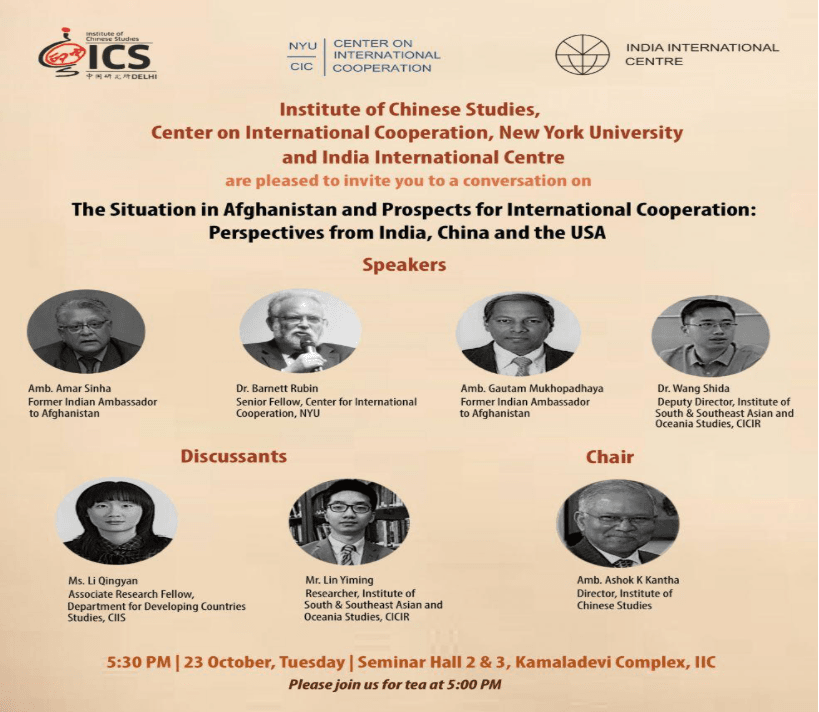
 Mr Ashok K. Kantha | Joined as Director of ICS, Delhi on March 31, 2017. | A career diplomat who served as India’s Ambassador to China until January 2016. |
 Mr Vinod C. Khanna | Former Director of ICS. | A member of the Indian Foreign Service (IFS) who served as India’s Ambassador to Cuba, Indonesia, and Bhutan. During his diplomatic career, he handled several key responsibilities relating to Sino-Indian relations. |
The Multi-Agency Chinese Assault: A Unified Front
Chinese engagement with Indian think tanks is not handled by a single entity; rather, it is a highly synchronised effort by three distinct arms of the Chinese Communist Party (CCP) apparatus.
1. The Three Arms of the CCP Apparatus
| CCP Arm / Organization | Primary Function / Role | Key Personnel / Examples |
|---|---|---|
| CICIR (Ministry of State Security – MSS) | Handles covert intelligence collection, strategic elicitation, and threat profiling of Indian strategic assets. | Dr. Li Li, Dr. Wang Shida |
| IDCPC (International Department of the CPC Central Committee) | Handles overt “Party-to-Party” diplomacy and executes political influence operations. | Dong Weihua |
| CCBTC (China Council for BRICS Think Tank Cooperation) | Acts as a “United Front” Track-II mechanism designed to build and leverage long-term elite networks. | Luan Jianzhang, Suo Bugu |
2. The Security Risk: Assessing the Unified Front
| Aspect | Details and Strategic Implications |
|---|---|
| Evidence of Coordination | The presence of CCBTC personnel (such as Suo Bugu and Gao Yuanyuan) at IDCPC meetings in Delhi proves that these organizations do not operate in silos. |
| A Unified Instrument | Rather than functioning as separate entities, CICIR, IDCPC, and CCBTC operate as a single, highly coordinated instrument of the Chinese Communist Party. |
| Combined Impact on Indian Think Tanks | When these delegations visit Indian institutions like the Vivekananda International Foundation (VIF), they bring the synchronized, combined weight of Chinese intelligence (MSS), political influence (IDCPC), and elite networking (United Front) to bear directly on Indian strategists and policymakers. |
Strategic Exploitation by Chinese Intelligence Agencies
| Strategic Tactic / Focus Area | Specific Engagements & Examples | Security Risk & Intelligence Objective |
|---|---|---|
| 3. Exploiting Transitions: Strategic Forecasting | May 30, 2014 VIF Visit: Dr. Li Li and Dr. Wang Shida (CICIR) visited VIF just weeks after the historic 2014 Indian general elections to discuss “India’s Foreign Policy – post 2014 Elections.” | Textbook Strategic Forecasting: The MSS does not wait for official policy announcements. They use Track II channels to probe the inner circle’s intentions, identify the new Prime Minister’s core advisors, and map the incoming administration’s red lines before they even take office. |
| 4. Targeting the “Revolving Door” of Indian Diplomacy | Targeting Retired Diplomats: Engaging former ambassadors who run or staff India’s premier think tanks. • VIF: Engaged via former diplomats like Amb. R. Rajagopalan. • ICS: Directed by Ashok K. Kantha (Former Amb. to China) and previously Vinod C. Khanna. | High-Value Targets: Former diplomats possess immense expertise and are prime targets for MSS/IDCPC. • Network Access: They retain direct, personal access to current decision-makers in the MEA and PMO. • Elicitation: Chinese officers use shared diplomatic backgrounds to build rapport and subtly extract insights into the current government’s views. • Influence: Beijing uses IDCPC/CICIR to plant backchannel narratives with these diplomats, knowing they will be echoed in New Delhi’s corridors of power (e.g., to the NSA or EAM). |
| 5. Timing of Engagements: Crisis Exploitation | Engagements are deliberately timed to align with periods of high strategic stress for India: • Jan 2019 (CGSS, Pakistan): Chinese intelligence/military met Pakistani think tanks to coordinate the diplomatic fallout of the Pulwama/Balakot crisis. • Aug 2019 (IDSA, India): Engaged IDSA months after Pulwama/Balakot and the abrogation of Article 370, when India-China relations were highly strained. | Crisis Calibration: By engaging during active geopolitical crises, Chinese entities can gauge Indian resolve, map immediate red lines, and coordinate adversarial strategies (such as aligning with Pakistan) in real-time. |
Conclusion: A Comprehensive Intelligence Penetration
The threat to Indian national security extends far beyond the border or cyberspace; the battlefield is the Indian think tank. The Chinese state is executing a sophisticated, multi-domain intelligence operation across the subcontinent.
| Operational Theater | Primary Actors Involved | Strategic Objective & Activities |
|---|---|---|
| In Delhi (India) | CICIR (MSS) and IDCPC | Penetration and Extraction: Actively penetrating premier Indian think tanks (VIF, IDSA, ICS). They utilize former ambassadors and diplomats to extract India’s strategic intent, map vulnerabilities, and deliver calibrated backchannel messaging to the Indian establishment. |
| In Islamabad (Pakistan) | CCBTC and Military Attachés | Adversarial Coordination: The exact same Chinese entities coordinate directly with the Pakistani military and former ISI chiefs. The objective is to align Pakistan’s strategic and diplomatic posture directly against India during times of regional crisis. |
PART 4 – ALLEGATION OF PMO NEGLIGENCE IN NATIONAL SECURITY MATTERS
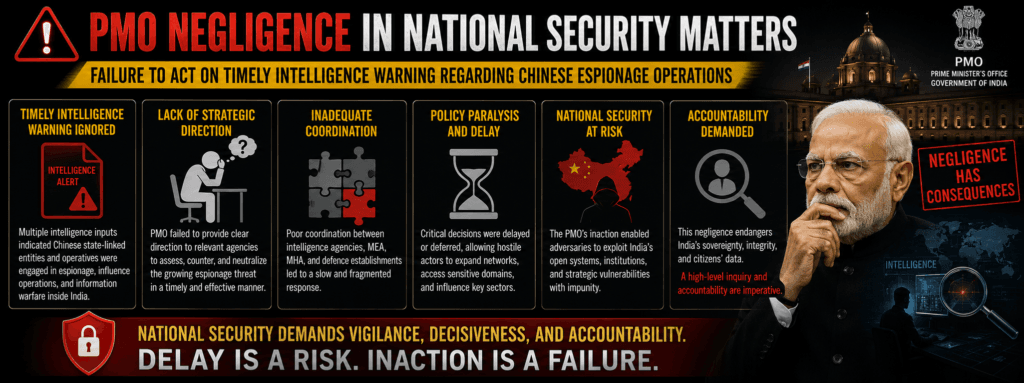
Failure to Act on Timely Intelligence Warnings Regarding Chinese Espionage
1. Timeline of Events and Inaction
| Timeframe | Event / Intelligence Action |
|---|---|
| March 30, 2020 | Prior Warning Issued: A confidential letter (Ref: DL/1045/03/2020) was submitted warning of China’s war planning against India and the US. This early warning was allegedly disregarded, establishing a pattern of unheeded alerts. |
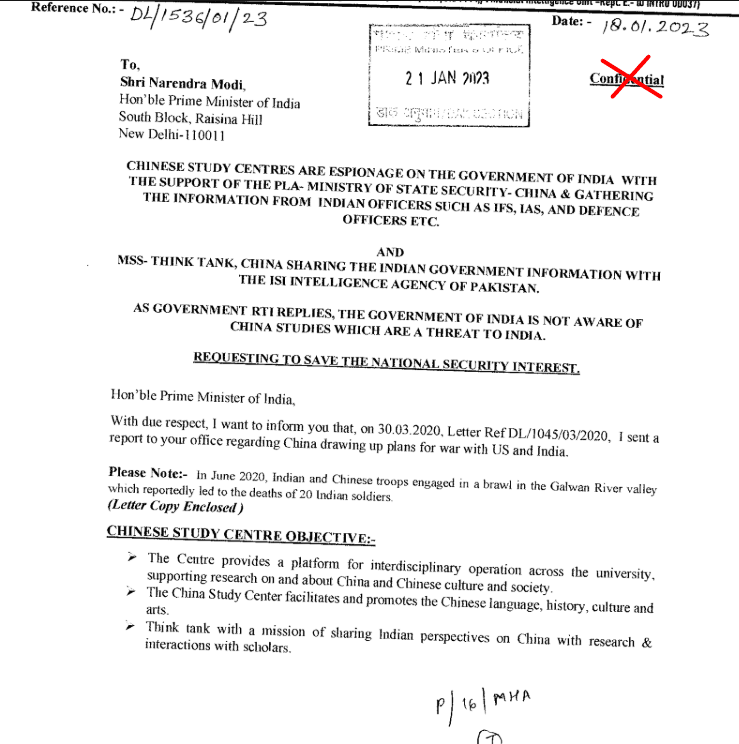
| January 18, 2023 | Urgent Warning Submitted: The Helpful Foundation submitted a confidential letter (Ref: DL/1536/01/23) to the Prime Minister’s Office (PMO). It warned of: • Chinese study centers operating as espionage platforms with MSS and PLA support. • Systematic gathering of sensitive information from Indian IFS, IAS, and Defence personnel. • MSS-affiliated think tanks sharing Indian government information with Pakistan’s ISI. |
| 2023 – 2025 | Period of Inaction: Despite the urgent and confidential nature of the January 2023 warning, the PMO allegedly: • Failed to forward the matter to relevant intelligence agencies under the Ministry of Home Affairs (MHA). • Did not initiate inter-agency coordination to investigate the claims. • Ignored specific references to ongoing espionage activities targeting national security. |
| 2025 (Two Years Later) | Delayed Referral: The PMO reportedly forwarded the matter to intelligence agencies, representing a critical 24-month delay in addressing highly credible national security threats. |
2. Nature of Alleged Negligence
| Category of Negligence | Specific Failures and Protocol Breaches |
|---|---|
| Procedural Failure | Standard national security protocol requires the immediate referral of credible intelligence warnings to the Intelligence Bureau (IB), Research and Analysis Wing (RAW), Ministry of Home Affairs (MHA), and the National Security Council Secretariat (NSCS). This immediate routing did not occur. |
| Substantive Threats Ignored | The PMO failed to act on explicit warnings regarding: • Active espionage operations operating within Indian academic institutions. • The active compromise of serving and former government officers. • Direct intelligence sharing between China’s MSS and Pakistan’s ISI. • Direct, ongoing threats to India’s national security infrastructure. |
| Prior Warnings Disregarded | The 2023 letter specifically referenced the ignored March 2020 communication regarding Chinese military planning, highlighting a systemic pattern of unheeded strategic warnings by the executive office. |
3. National Security Implications
| Implication Area | Strategic Consequence |
|---|---|
| Institutional Accountability | Raises severe questions regarding the PMO’s internal mechanisms, Standard Operating Procedures (SOPs), and filtering processes for handling and escalating critical national security communications. |
| 24-Month Intelligence Gap | Created a critical two-year window during which alleged Chinese espionage activities, MSS-ISI intelligence sharing, and the compromise of Indian officers continued entirely unchecked. |
| Continued Vulnerability | Indian strategic institutions, think tanks, and serving/retired officers remained exposed to active Chinese intelligence gathering and elicitation operations for over two years without state protection or warning. |
| Compromised Counter-Intelligence | The massive delay prevented Indian counter-intelligence agencies (IB/RAW) from taking proactive measures to identify, monitor, and neutralize the MSS-affiliated networks and compromised individuals operating within India. |
PART 5: NATIONAL SECURITY BETRAYAL: How MHA Under Amit Shah Ignored Chinese Espionage Warnings and Falsely Claimed Non-Receipt of Presidential Communications
Timeline of Events: The Routing of the National Security Warning
| Date | Event / Action | Key Details and References |
|---|---|---|
| January 18, 2023 | Initial Security Warning | The Helpful Foundation sends a confidential letter (Ref: DL/1536/01/23) to the Prime Minister, warning about Chinese espionage operations being conducted through study centers. |
| April 19, 2023 | Forwarding by President’s Secretariat | The President’s Secretariat forwards the petition to the Ministry of Home Affairs (MHA) via email (Letter No. P1/E/1904230213). • Sent to: Ajay Kumar Bhalla (shso@nic.in) – Under Secretary, MHA. • Attachments: 2 PDF documents containing the complaint. |
| August 21, 2023 | First RTI Filed (with MHA) | The Helpful Foundation files an RTI with the MHA inquiring about the action taken on the President’s Secretariat letter dated 19/04/2023. |
| August 29, 2023 | MHA’s RTI Response | The MHA officially replies: “As per available record, the letter dated 19/04/2023 forwarded by President’s Secretariat has NOT BEEN RECEIVED/TRACEABLE in this ministry.” |
| September 23, 2023 | Second RTI Filed (with President’s Secretariat) | The Helpful Foundation files an RTI with the President’s Secretariat asking: • Why was there no action on a critical national security threat? • Provide a copy of the forwarding letter/email to the MHA. • Who is responsible for this inaction? |
| October 5, 2023 | President’s Secretariat RTI Response | The Secretariat confirms they forward petitions to concerned ministries via email. They state: “A copy of forwarding email to Secretary, MHA is enclosed,” claiming documentary proof of transmission was provided. |
The Institutional Contradiction and Email Evidence
The RTI responses reveal a severe breakdown in inter-ministerial communication regarding a critical national security threat.
| Entity | Official Stance / Claim | Evidence and Discrepancies |
|---|---|---|
| Ministry of Home Affairs (MHA) | Denial of Receipt | Claims the letter forwarded by the President’s Secretariat was never received and is completely “untraceable” in their official records. |
| President’s Secretariat | Confirmation of Dispatch | Insists the communication was sent via email and provides documentary proof (a copy of the forwarding email to the MHA) to back up their claim. |
| The Email Evidence (The Reality) | Discrepancy in Dates & Routing | The actual email evidence exposes a discrepancy in the official timeline: • Actual Date Sent: The email was sent on April 21, 2023 (not April 19, 2023, as officially recorded in the letterhead). • Sender: P.C. Meena (Under Secretary, President’s Secretariat). • Recipient: Ajay Kumar Bhalla at the MHA. |
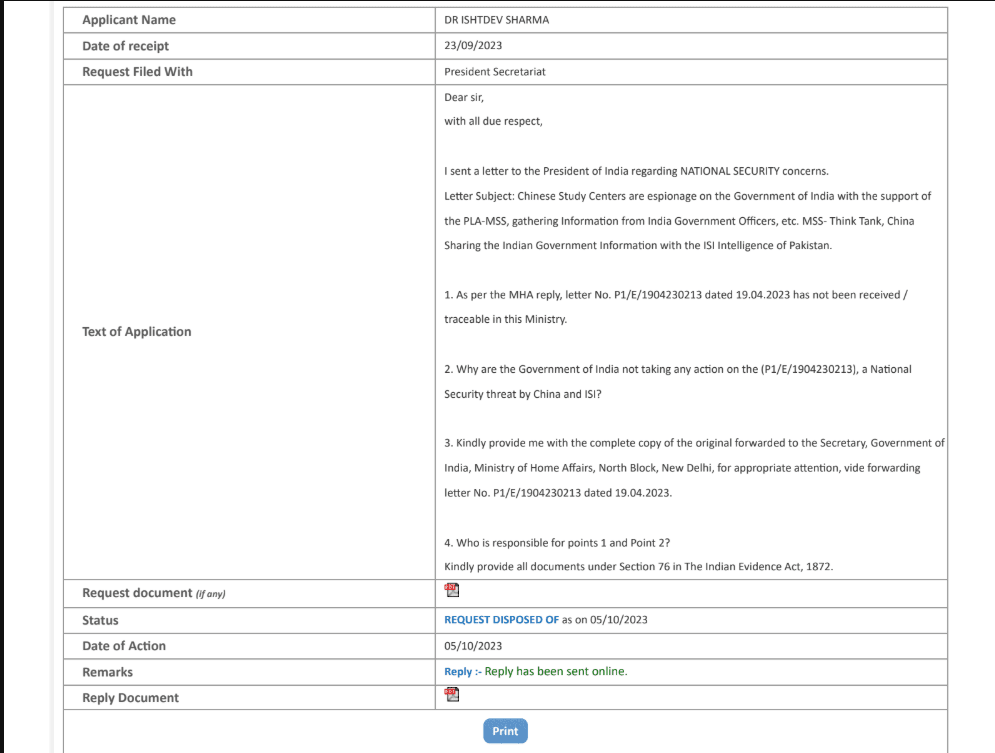
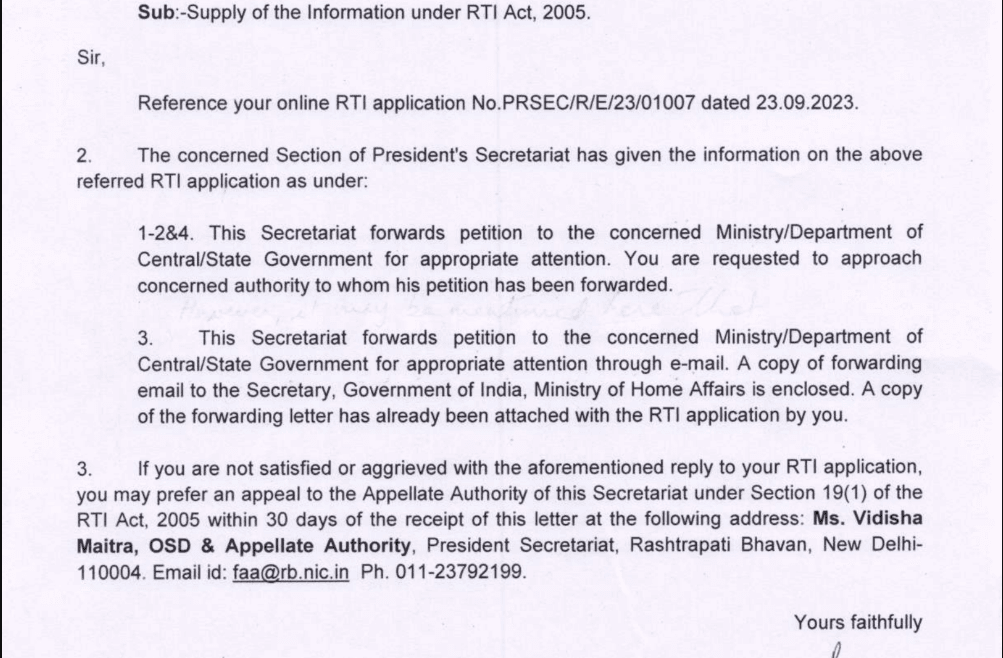
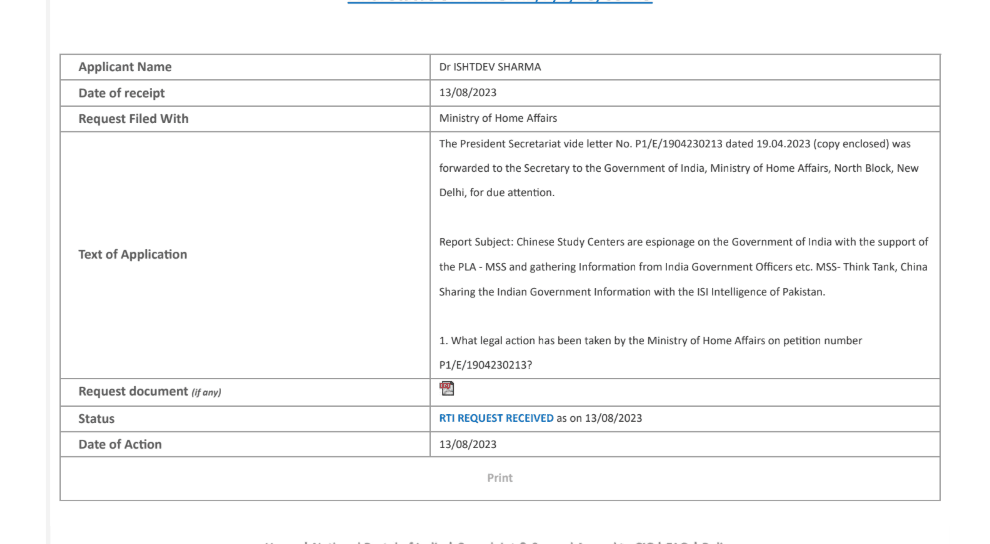
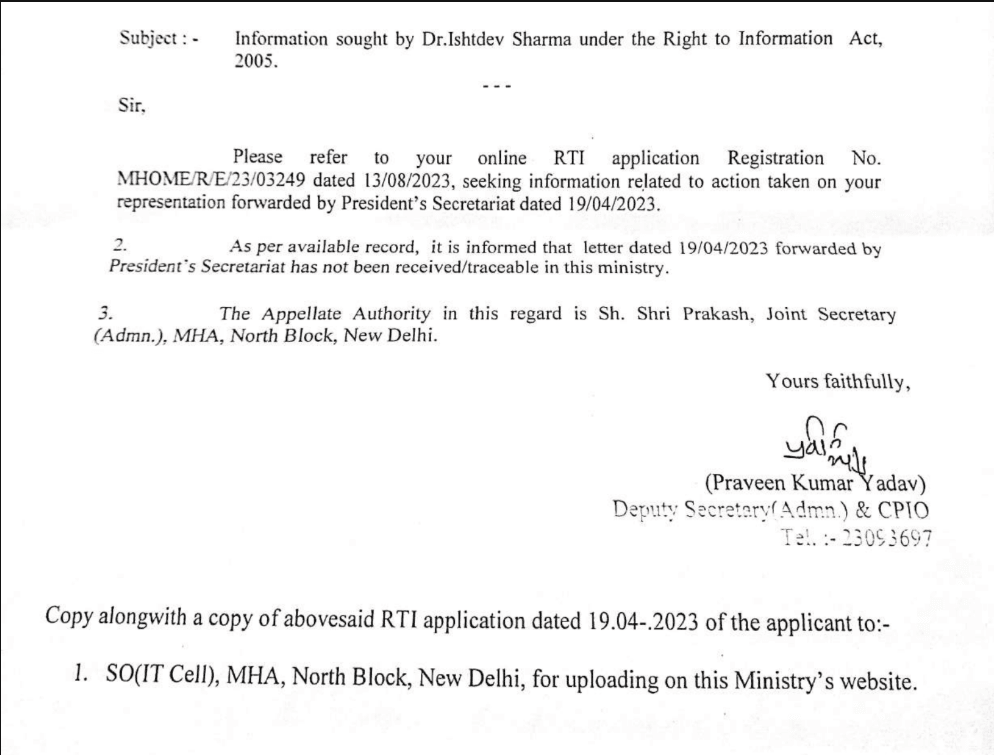
Here is the comprehensive national security threat assessment and institutional negligence report, organized into structured tables for clarity and analysis.
Table 1: Executive Summary & The Adversary Profile
| Aspect | Details & Strategic Context |
|---|---|
| Executive Summary | Documents an unprecedented, multi-agency intelligence failure leaving India’s strategic institutions exposed to China’s Ministry of State Security (MSS). Reveals a complete breakdown of counter-intelligence protocols across the PMO, NSA, MHA, MoD, MEA, MI, and DIA. Premier think tanks (including one founded by the NSA) were systematically penetrated by CICIR (MSS 11th Bureau) while the intelligence apparatus failed to identify, act on, or warn against the threat. |
| 1.1 MSS Threat Profile | China’s primary civilian intelligence, counter-intelligence, and secret police agency (“KGB-style”). Mandates: Foreign intelligence collection (political, economic, military), domestic political security (suppressing dissent), cyber & economic espionage, and neutralizing foreign intelligence. |
| 1.2 The 11th Bureau (CICIR) | Identity: China Institutes of Contemporary International Relations (CICIR) is not a think tank; it is the 11th Bureau of the MSS. Method: Uses “Track II” diplomacy, academic exchanges, and elite network building. The Asymmetric Threat: Exploits India’s democratic openness and academic freedom to extract intelligence through polite conversation and scholarly exchange rather than cyber hacks. |
Table 2: Documented Penetration of Indian Strategic Institutions
| Institution | Leadership / Status | Documented CICIR Engagements | Security Compromise / Risk |
|---|---|---|---|
| Vivekananda International Foundation (VIF) | Founded by NSA Ajit Doval. | May 2014: Dr. Li Li, Dr. Wang Shida (Post-2014 election policy). April 2019: Dr. Fu Mengzi, Dr. Hu Shisheng (Indo-Pacific, Quad, BRI). Nov 2023: Dr. Hu Shisheng (Border tensions, economic vulnerabilities). | VIF’s public statements revealed India’s strategic frustration, economic strain from military mobilization, and desire for normalization—information directly exploited by Chinese negotiators. |
| Manohar Parrikar Institute for Defence Studies and Analyses (MP-IDSA) | Autonomous think tank under the Ministry of Defence (MoD). | 2011: Dr. Lou Chunhao granted a 6-month fellowship (Indian Ocean strategy). Aug 2019: Dr. Lou Chunhao & Zhang Shujian met DG Amb. Sujan R. Chinoy. | The Smoking Gun (March 2025 RTI): MP-IDSA officially stated “NO” when asked if they knew CICIR is an MSS front. Proves MI/DIA failed to disseminate intelligence or MP-IDSA ignored it. |
| Institute of Chinese Studies (ICS) | Directed by former Ambassadors to China (Ashok K. Kantha, Vinod C. Khanna). | June 2018: Dr. Zhang Shujian (CICIR) visited ICS. | Former ambassadors with direct access to current MEA and PMO decision-makers are high-value targets for Chinese intelligence elicitation. |
| Gateway House | Led by former IFS officers (Neelam Deo, Manjeet Kripalani). | June 2018: Dr. Yuan Peng (VP, CICIR) led a delegation covering American & Asian studies. | MEA collaborated with Gateway House on the India-China Think Tanks Forum, raising severe questions about MEA’s security vetting protocols. |
Table 3: The Pakistan Nexus (Coordinated Two-Front Intelligence War)
| Aspect | Details & Evidence of Coordination |
|---|---|
| The Islamabad Connection | Jan 3, 2019 (CGSS, Islamabad): A Chinese delegation from CCBTC (including Suo Bugu, Gao Yuanyuan) and the Chinese Defence Attaché met with Pakistani military generals and former ISI links (referencing Lt. Gen. Zaheer-ul-Islam). |
| The Overlap (Same Entities, Two Fronts) | The exact same Chinese personnel and organizations engaging Indian think tanks in Delhi were simultaneously embedded with Pakistan’s military-intelligence establishment in Islamabad. (e.g., Suo Bugu and Gao Yuanyuan were present at IDCPC meetings in Delhi and CGSS meetings in Islamabad). |
| Strategic Implication | This is theater-wide intelligence coordination. China gathers strategic intelligence from Indian think tanks, cross-references it with Pakistan’s ISI, and uses military attachés to create a unified China-Pakistan strategic posture. This is the operational backbone of China’s “Two-Front War” strategy. |
Table 4: Institutional Negligence & Intelligence Failures
| Agency / Institution | Core Mandate / Expected Action | Documented Failures & Negligence |
|---|---|---|
| PMO & NSA (Ajit Doval) | Process national security warnings; oversee strategic institutions. | Ignored Warnings: Failed to act on 2020 and Jan 2023 warnings regarding Chinese study centers and MSS-ISI sharing. 24-Month Delay: Matter forwarded to intel agencies only in 2025. Conflict of Interest: NSA is the founder of VIF, creating an oversight and accountability gap regarding its foreign engagements. |
| Ministry of Home Affairs (MHA) | Process internal security threats; maintain accurate records. | The Email Scandal: President’s Secretariat forwarded the Jan 2023 warning to MHA via email in April 2023. In Aug 2023, MHA falsely claimed via RTI that the letter was “NOT RECEIVED/TRACEABLE.” In Oct 2023, the President’s Secretariat provided email proof of delivery. MHA made false official statements and ignored espionage warnings. |
| Military Intelligence (MI) & Defence Intelligence Agency (DIA) | Identify threats, brief MoD think tanks, flag adversarial entities, monitor Track II diplomacy. | Systemic Collapse: Failed to flag CICIR, failed to brief MP-IDSA (as proven by the 2025 RTI), and failed to monitor engagements. The CICIR-MSS link is public knowledge globally; MI/DIA’s failure to act on it represents a dereliction of constitutional duty. |
| Ministry of External Affairs (MEA) | Vet foreign engagements, secure diplomatic channels, manage post-service restrictions. | Protocol Failures: Collaborated with think tanks hosting MSS fronts without vetting. Allowed former IFS officers with access to US-India strategic communications and classified cables to engage CICIR without debriefing or oversight. |
Table 5: Legal & Constitutional Violations
| Law / Regulation | Specific Violation / Failure | Responsible Agency |
|---|---|---|
| Official Secrets Act, 1923 | Failure to protect defense establishments from foreign intelligence penetration. | MI, DIA, MoD, MP-IDSA |
| Defence Services Regulations | Negligence in safeguarding strategic information and military assets. | MI, DIA, MP-IDSA |
| RTI Act, 2005 | Providing demonstrably false information in official responses (MHA email denial). | MHA |
| IPC Section 120B | Criminal conspiracy (if the suppression of intelligence was deliberate). | All relevant agencies |
| IPC Section 201 & 218 | Causing disappearance of evidence / Public servant framing incorrect records to save persons from punishment. | MHA Officials |
| Constitutional Articles (53, 78, 309, 311) | Executive failure to protect national security; NSA failing to secure his own institution; lack of post-service restrictions for diplomats; no disciplinary action for false RTI statements. | PMO, MHA, MoD, MEA |
Table 6: National Security Implications & Damage Assessment
| Category | Specific Details & Impact |
|---|---|
| Intelligence Compromised | Military: IOR naval strategy, Quad dynamics, border deployments. Diplomatic: LAC red lines, negotiation fallbacks. Economic: Strain from mobilization, inflation vulnerabilities. Leadership: Profiling of PM, NSA, EAM decision-making styles. Alliances: Depth of US-India interoperability and intel-sharing. |
| Vulnerabilities Exploited by MSS | China knows India desires a “course correction” (giving China leverage to stall). China validated its “salami slicing” border strategy is draining Indian resources. China mapped India’s economic limits and confirmed India’s stance that the Quad is “not a military alliance.” |
| Long-Term Strategic Damage | Immediate: China holds psychological leverage in border negotiations. Medium-term: Exploitation of India’s economic vulnerabilities; enhanced Pak-China coordination. Long-term: Indian decision-makers permanently profiled; Chinese influence networks deeply embedded in India’s strategic community. |
Table 7: Conclusion & Final Assessment
| Assessment Area | Findings & Strategic Reality |
|---|---|
| The Evidence Proven | ✅ CICIR is an MSS front (globally known). ✅ Indian think tanks (VIF, IDSA, ICS, Gateway House) were penetrated. ✅ Intelligence agencies (MI/DIA) failed to warn or monitor. ✅ Ministries (MHA) lied via official RTI responses. ✅ PMO ignored warnings for 24 months. ✅ Pakistan coordination is confirmed. ✅ NSA has a conflict of interest regarding VIF. |
| The Strategic Reality | China’s Success: Mapped networks, extracted red lines, delivered calibrated warnings, built elite influence, and coordinated a two-front intel war. India’s Response: Institutional ignorance, bureaucratic deflection, false statements, ignored warnings, and zero accountability. |
| The Choice Before India | Option A (Continue Denial): Maintain false RTIs, ignore oversight, protect compromised officials. Result: Strategic defeat and subordination. Option B (Confront Reality): Launch independent investigations, prosecute negligent officials, implement CI reforms, designate CICIR as hostile, audit all foreign engagements. Result: Restored security posture. |
| Final Threat Assessment | THREAT LEVEL: CRITICAL / EXISTENTIAL. This is not a bureaucratic lapse; it is a comprehensive collapse of India’s national security architecture resulting in institutional treason and continued vulnerability. |