⚠️ DISCLAIMER: This document represents a synthesis of unclassified information on PLA structure. Detailed unit locations, strengths, equipment inventories, and readiness states are classified by China. All information below is derived from publicly available materials. Not for operational use.
📋 EXECUTIVE SUMMARY
Domain
Key Findings
Supreme Command
Central Military Commission (CMC) under CCP absolute control; Chairman Xi Jinping
Force Size
~2.035 million active personnel; ~40+ PLARF combat brigades; 13 PLAGF Group Armies; 6 amphibious ACABs
Major Reforms
2016: Theater Command system replaced Military Regions; 2017: Group Army restructuring; April 2024: SSF dissolved, replaced by three new Arms
Taiwan Contingency Focus
Eastern/Southern Theater Commands; 6 amphibious brigades (~30,000 troops); DF-17 hypersonic missiles in Fujian; DF-26 IRBMs for regional deterrence
Nuclear Posture Shift
From minimum deterrence to expanded arsenal: ~110 ICBM launchers (2023) → ~507+ projected (2028); new silo fields; potential Launch-on-Warning capability
Information Warfare
Information Support Force (ISF) established April 2024; communications infrastructure units secure southern networks
🏛️ SUPREME COMMAND STRUCTURE
CHINESE COMMUNIST PARTY (CCP) │ └─ CENTRAL MILITARY COMMISSION (CMC) — Supreme military authority │ ├─ CHAIRMAN: Xi Jinping (also CCP General Secretary, PRC President) ├─ VICE CHAIRMEN: General Zhang Shengmin (as of early 2026) ├─ MINISTER OF NATIONAL DEFENSE: Admiral Dong Jun (ceremonial/external role) │ ├─ CMC JOINT STAFF DEPARTMENT — Operational planning, joint command ├─ CMC POLITICAL WORK DEPARTMENT — Personnel, ideology, political commissars ├─ CMC DISCIPLINE INSPECTION COMMISSION — Anti-corruption, loyalty enforcement ├─ CMC LOGISTICS SUPPORT DEPARTMENT — Strategic logistics coordination ├─ CMC EQUIPMENT DEVELOPMENT DEPARTMENT — R&D, procurement, modernization │ └─ FOUR SERVICES + FOUR ARMS (see below)
Core Principle: Party Control
The PLA is constitutionally the armed wing of the CCP, not a national military
Dual-command system: Every operational commander has a political commissar counterpart with equal authority on political/loyalty matters
Political commissars report through Political Work Department, not operational chain
CMC retains sole authority to authorize nuclear weapon use
🎖️ FOUR SERVICES (军种) — Primary Warfighting Branches
Service
Headquarters
Personnel
Primary Missions
Key Taiwan-Relevant Capabilities
**PLA Ground Force **(PLAGF)
Beijing
~975,000
Land warfare, amphibious ops, border defense, internal security
6 Amphibious Combined Arms Brigades; 13 Group Armies; artillery/aviation/SOF support
**PLA Navy **(PLAN)
Beijing
~260,000
Maritime defense, sea lane security, power projection, amphibious sealift
3 Fleets; Type 075 LHDs; Type 055 destroyers; Marine Corps (6+ brigades); submarine force
**PLA Air Force **(PLAAF)
Beijing
~400,000
Air superiority, strategic strike, airborne operations, air defense
Strong artillery, aviation, SOF, EW capabilities can augment amphibious brigades
Alternative approaches
PLA may prioritize airborne/airmobile seizure of ports/airfields over traditional beach assault
Overall readiness for large-scale invasion
Capable of limited operations (offshore islands); not yet prepared for full-scale Taiwan invasion without significant buildup time
📡 INFORMATION SUPPORT FORCE & COMMUNICATIONS UNITS
ISF Context (Post-April 2024)
Information Support Force (ISF) — CMC Direct Command │ ├─ Mission: “Coordinating construction and application of network information systems” ├─ Grade: Deputy-theater-command level ├─ Structure: Not publicly detailed; likely organized by regional communications districts └─ Key Functions: ├─ Secure fiber/satellite/radio communications infrastructure ├─ Joint-force data integration and C2 network resilience ├─ Civil-military fusion: Leverage civilian telecom under national strategy └─ Support theater command operations across all domains
PHASE 3: EXPLOITATION & CONSOLIDATION (Days to Weeks) ├─ Follow-on PLAGF forces: Second-echelon landing via captured ports ├─ JLSF: Establish supply lines; medical evacuation; equipment repair ├─ PLARF: DF-26 nuclear ambiguity to deter US intervention ├─ Aerospace Force: Satellite reconnaissance; navigation support └─ ISF: Maintain C2 resilience amid electronic warfare/cyber attacks
Critical Capability Gaps
Gap
Impact on Taiwan Contingency
Amphibious Sealift
Insufficient PLAN LHDs/LSDs + civilian RO-RO to lift 6 ACABs (~30,000 troops, 2,400 vehicles) in first wave; requires days/weeks of buildup
Joint C2 Integration
Despite ISF establishment, real-time data sharing across services remains a work in progress; risk of fratricide/miscoordination
ISR for ASBM Targeting
DF-21D/DF-26 anti-ship role requires real-time, accurate targeting data for moving USN carriers; PLA ISR capabilities in contested environment unproven
Logistics Sustainment
Cross-strait supply lines vulnerable to US/Allied interdiction; JLSF capacity for prolonged high-intensity operations uncertain
Nuclear Ambiguity Risk
DF-26 dual-capable nature creates escalation risk: US cannot distinguish conventional vs. nuclear DF-26 launches during crisis
Most Likely PLA Courses of Action (Taiwan)
Coercion Short of War (Most Likely): Blockade, cyber attacks, missile demonstrations, gray-zone operations to pressure Taiwan politically
Limited Seizure of Offshore Islands (Plausible): Jinmen, Matsu, or Pratas Islands using SRBM suppression + amphibious battalion assault
Full-Scale Invasion (Least Likely in Near Term): Requires massive buildup, favorable weather, US non-intervention; high risk of escalation to US-China conflict
🔍 METHODOLOGY & LIMITATIONS
Why a “Complete” Order of Battle Is Impossible Publicly
Chinese State Secrets Law: Detailed unit locations, strengths, equipment inventories classified
MUCD Fluidity: Cover designators reassigned; units renumbered during reforms
Deception Practices: PLA employs camouflage, decoys, and false reporting
Rapid Reform Pace: April 2024 SSF dissolution demonstrates structure can change with little public notice
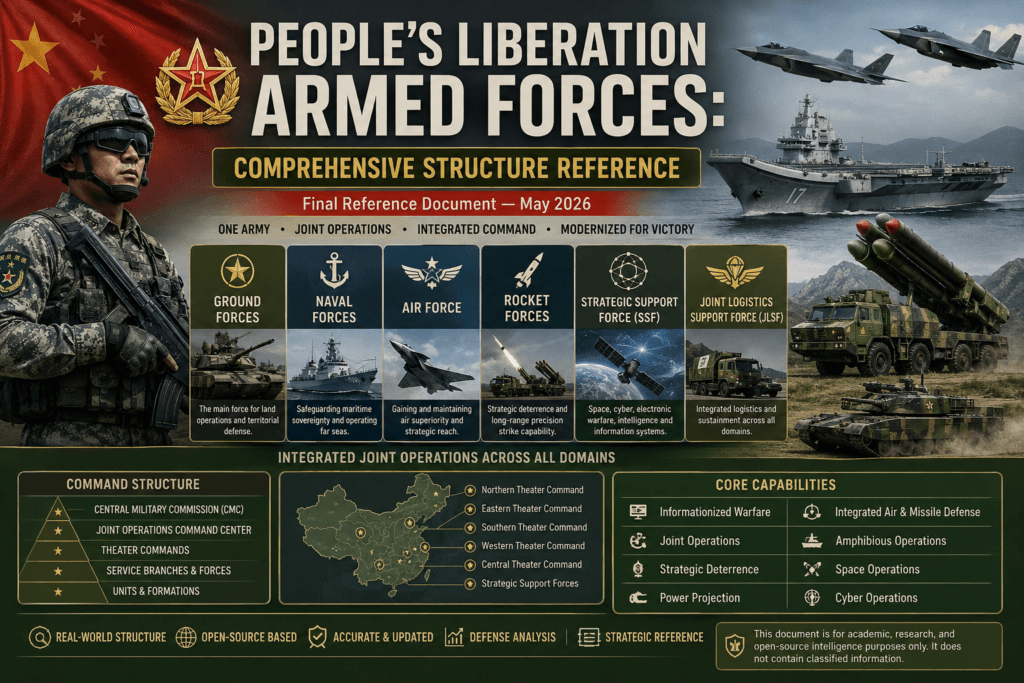
PLA Comprehensive visual overview of the People’s Liberation Armed Forces structure, command systems, military branches, strategic support forces, and integrated operational capabilities based on public-source research.
Confidence Levels by Domain
Domain
Confidence Level
Rationale
Supreme Command Structure
High
Official appointments publicly announced
Theater Command AORs
High
Officially published; stable since 2016
Group Army HQ Locations
High
Consistently reported in Chinese media
PLARF Base Locations
High
Satellite-verified; consistent reporting
PLARF Brigade Equipment
Medium-High
MUCD patterns + imagery + exercise reporting
Amphibious Brigade Locations
Medium-High
Analysis + satellite verification
Exact Launcher Counts
Medium
Estimated from garage capacity, vehicle counts; exact numbers classified
Nuclear Warhead Counts
Low
Highly classified; estimates vary widely among analysts
Unit Readiness States
Low
Training reports selective; readiness metrics not public
ℹ️ FINAL NOTE: This document represents a synthesis of the best available unclassified information as of May 2026. The PLA is undergoing continuous reform; structure, equipment, and doctrine evolve. For academic or professional analysis, always consult multiple sources, verify geolocations independently, and acknowledge uncertainty where it exists.
This report has been researched, analysed, and prepared by our strategic research partner, the Security Advisor and Research Organisation (SARO).
SARO (Security Advisory & Research Organisation) – Strategic Research Partner delivering Independent Intelligence, Strategic Research, and Advisory Excellence.
The Security Advisor and Research Organisation (SARO) is an independent intelligence, strategic research, and advisory organisation dedicated to advancing national security, resilience, and informed decision-making in an increasingly complex global security environment. Through evidence-based research, intelligence analysis, and strategic assessments, SARO supports governments, organisations, businesses, and stakeholders in understanding emerging risks, geopolitical developments, and security challenges.
Strategic Research Partner Independent Intelligence • Strategic Research • Advisory Excellence