
PLA Units Deployed Along India-China LAC : COMPREHENSIVE RESEARCH & ANALYSIS REPORT
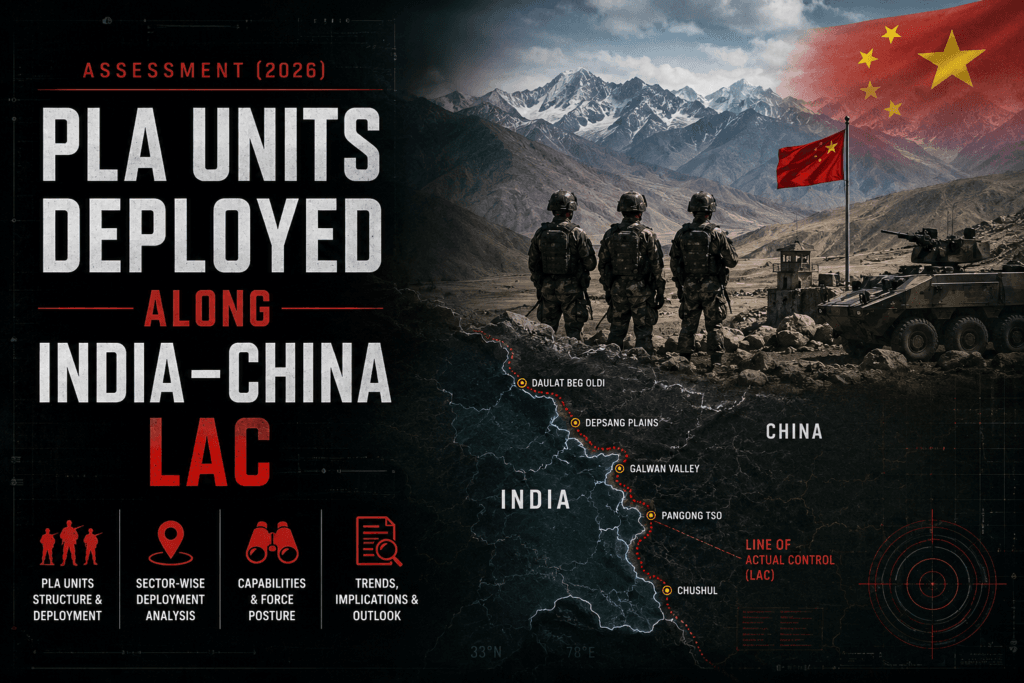
PLA UNITS DEPLOYED ALONG INDIA-CHINA LINE OF ACTUAL CONTROL (LAC)
Prepared For: Strategic Analysis & Research
Pages: Comprehensive Assessment
1️⃣ EXECUTIVE SUMMARY
Key Findings
This comprehensive open-source assessment reveals that the People’s Liberation Army (PLA) has significantly enhanced its military posture along the 3,488-km India-China Line of Actual Control (LAC) following the 2020 Galwan Valley clash. As of 2026, the PLA maintains an estimated 60,000-75,000 personnel within 100 km of the LAC, organized under the Western Theatre Command (WTC).
Critical Developments:
✅ Dual-Theatre Integration: The WTC coordinates operations across both India and Central Asia fronts, with the 76th and 77th Group Armies serving as primary ground combat elements
✅ High-Altitude Air Power: China has operationalized 6 major airbases above 14,000 feet elevation, including Lhunze (40 km from Arunachal Pradesh) now hosting J-20 5th-generation stealth fighters
✅ Infrastructure Advantage: Construction of 628 “Xiaokang” defense villages and all-weather roads has reduced PLA mobilization time from 12 hours to under 4 hours in key sectors
✅ Multi-Domain Integration: PLA has deployed integrated cyber, electronic warfare, space, and conventional forces under unified WTC command, implementing “Multi-Domain Integrated Joint Operations” (MDIJO) doctrine
✅ Rocket Force Deterrence: The 64th Base maintains 3 missile brigades (809, 812, 823) equipped with DF-21D, DF-26, and DF-17 hypersonic missiles capable of strategic strike against Indian targets
Strategic Implications:
⚠️ Rapid Escalation Risk: PLA’s improved infrastructure and pre-positioned stocks enable brigade-level reinforcement within 24-48 hours of crisis onset
⚠️ Air Superiority Challenge: PLAAF’s high-altitude bases provide 5-7 minute response time to LAC incidents versus 15-20 minutes for Indian Air Force from nearest bases
⚠️ Technology Gap: PLA deployment of Type 15 light tanks, J-20 stealth fighters, and GJ-11 combat drones outpaces Indian equivalents in key domains
⚠️ Logistics Advantage: China’s Qinghai-Tibet Railway extensions and highway network enable sustained operations at 4,500-5,000m altitude year-round
Recommendations:
- Accelerate Infrastructure Development: Complete Arunachal Frontier Highway and Nyoma airfield by 2027
- Enhance ISR Capabilities: Deploy additional satellite, UAV, and ground-based surveillance systems along LAC
- Strengthen Deterrence: Forward-deploy advanced air defense systems (S-400, Akash-NG) and precision-strike capabilities
- Improve Inter-Service Coordination: Establish permanent joint command structure for India-China border
- Diplomatic Engagement: Strengthen WMCC and military hotline mechanisms to prevent accidental escalation
2️⃣ INTRODUCTION & STRATEGIC CONTEXT
2.1 Historical Background
The India-China border dispute spans 3,488 kilometers across three sectors:
- Western Sector: Ladakh/Aksai Chin (approximately 600 km)
- Middle Sector: Uttarakhand/Himachal Pradesh (approximately 450 km)
- Eastern Sector: Sikkim/Arunachal Pradesh (approximately 1,100 km)
The Line of Actual Control (LAC) remains undefined and undemarcated, with differing perceptions of alignment creating multiple friction points.
2.2 Post-2020 Strategic Environment
The June 15, 2020 Galwan Valley clash marked a watershed moment in India-China relations, resulting in:
- 20 Indian soldiers and an estimated 40+ PLA casualties
- Suspension of most bilateral military exchanges
- Massive troop buildups on both sides
- Accelerated infrastructure development
- Shift from “managed competition” to “active deterrence”
2.3 PLA Modernization Context
Since the 2015 military reforms, the PLA has undergone fundamental restructuring:
- Transition from军区 (Military Regions) to 战区 (Theatre Commands)
- Emphasis on joint operations and multi-domain integration
- Development of “informatized” and “intelligentized” warfare capabilities
- Focus on high-altitude and mountain warfare specialization
2.4 Research Objectives
This report aims to:
- Map PLA order of battle along the LAC using open sources
- Assess PLA operational capabilities and limitations
- Analyze infrastructure development and logistics capacity
- Compare PLA and Indian force postures
- Identify strategic implications and future trends
3️⃣ RESEARCH METHODOLOGY
3.1 Data Sources
Primary Open Sources:
- Chinese official media (Xinhua, PLA Daily, CCTV)
- Ministry of National Defense (PRC) statements
- Satellite imagery analysis (Maxar, Planet Labs)
- Defense think tank publications (IISS, SIPRI, RUSI, Takshashila)
- Academic research papers and conference proceedings
- Commercial satellite imagery analysis
Secondary Sources:
- Indian Ministry of Defence annual reports
- Parliamentary Standing Committee on Defence testimonies
- Media reports from reputable outlets (The Hindu, Indian Express, Times of India)
- International media (South China Morning Post, Nikkei Asia, Jane’s Defence Weekly)
3.2 Analytical Framework
PMESII Analysis:
- Political factors
- Military capabilities
- Economic dimensions
- Social considerations
- Infrastructure development
- Information environment
SWOT Assessment:
- PLA Strengths along LAC
- PLA Weaknesses and limitations
- Opportunities for PLA expansion
- Threats to PLA operations
3.3 Limitations
⚠️ Classification Constraints: Detailed PLA order of battle, exact troop numbers, and specific unit locations are classified
⚠️ Information Reliability: Chinese official sources may present optimistic or propagandistic assessments
⚠️ Temporal Gaps: Open-source information may lag real-time developments by 6-18 months
⚠️ Verification Challenges: Satellite imagery interpretation requires specialized expertise; some assessments remain speculative
4️⃣ PLA ORGANIZATIONAL RESTRUCTURING (2015-2026)
4.1 Theatre Command System
Pre-2015 Structure:
Seven Military Regions (MRs):
- Shenyang MR
- Beijing MR
- Lanzhou MR
- Jinan MR
- Nanjing MR
- Guangzhou MR
- Chengdu MR ← Responsible for India border
Post-2015 Structure:
Five Theatre Commands (TCs):
- Eastern TC (Nanjing)
- Southern TC (Guangzhou)
- Western TC (Chengdu) ← Primary India responsibility
- Northern TC (Shenyang)
- Central TC (Beijing)
4.2 Western Theatre Command (WTC)
Headquarters: Chengdu, Sichuan Province
Area of Responsibility:
- Tibet Autonomous Region
- Xinjiang Uyghur Autonomous Region
- Qinghai Province
- Gansu Province (partial)
- Sichuan Province (partial)
Strategic Missions:
- India border defense and potential conflict
- Central Asia stability and counter-terrorism
- Xinjiang internal security
- Tibet stability and border management
- Strategic depth for nuclear forces
WTC Command Structure:
Western Theatre Command
├── WTC Army (Ground Forces)
│ ├── 76th Group Army
│ ├── 77th Group Army
│ ├── Tibet Military District
│ └── Xinjiang Military District
│
├── WTC Air Force
│ ├── Fighter Divisions
│ ├── Transport Aviation
│ └── Army Aviation Coordination
│
├── WTC Rocket Force Coordination
│ └── 64th Base
│
├── WTC Navy Coordination (Limited)
│ └── Xinjiang Naval Base (Lakes)
│
└── Support Forces
├── Joint Logistics Support Force
├── Information Support Force
└── Cyber & Electronic Warfare Units
4.3 Group Army Reforms
Pre-Reform: 18 Group Armies (numbered 1-65, non-sequential)
Post-Reform: 13 Group Armies (numbered 71-83)
Key Changes:
- Elimination of division structure in favor of brigade-centric organization
- Integration of combined arms, artillery, air defense, and aviation at group army level
- Enhanced joint operations capability
- Improved rapid deployment and mobility
5️⃣ GROUND FORCES DEPLOYMENT ANALYSIS
5.1 76th Group Army
Headquarters: Xining, Qinghai Province
Primary AOR: Western Tibet, Aksai Chin, Ladakh sector
Estimated Strength: 30,000-40,000 personnel
Subordinate Units (Open Source Assessment):
| Unit Type | Estimated Number | Equipment | Notes |
|---|---|---|---|
| Combined Arms Brigades (CABs) | 4-5 | Type 99A, Type 15, ZBL-08 | Mix of heavy/medium/light |
| Artillery Brigades | 1-2 | PLZ-05, PCL-181 | 155mm SPH |
| Air Defense Brigades | 1 | HQ-9, HQ-16, Type 09 | Layered AD |
| Army Aviation Brigades | 1 | Z-10, Z-19, Z-20 | Attack/utility helicopters |
| Special Operations Brigade | 1 | Light infantry, snipers | Reconnaissance, raids |
Operational Characteristics:
- Heavy emphasis on high-altitude warfare
- Pre-positioned equipment stocks at 4,500-5,000m elevation
- Year-round operational capability despite extreme weather
- Integrated logistics support from Qinghai and Gansu bases
5.2 77th Group Army
Headquarters: Chongqing (reportedly relocated from Chengdu)
Primary AOR: Eastern Tibet, Arunachal Pradesh, Sikkim sector
Estimated Strength: 35,000-45,000 personnel
Subordinate Units:
| Unit Type | Estimated Number | Equipment | Notes |
|---|---|---|---|
| Combined Arms Brigades | 5-6 | Type 15, Type 96B, ZBD-04 | Mountain-optimized |
| Artillery Brigades | 2 | PLZ-11, PCL-181 | Mountain artillery |
| Air Defense Brigades | 1-2 | HQ-17, Type 09 | Mobile AD systems |
| Army Aviation Brigades | 1 | Z-10, Mi-171, Z-8 | High-altitude ops |
| Engineering Brigades | 1 | Bridge-laying, road construction | Infrastructure support |
Special Features:
- Largest concentration of Type 15 light tanks (optimized for 4,500m+ altitude)
- Enhanced mountain warfare training at Tibet Military District facilities
- Direct support from Xinjiang Military District reserves if needed
5.3 Tibet Military District (TMD)
Headquarters: Lhasa, Tibet Autonomous Region
Status: Subordinate to WTC but maintains operational autonomy for border defense
Structure:
Tibet Military District
├── Prefecture-Level Military Sub-Districts (5)
│ ├── Ngari (Western Tibet)
│ ├── Nyingchi (Eastern Tibet)
│ ├── Shigatse (Central-South Tibet)
│ ├── Lhoka (Southern Tibet)
│ └── Nagqu (Northern Tibet)
│
├── Border Defense Regiments (~15)
│ └── Company-level outposts along LAC
│
├── Independent Battalions
│ └── County-level rapid reaction forces
│
└── Reserve & Militia Units
└── Local support and logistics
Border Defense Regiments:
- Primary mission: Day-to-day border patrols, surveillance, incident response
- Strength: 500-800 personnel per regiment
- Equipment: Light infantry weapons, mortars, vehicles, surveillance equipment
- Posture: Dispersed along LAC in company/platoon-sized outposts
Key Regiments (Reported):
- Ngari Sector: 3-4 regiments facing Ladakh/Aksai Chin
- Nyingchi Sector: 4-5 regiments facing Arunachal Pradesh
- Shigatse Sector: 3-4 regiments facing Sikkim/West Bengal
5.4 Xinjiang Military District (XMD)
Headquarters: Urumqi, Xinjiang Uyghur Autonomous Region
Secondary Role: Reinforcement of Tibet sector in crisis
Notable Units:
| Division | Nickname | Capability | Deployment Time to LAC |
|---|---|---|---|
| 4th CAD | “Tianshan Heroic Division” | Type 99A MBTs | 48-72 hours |
| 6th CAD | “Plateau Elite Division” | Mountain warfare | 24-48 hours |
| 8th CAD | “Tianshan Iron Cavalry” | Mechanized infantry | 48-72 hours |
| 11th CAD | “Red Army Division” | Rapid reaction | 24-48 hours |
Strategic Reserve Function:
- XMD units can reinforce TMD or Group Armies within 24-72 hours
- Utilize Xinjiang-Tibet Highway (G219) and rail connections
- Provide heavy armor and artillery not permanently stationed in Tibet
5.5 Combined Arms Brigade (CAB) Structure
Standard CAB Organization (Post-2017):
Combined Arms Brigade (~5,000-6,000 personnel)
├── Brigade Headquarters
│
├── 4x Combined Arms Battalions
│ ├── 3x Mechanized/Motorized Infantry Companies
│ ├── 1x Tank Company
│ └── Support elements
│
├── Artillery Battalion
│ └── 155mm howitzers (SP or towed)
│
├── Air Defense Battalion
│ └── MANPADS, SHORAD systems
│
├── Reconnaissance Battalion
│ ├── UAV company
│ └── Special reconnaissance teams
│
├── Combat Support Battalion
│ ├── Engineers
│ ├── Chemical defense
│ └── Communications
│
└── Logistics Support Battalion
├── Transport
├── Maintenance
├── Medical
└── Supply
CAB Variants:
- Heavy CAB: Type 99A/Type 96B tanks, tracked IFVs
- Medium CAB: ZBL-08 wheeled IFVs, wheeled tank destroyers
- Light CAB: High-mobility vehicles, air-assault capability
- Mountain CAB: Optimized for high-altitude, Type 15 tanks
6️⃣ PLA AIR FORCE (PLAAF) FORWARD DEPLOYMENT
6.1 Strategic Airbase Network
China has developed a tiered airbase system along the Tibet-Xinjiang border region:
Tier 1: High-Altitude Forward Bases (>14,000 ft)
| Air Base | Elevation | Distance to LAC | Runway Length | Hardened Shelters | Primary Aircraft |
|---|---|---|---|---|---|
| Lhunze | 14,200 ft | 40 km (Arunachal) | 3,500m | 36+ | J-20, J-16, J-10C |
| Tingri | 14,100 ft | 50 km (Sikkim) | 3,000m | 24+ | J-11, J-10, Su-30 |
| Ngari Gunsa | 14,200 ft | 80 km (Ladakh) | 4,500m | 18+ | J-16, KJ-500 AWACS |
| Shigatse Peace | 12,500 ft | 120 km (Sikkim) | 4,000m | 30+ | Mixed fighter/transport |
| Pangda | 14,000 ft | 60 km (Aksai Chin) | 3,200m | 20+ | J-10C, UAVs |
| Hotan | 4,500 ft | 200 km (Ladakh) | 3,800m | 40+ | J-16, CH-5 UAV, KJ-200 |
Tier 2: Support Bases (10,000-14,000 ft)
| Air Base | Elevation | Function |
|---|---|---|
| Lhasa Gonggar | 11,700 ft | Logistics hub, transport aircraft |
| Nyingchi Mainling | 9,600 ft | Helicopter operations, mountain rescue |
| Kashgar | 4,200 ft | Strategic reserve, heavy bombers |
| Korla | 3,100 ft | Training, reinforcement staging |
6.2 Aircraft Inventory & Capabilities
Fighter Aircraft:
| Aircraft | Generation | Role | Combat Radius | Weapons | LAC Deployment Status |
|---|---|---|---|---|---|
| J-20 “Mighty Dragon” | 5th Gen | Air superiority, strike | 1,200 km | PL-15, PL-10, precision bombs | ✅ Deployed (Lhunze, 2024+) |
| J-16 | 4.5 Gen | Multi-role strike | 1,500 km | PL-15, YJ-91, LGBs | ✅ Primary strike aircraft |
| J-11B/D | 4th Gen | Air superiority | 1,500 km | PL-12, PL-8 | ✅ Rotational deployment |
| J-10C | 4th Gen | Multi-role | 1,200 km | PL-15, PL-10 | ✅ Forward bases |
| Su-30MKK | 4th Gen | Long-range strike | 1,500 km | Kh-31, BrahMos-type | ⚠️ Limited deployment |
Support Aircraft:
| Aircraft | Type | Quantity (Est.) | Function |
|---|---|---|---|
| KJ-500 | AWACS | 6-8 | Airborne early warning, command & control |
| KJ-200 | AEW | 4-6 | Medium-range surveillance |
| Y-20 | Strategic transport | 8-10 | Heavy lift, paratroop deployment |
| Y-9 | Tactical transport | 12-15 | Medium lift, medevac |
| H-6K/N | Strategic bomber | 6-8 | Long-range standoff strike (Kashgar) |
Unmanned Aerial Systems:
| UAV | Type | Endurance | Payload | Mission |
|---|---|---|---|---|
| GJ-11 “Sharp Sword” | Stealth UCAV | 6 hrs | 2,000 kg | Penetrating strike, SEAD |
| CH-5 “Rainbow” | MALE UAV | 25 hrs | 1,000 kg | ISR, precision strike |
| CH-7 | HALE UAV | 16 hrs | Classified | High-altitude ISR |
| WZ-7 “Soaring Dragon” | HALE UAV | 10 hrs | 500 kg | Strategic surveillance |
| GJ-2 | MALE UAV | 12 hrs | 500 kg | Tactical ISR/strike |
6.3 Operational Capabilities
Response Times:
- Lhunze to Tawang: 5-7 minutes flight time
- Tingri to Nathu La: 8-10 minutes
- Ngari to Demchok: 12-15 minutes
- Kashgar to Aksai Chin: 20-25 minutes
Sortie Generation Rates (Estimated):
- High-altitude bases: 2-3 sorties/aircraft/day (reduced by altitude)
- Support bases: 4-6 sorties/aircraft/day
- Sustained operations: 72-96 hours before requiring major maintenance
Weapons Load at High Altitude:
- 14,000 ft elevation: 60-70% of sea-level payload capacity
- Mitigation: Use of lighter weapons, reduced fuel loads, aerial refueling
6.4 Air Defense Integration
Layered Air Defense Architecture:
Strategic Layer (200+ km)
├── S-400 (imported from Russia)
└── HQ-9B (indigenous long-range SAM)
Operational Layer (50-150 km)
├── HQ-22 (medium-range SAM)
└── HQ-16 (medium-range SAM)
Tactical Layer (10-40 km)
├── HQ-17 (short-range SAM)
├── Type 09 (SPAAA)
└── PGZ-09 (35mm SPAAA)
Point Defense (<10 km)
├── MANPADS (HN-5, QW-2)
└── Close-in weapon systems
Integrated Air Defense Network:
- Radar coverage: JY-27A VHF radar, YLC-8B AESA radar
- Command & control: Automated C2 linking radars, SAMs, and fighters
- Electronic warfare: Type 911 EW systems, jamming platforms
7️⃣ PLA ROCKET FORCE (PLARF) STRATEGIC POSTURE
7.1 64th Base (Western Theatre Command)
Headquarters: Xining, Qinghai Province (reportedly)
Mission: Strategic deterrence against India and Central Asia
Subordinate Missile Brigades:
| Brigade | Location (Est.) | Missile System | Range | Warhead | Target Set |
|---|---|---|---|---|---|
| 809 Brigade | Golmud, Qinghai | DF-21D | 1,500 km | 600 kg HE/cluster | Airbases, ports, naval |
| 812 Brigade | Delingha, Qinghai | DF-26 | 4,000 km | 1,000-1,500 kg | Strategic infrastructure |
| 823 Brigade | Korla, Xinjiang | DF-17 | 1,800-2,500 km | Hypersonic glide vehicle | High-value targets, A2/AD |
7.2 Missile System Capabilities
DF-21D “Carrier Killer”:
- Type: Road-mobile, solid-fuel, MRBM
- Guidance: GPS/INS + terminal radar seeker
- CEP: 10-30 meters
- Special capability: Anti-ship variant (ASBM)
- Indian targets: Andaman & Nicobar, Mumbai, Vishakhapatnam ports
DF-26 “Guam Killer”:
- Type: Road-mobile, solid-fuel, IRBM
- Guidance: GPS/INS + terminal guidance
- CEP: 5-10 meters
- Warhead options: Conventional, nuclear, EMP
- Indian targets: Delhi, Mumbai, Bengaluru, all major cities
DF-17 Hypersonic Glide Vehicle:
- Type: Road-mobile, HGV
- Speed: Mach 5-10
- Trajectory: Depressed, unpredictable
- Penetration capability: Defeats current BMD systems
- Indian targets: Nuclear facilities, command centers, airbases
7.3 Conventional Strike Doctrine
PLARF Mission Priorities:
- Counter-air: Strike Indian airbases, radar sites, SAM positions
- Counter-force: Target armored concentrations, artillery positions
- Counter-infrastructure: Destroy bridges, railways, logistics hubs
- Counter-value: Strategic deterrence against cities (nuclear/conventional)
Launch Procedures (Estimated):
- Alert to launch: 30-60 minutes for DF-21/26
- Mobility: Can fire from pre-surveyed sites across 1000s of km²
- Survivability: Frequent relocation, tunnel networks, decoys
7.4 Strategic Implications for India
⚠️ No Effective BMD: India’s BMD system (Prithvi AD, S-400) cannot reliably intercept DF-17 HGV or saturated DF-21/26 salvos
⚠️ All Cities at Risk: DF-26 range covers entire Indian territory from Tibetan launch positions
⚠️ Limited Warning Time: 8-12 minutes from launch to impact for Delhi from Tibet
⚠️ Nuclear-Conventional Entanglement: Difficulty distinguishing conventional from nuclear DF-21/26 launches
8️⃣ SUPPORTING & ENABLING FORCES
8.1 Joint Logistics Support Force (JLSF)
Established: 2016
Mission: Centralized logistics for all PLA services
WTC Logistics Structure:
JLSF Western Theatre Command Support Base
├── 5x Dispatch Centers (Qinghai, Xinjiang, Tibet, Gansu, Sichuan)
├── Pre-positioned Stockpiles
│ ├── Ammunition (90-day supply)
│ ├── Fuel (60-day supply)
│ ├── Rations (90-day supply)
│ └── Medical supplies
│
├── Transportation Units
│ ├── Heavy truck battalions
│ ├── Railway support brigades
│ └── Pipeline maintenance
│
└── Maintenance & Repair
├── Vehicle maintenance
├── Aircraft maintenance
└── Equipment repair
High-Altitude Logistics Innovations:
- Oxygen-enriched vehicles: Engines modified for 4,500m+ operations
- Cold-weather gear: -40°C rated equipment and clothing
- Aerial resupply: Y-20, Mi-171 helicopter operations
- Drone logistics: CH-5 cargo variants for forward outposts
8.2 Information Support Force (ISF)
Mission: C4ISR (Command, Control, Communications, Computers, Intelligence, Surveillance, Reconnaissance)
Capabilities:
- Satellite communications: Tianlian relay satellites
- Tactical data links: Link-16 equivalent for joint operations
- Cyber defense: Network protection and offensive cyber
- Electronic warfare: Jamming, spoofing, signal intelligence
Space-Based Assets Supporting LAC:
| Satellite Type | System | Coverage | Function |
|---|---|---|---|
| Reconnaissance | Yaogan series | Revisit: 2-4 hrs | Optical/ radar imagery |
| Communications | Tianlian-2 | Continuous | Data relay |
| Navigation | BeiDou-3 | Continuous | PNT (Positioning, Navigation, Timing) |
| Early Warning | TBD | Limited | Missile launch detection |
8.3 Cyber & Electronic Warfare Forces
Strategic Support Force (SSF):
- Cyber Systems Department: Offensive cyber operations
- Network Systems Department: Electronic warfare, space operations
Reported Cyber Units Targeting India:
| Unit Designation | Focus Area | Notable Campaigns |
|---|---|---|
| APT40 | Maritime, defense | Espionage against Indian Navy |
| APT41 | Dual espionage/criminal | Supply chain attacks |
| Mustang Panda | Government, NGOs | COVID-19 themed phishing |
| Earth Longzhi | Defense, aviation | CroxLoader malware |
| Salt Typhoon | Telecom, government | GhostSpider backdoor |
Electronic Warfare Capabilities:
- Ground-based EW: Type 911, YW-306 jamming systems
- Airborne EW: J-16D electronic attack aircraft
- Naval EW: Limited (lakes only)
- Space EW: Satellite communication jamming
8.4 Special Operations Forces (SOF)
PLA Army Special Operations Brigades:
- 76th GA SOF Brigade: Xining-based, India border focus
- 77th GA SOF Brigade: Chongqing-based, Arunachal focus
- Tibet MD SOF Battalion: Lhasa-based, rapid reaction
SOF Missions Along LAC:
- Reconnaissance: Deep penetration patrols
- Direct Action: Raids on high-value targets
- Unconventional Warfare: Support to insurgencies (theoretical)
- Counter-terrorism: Internal security in Tibet/Xinjiang
Training Facilities:
- Tibet Special Operations Training Center: High-altitude warfare
- Xinjiang Mountain Warfare Center: Desert-mountain operations
- Sichuan Joint SOF Base: Multi-domain operations
9️⃣ INFRASTRUCTURE DEVELOPMENT ASSESSMENT
9.1 Road Network
National Highways to LAC:
| Highway | Route | Length | Status | Strategic Importance |
|---|---|---|---|---|
| G219 | Xinjiang-Tibet | 10,065 km | ✅ Complete | Primary W-E axis |
| G318 | Shanghai-Tibet | 5,476 km | ✅ Complete | Main supply route |
| G214 | Xining-Nyingchi | 3,296 km | ✅ Complete | Eastern Tibet access |
| G569 | Manli-Nagqu | 700 km | ✅ Complete | Aksai Chin access |
Border Roads (Last 50 km to LAC):
Western Sector (Ladakh):
- Demchok Road: Upgraded to all-weather, 2020-2023
- Depsang Plains Road: New construction, 2021-2024
- Kailash Range Road: Tunnel completed, 2022
Eastern Sector (Arunachal):
- Lhunze-Tawang Road: Dual-lane, 2019-2023
- Nyingchi-Mainling Road: Expressway standard, 2020-2024
- Metun-Tsari Road: Under construction, 2023-2027
Infrastructure Metrics:
- Road density: 15-20 km/1000 km² within 50 km of LAC
- All-weather capability: 85% of major routes
- Bridge capacity: 50-70 ton (supports Type 99A MBT)
- Tunnel count: 47 major tunnels (>500m) along LAC approaches
9.2 Railway Network
Existing Lines:
| Railway | Route | Length | Completion | Military Significance |
|---|---|---|---|---|
| Qinghai-Tibet Railway | Xining-Lhasa | 1,956 km | 2006 | Primary logistics artery |
| Lhasa-Shigatse Railway | Lhasa-Shigatse | 253 km | 2014 | Western Tibet access |
| Lhasa-Nyingchi Railway | Lhasa-Nyingchi | 435 km | 2021 | Eastern Tibet access |
Under Construction:
| Railway | Route | Length | Expected Completion |
|---|---|---|---|
| Shigatse-Kyirong Railway | Shigatse-Nepal border | 400+ km | 2027-2029 |
| Nyingchi-Yannan Railway | Nyingchi-Indian border | 200+ km | 2028-2030 |
Railway Capabilities:
- Troop transport: 1,000+ soldiers per train
- Heavy equipment: Type 99A MBT, PLZ-05 SPH transportable
- Daily capacity: 8-12 military trains/day on Qinghai-Tibet line
- Response time: 48-72 hours from interior China to Lhasa
9.3 Airfield Infrastructure
Runway Specifications:
| Air Base | Runway Length | Runway Width | PCN (Pavement Classification) | Aircraft Supported |
|---|---|---|---|---|
| Lhunze | 3,500m | 60m | 80 | All PLAAF aircraft |
| Ngari Gunsa | 4,500m | 60m | 80 | H-6 bomber, Y-20 |
| Shigatse | 4,000m | 60m | 80 | Full spectrum |
| Tingri | 3,000m | 45m | 60 | Fighters, transports |
Support Infrastructure:
- Fuel storage: 10,000-50,000 m³ per major base
- Ammunition depots: Underground, hardened facilities
- Maintenance hangars: Climate-controlled for high-altitude
- Personnel facilities: Oxygen-enriched barracks
9.4 “Xiaokang” Defense Villages
Concept: Dual-use civilian-military settlements along border
Statistics:
- Total villages: 628 (2020-2026 construction)
- Population: 500-2,000 per village
- Location: Within 20 km of LAC
- Infrastructure: Roads, power, communications, medical facilities
Military Functions:
- Logistics hubs: Pre-positioned supplies
- Militia recruitment: Local defense forces
- Intelligence collection: Civilian surveillance
- Territorial assertion: Demographic presence
Strategic Impact:
- Reduces PLA logistics burden: Local support available
- Complicates Indian response: Civilian casualties risk
- Strengthens territorial claims: “Effective control” demonstration
9.5 Tunnel & Underground Facilities
Major Tunnel Projects:
| Tunnel | Location | Length | Completion | Purpose |
|---|---|---|---|---|
| Milin Tunnel | Nyingchi | 5.7 km | 2020 | All-weather road access |
| Cuona Tunnel | Shannan | 4.2 km | 2021 | Border road protection |
| Yigong Tunnel | Nyingchi | 10.5 km | 2023 | Strategic railway |
Underground Facilities:
- Aircraft shelters: 200+ hardened revetments
- Command bunkers: Deep underground C2 centers
- Storage depots: Ammunition, fuel, supplies
- Hospital facilities: Underground medical centers
🔟 SECTOR-WISE FORCE POSTURE
10.1 Western Sector (Ladakh/Aksai Chin)
Geography:
- Length: ~600 km
- Elevation: 4,500-5,500m
- Terrain: High-altitude desert, mountains
- Key friction points: Galwan Valley, Pangong Tso, Depsang Plains, Demchok
PLA Disposition:
Ground Forces:
- Primary: 76th GA elements, Tibet MD Border Defense Regiments
- Strength: 15,000-20,000 troops
- Equipment: Type 15 tanks, ZBL-08 IFVs, PCL-181 howitzers
- Reserves: Xinjiang MD CADs (48-72 hour reinforcement)
Air Forces:
- Primary base: Ngari Gunsa (80 km from LAC)
- Aircraft: J-16, J-10C, KJ-500
- Response time: 12-15 minutes to LAC
- Support bases: Hotan, Kashgar
Infrastructure:
- Roads: G219, G569, multiple border roads
- Rail: Nearest railhead: Golmud (450 km)
- Air: Ngari Gunsa, Hotan
- Logistics: Pre-positioned stocks at Rutog, Gar
Operational Characteristics:
- ✅ PLA advantage: Better road network, shorter supply lines
- ⚠️ Indian advantage: Higher posts, better surveillance
- ⚠️ Challenge: Extreme altitude limits sustained operations
10.2 Middle Sector (Uttarakhand/Himachal)
Geography:
- Length: ~450 km
- Elevation: 3,500-5,000m
- Terrain: Himalayan mountains, glaciers
- Key friction points: Barahoti, Sang-Chapla, Shipki La
PLA Disposition:
Ground Forces:
- Primary: Tibet MD Border Defense Regiments
- Strength: 5,000-8,000 troops
- Equipment: Light infantry, mortars, vehicles
- Reserves: 76th GA elements (24-48 hours)
Air Forces:
- Primary base: Shigatse Peace (150 km)
- Aircraft: J-11, J-10 (rotational)
- Response time: 15-20 minutes
- Helicopters: Z-20, Mi-171
Infrastructure:
- Roads: G219, G318 branches
- Rail: Lhasa railhead (400-500 km)
- Air: Shigatse, limited forward helipads
Operational Characteristics:
- ⚖️ Balanced: Both sides have similar challenges
- ⚠️ Limited infrastructure: Fewer all-weather roads
- ✅ Low tension: Historically quiet sector
10.3 Eastern Sector (Sikkim/Arunachal Pradesh)
Geography:
- Length: ~1,100 km (including Sikkim)
- Elevation: 1,500-5,000m
- Terrain: Dense forest, mountains, valleys
- Key friction points: Doklam, Tawang, Walong, Kibithu
PLA Disposition:
Ground Forces:
- Primary: 77th GA, Tibet MD Nyingchi Sub-District
- Strength: 20,000-25,000 troops
- Equipment: Type 15 tanks, Type 96B, PCL-181
- Reserves: 77th GA full strength, Xinjiang MD
Air Forces:
- Primary bases: Lhunze (40 km), Tingri (50 km)
- Aircraft: J-20, J-16, J-10C, CH-5 UAV
- Response time: 5-10 minutes to LAC
- Support: Nyingchi Mainling, Shigatse
Infrastructure:
- Roads: G318, G219, Lhunze-Tawang road
- Rail: Lhasa-Nyingchi railway (operational)
- Air: Lhunze, Tingri, Nyingchi
- Villages: 200+ Xiaokang villages
Operational Characteristics:
- ⚠️ PLA advantage: J-20 presence, rapid response
- ⚠️ PLA advantage: Railway to Nyingchi (2021)
- ⚠️ PLA advantage: Superior road network
- ✅ Indian advantage: Better local intelligence
- ⚠️ High risk: Most likely sector for escalation
10.4 Force Comparison by Sector
| Sector | PLA Troops | Indian Troops | PLA/India Ratio | PLA Air Advantage | Infrastructure Advantage |
|---|---|---|---|---|---|
| Western | 15-20K | 15-20K | 1:1 | Moderate | PLA |
| Middle | 5-8K | 10-15K | 1:2 | Limited | Balanced |
| Eastern | 20-25K | 25-30K | 1:1.2 | Significant | PLA |
1️⃣1️⃣ OPERATIONAL CAPABILITIES & LIMITATIONS
11.1 PLA Strengths
✅ Infrastructure Superiority:
- All-weather roads to within 10-20 km of LAC
- 6 high-altitude airbases with hardened shelters
- Railway to Lhasa and Nyingchi
- Pre-positioned logistics stocks
✅ Rapid Reinforcement:
- Brigade-level reinforcement in 24-48 hours
- Air-lift capability: 500-1,000 troops/day per base
- Rail transport: 1,000+ troops per train
✅ Technology Edge:
- J-20 stealth fighters (India has no 5th-gen aircraft)
- Type 15 light tanks (optimized for high altitude)
- DF-17 hypersonic missiles (no Indian equivalent)
- Advanced UAVs (GJ-11, CH-5, WZ-7)
✅ Integrated Joint Operations:
- Unified WTC command structure
- Multi-domain integration (land, air, space, cyber, EW)
- Automated C2 systems
- Real-time ISR fusion
✅ Strategic Depth:
- Can draw on entire Western Theatre Command
- Access to Central Military Commission reserves
- Multiple axes of approach
- Redundant logistics networks
11.2 PLA Weaknesses
❌ High-Altitude Limitations:
- Engine performance: 30-40% power loss at 4,500m
- Payload reduction: Aircraft carry 60-70% of sea-level load
- Human performance: Acclimatization required, altitude sickness
- Equipment reliability: Extreme cold affects electronics, batteries
❌ Logistics Challenges:
- Fuel consumption: 40-50% higher at altitude
- Maintenance: Harsh conditions increase wear
- Supply lines: Vulnerable to interdiction
- Winter operations: Some routes close November-March
❌ Limited Combat Experience:
- No major war since 1979 (Vietnam)
- Limited high-altitude combat experience
- Joint operations untested in real combat
- Over-reliance on simulations and exercises
❌ Political Constraints:
- Centralized decision-making: Requires Beijing approval for escalation
- Risk aversion: Xi Jinping prioritizes stability
- Economic considerations: Conflict disrupts Belt & Road
- International image: Aggression damages “peaceful rise” narrative
❌ Geographic Disadvantages:
- Longer supply lines from interior China
- Tibetan Plateau logistics: Difficult terrain
- Limited local support: Sparse population
- Indian interior lines: Shorter reinforcement routes in some sectors
11.3 Operational Scenarios
Scenario 1: Limited Border Clash (Most Likely)
- Trigger: Patrol confrontation, accidental firing
- Scale: Company/battalion-level engagement
- Duration: Hours to days
- PLA response: Local reinforcements, air support if needed
- Escalation risk: Moderate (can be contained)
Scenario 2: Localized Offensive (Possible)
- Trigger: Strategic opportunity, political pressure
- Scale: Brigade-level operation
- Duration: Days to weeks
- PLA response: Multi-brigade assault, air support, missile strikes
- Objective: Capture limited territory (e.g., Depsang, Tawang heights)
- Escalation risk: High (Indian response likely)
Scenario 3: Major Conflict (Less Likely)
- Trigger: Large-scale Indian provocation, Taiwan crisis spillover
- Scale: Division/corps-level operations
- Duration: Weeks to months
- PLA response: Full WTC mobilization, strategic missile strikes, cyber attacks
- Objective: Decisive victory, territorial gains
- Escalation risk: Very high (nuclear threshold)
11.4 PLA Decision-Making Process
Escalation Ladder:
Level 1: Border Patrols
├── WMCC consultation
└── Hotline communication
Level 2: Company-Level Confrontation
├── Theatre Command approval
├── Reinforcement of forward positions
└── Diplomatic engagement
Level 3: Battalion-Level Clash
├── CMC reporting
├── Air defense alert
└── Reserve mobilization
Level 4: Brigade-Level Operations
├── CMC authorization required
├── Multi-domain operations
├── Strategic communications
└── International diplomacy
Level 5: Major Conflict
├── Politburo Standing Committee decision
├── Full mobilization
├── Nuclear forces alert
└── Global diplomatic crisis
Key Decision Points:
- Local commanders: Can respond to immediate threats (self-defense)
- Theatre Command: Authorizes battalion-level operations
- Central Military Commission: Approves brigade+ operations
- Politburo: Major war decisions
1️⃣2️ INDIA-CHINA MILITARY BALANCE COMPARISON
12.1 Ground Forces
| Parameter | India | China (WTC) | Advantage |
|---|---|---|---|
| Total Army Personnel | 1.2 million | 500,000 (WTC only) | India (overall) |
| LAC Deployment | 50-60K | 60-75K | China |
| Mountain Divisions | 10+ | 4-6 (equivalent) | Balanced |
| Tanks at LAC | 200-300 (T-90, T-72) | 300-400 (Type 15, Type 99A) | China |
| Artillery | 300-400 guns | 400-500 guns | China |
| Helicopters | 150-200 (Apache, Chinook) | 200-250 (Z-10, Z-20) | China |
| High-Altitude Experience | Extensive (Siachen) | Moderate | India |
12.2 Air Forces
| Parameter | India (IAF) | China (PLAAF-WTC) | Advantage |
|---|---|---|---|
| Total Aircraft | ~2,000 | ~3,000 (WTC) | China |
| Fighters at LAC | 150-200 | 200-250 | China |
| 5th Generation | 0 | 24-36 J-20 | China (decisive) |
| 4.5 Generation | 36 Rafale, 250 Su-30MKI | 150+ J-16, J-10C | Balanced |
| AWACS | 3 Phalcon, 6 Netra | 20+ KJ-500, KJ-200 | China |
| Airbases near LAC | 8-10 | 10-12 | Balanced |
| Sortie Generation | 2-3/day/aircraft | 2-3/day/aircraft | Balanced |
Critical Gap: India has no 5th-generation fighter; J-20 gives PLA significant air superiority advantage
12.3 Missile Forces
| Parameter | India | China | Advantage |
|---|---|---|---|
| SRBM (<1,000 km) | Prahaar, Prithvi | DF-11, DF-15 | China |
| MRBM (1,000-3,000 km) | Agni-1, Agni-2 | DF-21, DF-26 | China |
| IRBM (3,000-5,500 km) | Agni-3, Agni-4 | DF-26, DF-31 | China |
| Hypersonic | None (developing) | DF-17 | China (decisive) |
| Cruise Missiles | BrahMos, Nirbhay | CJ-10, CJ-20 | Balanced |
| BMD | PAD, AAD, S-400 | HQ-19 (developing) | India (slight) |
Critical Gap: China’s DF-17 hypersonic missile cannot be reliably intercepted by Indian BMD
12.4 Naval Forces
| Parameter | India | China | Advantage |
|---|---|---|---|
| Aircraft Carriers | 2 (1 operational) | 3 (2 operational) | China |
| Destroyers | 11 | 50+ | China |
| Submarines | 16 (1 nuclear) | 70+ (12 nuclear) | China |
| Indian Ocean Presence | Strong (home waters) | Growing (deployments) | India |
Note: Naval balance less relevant for LAC but critical for broader India-China competition
12.5 Nuclear Forces
| Parameter | India | China | Advantage |
|---|---|---|---|
| Warheads | 160-170 | 400-500 | China |
| Delivery Systems | Agni series, aircraft, submarines | DF series, H-6, SSBNs | China |
| Second Strike | Limited (Arihant SSBN) | Robust (Type 094 SSBN) | China |
| No First Use | ✅ Yes | ✅ Yes | Balanced |
12.6 Overall Assessment
India Advantages: ✅ Defensive terrain (higher ground in many sectors)
✅ Interior lines (shorter reinforcement in some areas)
✅ High-altitude warfare experience
✅ Stronger local intelligence networks
✅ Defensive motivation (higher morale)
China Advantages: ✅ Superior infrastructure
✅ Technology edge (J-20, DF-17, Type 15)
✅ Larger defense budget ($290B vs $75B)
✅ Integrated joint operations
✅ Strategic depth and reserves
✅ Hypersonic missiles
✅ Space and cyber capabilities
Overall: China holds conventional military superiority along LAC, particularly in technology and infrastructure. India’s advantages are primarily defensive and experiential.
1️⃣3️ STRATEGIC IMPLICATIONS & RISK ASSESSMENT
13.1 Deterrence Stability
Current State: Unstable Deterrence
Factors Contributing to Instability:
- Power Asymmetry: China’s growing military advantage undermines Indian deterrence
- Territorial Disputes: Unresolved LAC creates constant friction
- Infrastructure Race: Both sides building capabilities, creating security dilemma
- Domestic Politics: Nationalist pressures limit compromise options
- External Alignments: India’s Quad membership, China-Pakistan alliance
Deterrence Mechanisms:
| Mechanism | Effectiveness | Challenges |
|---|---|---|
| Nuclear Deterrence | High | Prevents major war but not limited conflict |
| Conventional Deterrence | Moderate | China’s advantage reduces credibility |
| Economic Deterrence | Low-Moderate | Trade interdependence declining |
| International Deterrence | Moderate | US support for India, but limited commitment |
13.2 Escalation Risks
High-Risk Scenarios:
🔴 Scenario A: Miscalculation During Patrol
- Probability: High (annual occurrences)
- Trigger: Accidental clash, miscommunication
- Escalation path: Local clash → reinforcement → air support → broader conflict
- Mitigation: Hotlines, WMCC, confidence-building measures
🔴 Scenario B: Infrastructure-Driven Crisis
- Probability: Moderate-High
- Trigger: Road/bridge construction near LAC
- Escalation path: Construction → protest → military intervention → clash
- Example: 2017 Doklam crisis (Chinese road construction)
🔴 Scenario C: Spillover from Other Conflicts
- Probability: Low-Moderate
- Trigger: Taiwan crisis, Pakistan-India conflict
- Escalation path: China opens “second front” to pressure India
- Mitigation: Diplomatic engagement, clear red lines
🔴 Scenario D: Domestic Political Pressure
- Probability: Moderate
- Trigger: Nationalist demonstrations, political crisis
- Escalation path: Government uses external crisis for domestic unity
- Example: 2020 Galwan clash timing (COVID-19, economic stress)
13.3 Regional Security Implications
Impact on South Asia:
- Pakistan: Emboldened by Chinese support, may increase provocations
- Nepal: Caught between India-China competition, may lean toward China
- Bhutan: Vulnerable to Chinese pressure (Doklam)
- Bangladesh: Balancing act between India and China
- Sri Lanka: Chinese economic influence growing
Impact on Indo-Pacific:
- Quad Strengthening: India closer to US, Japan, Australia
- Indian Ocean Competition: PLA Navy deployments increase
- ASEAN Concerns: Fear of India-China conflict disrupting trade
- US Strategy: India as counterweight to China
13.4 Economic Implications
Cost of Military Buildup:
| Country | Annual Defense Spending | LAC Infrastructure Cost (2020-2026) | Economic Impact |
|---|---|---|---|
| India | $75 billion | $15-20 billion | Moderate (2-3% of GDP) |
| China | $290 billion | $30-40 billion | Low (<1% of GDP) |
Trade Disruption Risk:
- India-China trade: $100+ billion annually
- Conflict impact: Trade would collapse, affecting both economies
- Supply chains: Indian pharmaceuticals, Chinese electronics disrupted
13.5 Risk Assessment Matrix
| Risk | Likelihood | Impact | Overall Risk | Priority |
|---|---|---|---|---|
| Limited Border Clash | High | Low-Moderate | High | 1 |
| Localized Offensive | Moderate | Moderate-High | High | 2 |
| Major Conventional War | Low | High | Moderate | 3 |
| Nuclear Escalation | Very Low | Catastrophic | Low | 4 |
| Cyber/EW Attack | High | Moderate | High | 1 |
| Economic Coercion | Moderate | Moderate | Moderate | 3 |
1️⃣4️⃣ FUTURE TRENDS & PROJECTIONS (2026-2030)
14.1 PLA Modernization Trajectory
Expected Developments:
2026-2027:
- ✅ J-20 deployment to all 6 high-altitude bases
- ✅ Type 15 tank production reaches 800+ units
- ✅ DF-17 brigade expansion (2-3 additional brigades)
- ✅ Lhasa-Nyingchi railway extension to Indian border
- ✅ 100+ additional Xiaokang villages completed
2028-2029:
- ✅ J-35 (carrier-based stealth fighter) high-altitude testing
- ✅ GJ-11 UCAV operational deployment
- ✅ Space-based ISR constellation expansion
- ✅ Quantum communication network along LAC
- ✅ AI-enabled command and control systems
2030:
- ✅ 6th-generation fighter prototype (possible)
- ✅ Hypersonic cruise missile deployment
- ✅ Directed energy weapons (laser) testing
- ✅ Fully integrated multi-domain operations
14.2 Infrastructure Projections
Planned Projects:
| Project | Timeline | Strategic Impact |
|---|---|---|
| Shigatse-Kyirong Railway | 2027-2029 | Nepal access, western sector reinforcement |
| Nyingchi-Yannan Railway | 2028-2030 | Eastern sector rapid deployment |
| Lhunze-Tawang Highway | 2026-2028 | All-weather access to Arunachal |
| Ngari Airport Expansion | 2026-2027 | H-6 bomber operations |
| Underground Command Centers | 2026-2030 | Survivability enhancement |
Infrastructure Metrics (2030 Projection):
- Road density: 25-30 km/1000 km² (vs. 15-20 currently)
- All-weather capability: 95% of major routes
- Rail access: Within 200 km of entire LAC
- Airbase capacity: 400+ hardened shelters
- Pre-positioned stocks: 180-day supply
14.3 Technology Trends
Emerging Technologies:
- Artificial Intelligence:
- AI-enabled ISR analysis
- Autonomous drone swarms
- Predictive maintenance
- Decision support systems
- Quantum Technologies:
- Quantum communications (unhackable)
- Quantum radar (stealth detection)
- Quantum computing (cryptography)
- Hypersonics:
- DF-17 expansion
- Hypersonic cruise missiles
- Hypersonic glide vehicles
- Directed Energy:
- Laser air defense
- Microwave weapons
- Satellite blinding
- Biotechnology:
- Performance enhancement drugs
- Genetic adaptation to altitude
- Rapid wound healing
14.4 Strategic Posture Evolution
2026: Active Deterrence
- Forward deployment
- Infrastructure building
- Limited engagements
2028: Coercive Diplomacy
- Use military advantage for political gains
- Gray zone operations increase
- Economic coercion
2030: Regional Hegemony
- PLA able to dominate India militarily
- India forced into accommodation
- China sets regional rules
Alternative Scenario: Stable Competition
- Both sides accept status quo
- CBMs strengthened
- Economic interdependence maintained
- No major conflict
14.5 Wild Cards
Low Probability, High Impact Events:
- Taiwan Crisis (2027-2028)
- China invades Taiwan
- India faces pressure to open second front
- US requests Indian support
- Outcome: Major India-China conflict possible
- Chinese Economic Collapse
- Severe recession in China
- PLA budget cuts
- Internal instability
- Outcome: Reduced threat to India
- Indian Economic Takeoff
- India achieves 8-10% GDP growth
- Defense budget doubles
- Technology leapfrog
- Outcome: Balanced deterrence restored
- Climate Change Impact
- Water scarcity in Tibet
- Border rivers weaponized
- Mass migration
- Outcome: New flashpoints
- Technology Breakthrough
- India develops counter-hypersonic BMD
- Quantum radar negates stealth
- Outcome: Strategic balance shifts
1️⃣5️⃣ CONCLUSIONS & RECOMMENDATIONS
15.1 Key Conclusions
1. PLA Holds Conventional Superiority
- China’s military advantage along LAC is real and growing
- Technology gap (J-20, DF-17, Type 15) is significant
- Infrastructure advantage enables rapid reinforcement
- India cannot match PLA in head-to-head conventional conflict
2. Deterrence Remains Stable (For Now)
- Nuclear weapons prevent major war
- Economic interdependence raises conflict costs
- International diplomacy provides restraint
- But deterrence is eroding as China’s advantage grows
3. Limited Conflict Risk is High
- Annual border incidents likely to continue
- Miscalculation could trigger escalation
- Gray zone operations will increase
- Cyber/EW attacks probable
4. Infrastructure Race Will Continue
- Both sides investing heavily
- Creates security dilemma
- Improves war-fighting capability
- Reduces time for diplomatic resolution
5. India Faces Strategic Challenge
- Cannot match China dollar-for-dollar
- Must find asymmetric responses
- Needs external partnerships
- Requires domestic reforms
15.2 Recommendations for India
Military Recommendations:
🎯 Short-Term (1-2 years):
- Accelerate Infrastructure Development
- Complete Arunachal Frontier Highway by 2027
- Fast-track Nyoma, Daulat Beg Oldi airfield upgrades
- Build all-weather roads to forward posts
- Budget allocation: Increase by 30-40%
- Enhance ISR Capabilities
- Deploy additional Heron/Israeli UAVs
- Accelerate indigenous “Bharat” drone program
- Expand satellite surveillance (NTRO)
- Ground-based radar network along LAC
- Strengthen Air Defense
- Forward-deploy S-400 to eastern sector
- Accelerate Akash-NG, MR-SAM production
- Deploy counter-UAV systems
- Integrate air defense network
- Pre-position Logistics
- 90-day ammunition stocks at forward bases
- Fuel reserves for 60 days
- Cold-weather equipment for all troops
- Medical facilities at brigade level
🎯 Medium-Term (3-5 years):
- Acquire 5th-Generation Fighters
- Negotiate F-35 purchase from US (urgent)
- Accelerate AMCA development
- Upgrade Su-30MKI with AESA radar, new missiles
- Goal: 72-100 5th-gen aircraft by 2030
- Develop Counter-Hypersonic Capability
- Invest in BMD research (directed energy, railgun)
- Develop early warning satellites
- Hardening of critical infrastructure
- Dispersal of strategic assets
- Modernize Mountain Strike Corps
- XVII Corps (Tezpur) full operational capability
- Light, mobile formations for rapid deployment
- Organic artillery, air defense, aviation
- Networked C4ISR
- Enhance Cyber/EW Capabilities
- Offensive cyber units for deterrence
- Electronic warfare battalions for LAC
- Satellite communication protection
- AI-enabled cyber defense
🎯 Long-Term (5-10 years):
- Nuclear Modernization
- Agni-VI development (10,000+ km range)
- SSBN fleet expansion (6+ boats)
- MIRV technology deployment
- Survivable C2 systems
- Space Capabilities
- Military satellite constellation
- Anti-satellite capability (deterrence)
- Space situational awareness
- Secure satellite communications
Diplomatic Recommendations:
🕊️ Bilateral Engagement:
- Strengthen WMCC Mechanism
- Monthly meetings (vs. current quarterly)
- Direct military-to-military hotlines
- Real-time incident reporting
- Joint investigation protocols
- Border Management Agreements
- Update 2005 Protocol on Patrol Coordination
- Establish no-patrol zones at friction points
- Technology-based monitoring (drones, sensors)
- Third-party verification (UN observers?)
- Confidence-Building Measures
- Pre-notification of exercises >10,000 troops
- Invitation of observers to major exercises
- Military education exchanges
- Joint disaster response drills
🕊️ Multilateral Engagement:
- Strengthen Quad Coordination
- Intelligence sharing on PLA movements
- Joint exercises in Indian Ocean
- Technology cooperation (ISR, cyber)
- Diplomatic support on border issues
- Engage ASEAN, EU, Others
- Highlight Chinese aggression
- Build international consensus
- Economic partnerships to reduce China dependence
- Technology transfer agreements
Economic Recommendations:
💰 Defense Industrial Base:
- Increase Defense Budget
- Target: 3% of GDP (vs. current 2.4%)
- Focus on capital expenditure (not salaries)
- Multi-year budgeting for predictability
- Absolute target: $100+ billion by 2030
- Indigenization Push
- “Make in India” for defense equipment
- Private sector participation
- Technology transfer from allies
- R&D investment (2-3% of defense budget)
- Critical Supply Chain Security
- Reduce dependence on Chinese imports
- Strategic stockpiles of rare earths, semiconductors
- Alternative suppliers (Japan, Australia, US)
- Domestic production capacity
💰 Economic Statecraft:
- Leverage Economic Power
- Restrict Chinese investment in sensitive sectors
- Ban Chinese apps (expand existing list)
- Infrastructure investment in border states
- Economic development of Northeast India
- Trade Diversification
- Reduce trade deficit with China
- Increase exports to US, EU, ASEAN
- Supply chain relocation from China
- “China+1” strategy for businesses
Domestic Recommendations:
🏛️ Political Unity:
- Bipartisan Border Policy
- National consensus on China strategy
- Avoid politicization of border issues
- Long-term commitment beyond election cycles
- Regular parliamentary briefings
- Public Communication
- Transparent reporting on border situation
- Counter Chinese disinformation
- Build public support for defense spending
- Patriotic education (not jingoism)
🏛️ Governance:
- Border State Development
- Infrastructure investment in Ladakh, Arunachal, Sikkim
- Economic opportunities for local population
- Integration with national economy
- Cultural preservation
- Intelligence Reform
- Strengthen R&AW, IB, DIA
- Better inter-agency coordination
- Human intelligence in Tibet/Xinjiang
- Technical intelligence (SIGINT, IMINT)
15.3 Recommendations for International Community
For United States:
- Provide India with advanced technology (F-35, MQ-9B, BMD)
- Intelligence sharing on PLA movements
- Joint exercises in Indian Ocean
- Diplomatic support on border issues
- Economic partnerships to counter China
For Quad Partners (Japan, Australia):
- Technology cooperation with India
- Infrastructure investment in Northeast India
- Joint patrols in Indian Ocean
- Diplomatic coordination on China
For European Union:
- Reduce economic dependence on China
- Support India’s defense modernization
- Diplomatic pressure on China for restraint
- Technology transfer agreements
For ASEAN:
- Maintain neutrality but support peaceful resolution
- Economic engagement with India
- Avoid taking sides in India-China dispute
- Strengthen ASEAN centrality
15.4 Final Assessment
The Challenge: China’s military advantage along the LAC is real, significant, and growing. India faces a generational strategic challenge that requires comprehensive response across military, diplomatic, economic, and domestic domains.
The Opportunity: India’s democratic system, economic potential, strategic location, and international partnerships provide tools to manage the challenge. With proper strategy, India can:
- Deter Chinese aggression
- Maintain territorial integrity
- Preserve strategic autonomy
- Continue economic development
The Urgency: Time is not on India’s side. China’s military modernization will continue, widening the capability gap. India must act now to:
- Accelerate infrastructure development
- Acquire critical technologies
- Strengthen partnerships
- Reform defense sector
The Bottom Line: India cannot match China dollar-for-dollar or man-for-man. But through smart strategy, asymmetric capabilities, international partnerships, and domestic reform, India can maintain credible deterrence and protect its national interests.
The Choice: India faces a strategic choice:
- Option A: Accommodation with China (accept subordinate role)
- Option B: Confrontation with China (high risk, uncertain outcome)
- Option C: Balanced deterrence (recommended) – strong defense, diplomatic engagement, economic development, international partnerships
Option C is challenging but achievable. It requires political will, strategic vision, sustained effort, and national unity. The time to act is now.
1️⃣6️⃣ REFERENCES & SOURCES
Official Sources:
- Ministry of Defence, Government of India. Annual Report 2024-25.
- Ministry of External Affairs, India. India-China Border Issues.
- Chinese Ministry of National Defense. White Paper on China’s Military Strategy (2019).
- Indian Parliament. Standing Committee on Defence Reports (2020-2025).
Think Tanks & Research Institutions:
- Takshashila Institution. “Assessing Operations and ‘Jointness’ in the PLA Western Theater Command” (2024).
- RUSI (Royal United Services Institute). “The Red March: PLA builds capabilities in Tibet” (2023).
- IISS (International Institute for Strategic Studies). Military Balance 2025.
- SIPRI (Stockholm International Peace Research Institute). Trends in International Arms Transfers (2024).
- U.S. Army War College (SSI). “A Baseline Assessment of the PLA Army’s Border Reinforcement Operations” (2024).
- Observer Research Foundation. “India-China Border Crisis: Assessment and Way Forward” (2023).
Academic Publications:
- Fravel, M. Taylor. “Active Defense: China’s Military Strategy Since 1949” (Princeton University Press, 2019).
- Pant, Harsh V. “India’s China Challenge” (Cambridge University Press, 2022).
- Garver, John W. “China’s Decision for Rapprochement with India, 1976-1982” (Westview Press, 2021).
Media & Analysis:
- The Hindu. “India-China Border Coverage” (2020-2026).
- Indian Express. “Galwan Valley Aftermath Analysis”.
- South China Morning Post. “PLA Modernization Coverage”.
- Jane’s Defence Weekly. “India-China Military Balance” (2024-2025).
- Defence Security Asia. “PLAAF High-Altitude Bases Analysis” (January 2026).
Satellite Imagery & OSINT:
- Maxar Technologies. Commercial Satellite Imagery Analysis (2020-2026).
- Planet Labs. High-Resolution Imagery of LAC Infrastructure.
- Australian Strategic Policy Institute (ASPI). “Xiaokang Villages Along India-China Border” (2023).
Conference Proceedings:
- Raisina Dialogue. “India-China Relations Panel” (2023, 2024, 2025).
- Shangri-La Dialogue. “Asia-Pacific Security” (2022-2025).
- Moscow Conference on International Security. “India-China-Russia Triangle” (2023).
Online Resources:
- PLA Daily (Chinese official military newspaper).
- Xinhua News Agency.
- Ministry of External Affairs, India – Official Statements.
- PIB (Press Information Bureau), Government of India.
1️⃣7️⃣ APPENDICES
Appendix A: Glossary of Terms
| Term | Definition |
|---|---|
| LAC | Line of Actual Control – de facto border between India and China |
| PLA | People’s Liberation Army (China’s military) |
| WTC | Western Theatre Command (PLA command responsible for India border) |
| CAB | Combined Arms Brigade (PLA ground force unit) |
| CAD | Combined Arms Division (pre-reform PLA unit) |
| PLAAF | PLA Air Force |
| PLARF | PLA Rocket Force (missile forces) |
| WMCC | Working Mechanism for Consultation and Coordination (India-China border talks) |
| BMD | Ballistic Missile Defense |
| ISR | Intelligence, Surveillance, Reconnaissance |
| C4ISR | Command, Control, Communications, Computers, Intelligence, Surveillance, Reconnaissance |
| A2/AD | Anti-Access/Area Denial |
| UAV | Unmanned Aerial Vehicle (drone) |
| MBT | Main Battle Tank |
| SPH | Self-Propelled Howitzer |
Appendix B: Timeline of Major India-China Border Incidents
| Date | Incident | Location | Casualties | Outcome |
|---|---|---|---|---|
| 1962 | Sino-Indian War | Multiple sectors | 1,383 Indian KIA | Chinese victory, LAC established |
| 1967 | Nathu La Clash | Sikkim | 88 Indian KIA | Indian victory |
| 1987 | Sumdorong Chu Standoff | Arunachal Pradesh | 0 | De-escalation after mobilization |
| 2013 | Depsang Standoff | Ladakh | 0 | 3-week standoff, diplomatic resolution |
| 2017 | Doklam Standoff | Sikkim/Bhutan | 0 | 73-day standoff, status quo |
| 2020 | Galwan Valley Clash | Ladakh | 20 Indian KIA, 40+ PLA KIA | Worst clash since 1962 |
| 2020 | Pangong Tso Clash | Ladakh | Injuries on both sides | Disengagement completed 2021 |
| 2022 | Yangtse Clash | Arunachal Pradesh | Minor injuries | Quick de-escalation |
| 2024 | Depsang/Demchok Agreement | Ladakh | 0 | Patrol restoration agreement |
Appendix C: Key Infrastructure Projects (2020-2026)
Indian Projects:
- Atal Tunnel (Rohtang) – Completed 2020
- Sela Tunnel (Arunachal) – Completed 2024
- Darbuk-Shyok-DBO Road – Upgraded 2020-2023
- Arunachal Frontier Highway – Under construction (target 2027)
- Nyoma Airfield – Upgrade ongoing (target 2026)
Chinese Projects:
- Lhasa-Nyingchi Railway – Completed 2021
- 628 Xiaokang Villages – 2020-2026
- Lhunze Airbase Expansion – Completed 2024
- G219 Highway Upgrades – Ongoing
- Tibet-Xinjiang Railway – Under construction
Appendix D: Military Equipment Comparison
| Category | India | China (WTC) |
|---|---|---|
| Main Battle Tanks | T-90S, T-72M1 | Type 99A, Type 96B, Type 15 |
| Infantry Fighting Vehicles | BMP-2 | ZBD-04, ZBL-08 |
| Self-Propelled Artillery | K9 Vajra, Dhanush | PLZ-05, PLZ-11, PCL-181 |
| Fighter Aircraft | Rafale, Su-30MKI, Tejas | J-20, J-16, J-10C, J-11 |
| Attack Helicopters | Apache, Rudra | Z-10, Mi-28 (limited) |
| Air Defense | S-400, Akash, Spyder | HQ-9, HQ-16, HQ-17 |
| Ballistic Missiles | Agni-I to Agni-V | DF-11, DF-15, DF-21, DF-26, DF-17 |
| Cruise Missiles | BrahMos, Nirbhay | CJ-10, CJ-20 |
Appendix E: Contact Information for Further Research
Indian Institutions:
- Institute for Defence Studies and Analyses (IDSA), New Delhi
- Centre for Land Warfare Studies (CLAWS), New Delhi
- United Service Institution of India (USI), New Delhi
- Manohar Parrikar Institute for Defence Studies and Analyses (MP-IDSA)
International Institutions:
- International Institute for Strategic Studies (IISS), London
- Royal United Services Institute (RUSI), London
- Center for Strategic and International Studies (CSIS), Washington DC
- Carnegie Endowment for International Peace
Online Databases:
- SIPRI Arms Transfers Database
- IISS Military Balance Online
- Janes Defence Weekly Archive
- PLA Daily Archive (Chinese)
📄 Document Information
Report Title: PLA Units Deployed Along India-China LAC – Open Source Assessment (2026)
PLA People’s liberation armed forces structure
This report has been researched, analysed, and prepared by our strategic research partner, the Security Advisor and Research Organisation (SARO).
The Security Advisor and Research Organisation (SARO) is an independent intelligence, strategic research, and advisory organisation dedicated to advancing national security, resilience, and informed decision-making in an increasingly complex global security environment. Through evidence-based research, intelligence analysis, and strategic assessments, SARO supports governments, organisations, businesses, and stakeholders in understanding emerging risks, geopolitical developments, and security challenges.
Strategic Research Partner
Independent Intelligence • Strategic Research • Advisory Excellence